


Post-Storage Car Recommissioning Service in Southampton: The Collector’s Guide
Updated: Sep 11
The most critical moment for a high-performance engine is not during a spirited drive, but rather the first turn of the ignition after months of seasonal stasis. For the discerning collector, the conclusion of winter storage represents a period of mechanical risk where dry-starting, fuel degradation, and brake seizure can cause irreversible damage. Utilizing a specialized post-storage car recommissioning service Southampton is the only way to ensure these risks are mitigated before the vehicle returns to the road. It's a process of mechanical curatorship that prioritizes the long-term health of the machine over the convenience of a quick start.
You recognize that a vehicle of significant pedigree requires more than a simple battery charge to perform at its peak. This guide provides a technical overview of how professional recommissioning preserves mechanical integrity, protects vehicle provenance, and maintains the reliability you expect for the driving season. We will examine the essential protocols for fluid management, system inspections, and the meticulous documentation required to uphold the value of your collection.
Table of Contents
The Risks of Automotive Stasis: Why Recommissioning Is Mandatory
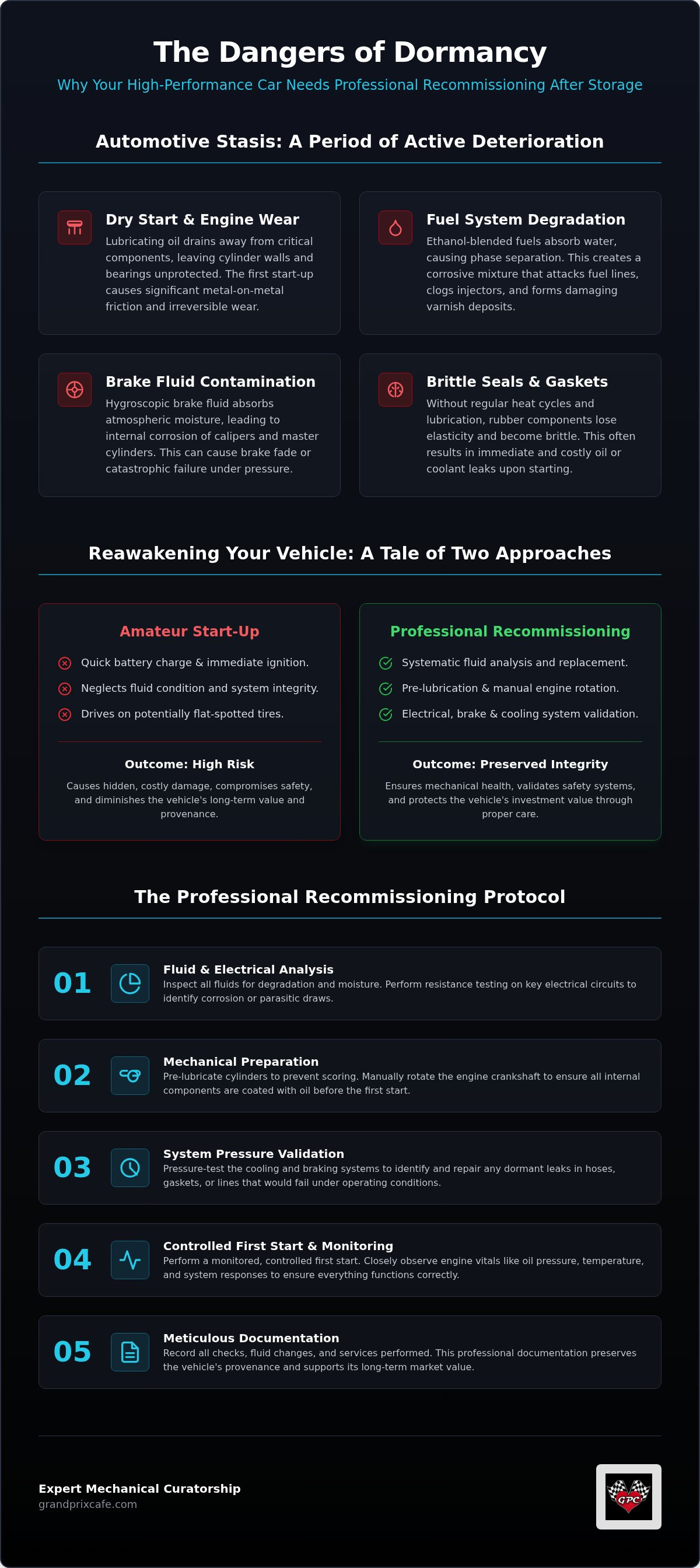
Mechanical stasis is often misunderstood as a neutral state of preservation. For a high-performance engine, it's actually a period of active chemical and physical deterioration. When a vehicle sits idle for several months, the gravity-induced drainage of lubricants leaves internal components vulnerable to oxidation. A professional post-storage car recommissioning service Southampton addresses these specific risks before they manifest as costly mechanical failures. High-end vehicles, such as those recognized by the Classic Car Club of America (CCCA), require a methodical approach to reverse the effects of dormancy. Simply turning the key after a winter in the Hamptons can cause immediate top-end engine wear because the protective oil film on cylinder walls has long since dissipated.
The climate in Southampton presents unique challenges. High humidity levels during the off-season accelerate the behavior of hygroscopic fluids. Brake fluid, for instance, naturally attracts moisture from the atmosphere. Over six months, this water content can settle in the lowest points of the braking system, leading to internal corrosion of calipers and master cylinders. Without a technical inspection, this moisture remains hidden until the system is under heat and pressure, potentially resulting in brake fade or total failure during your first drive of the season.
The Chemistry of Degraded Fuel and Lubricants
Modern ethanol-blended fuels are particularly volatile when left in a static fuel system. Over a six-month period, phase separation occurs as the ethanol absorbs water and sinks to the bottom of the tank. This process creates a corrosive mixture that attacks fuel lines and leads to varnish formation inside carburetors or fuel injectors. These deposits block fine orifices, causing lean-running conditions that can damage pistons. While fuel stabilizers offer some protection, they aren't a permanent cure for fuel that has already begun to break down. Similarly, engine oil accumulates acidic byproducts from the combustion process. When left to sit, these acids can etch bearing surfaces and degrade the oil's viscosity, necessitating a fresh change as part of any post-storage car recommissioning service Southampton.
Seals, Gaskets, and the Perils of Dryness
Rubber components and gaskets rely on regular heat cycles and lubricant circulation to remain pliable. In a state of stasis, these materials lose their elasticity and become brittle. This often results in immediate leaks from the rear main seal or timing cover once the engine reaches operating temperature. Professional technicians mitigate this by pre-lubricating the cylinders and manually rotating the engine before the first crank. This ensures that piston rings don't drag against dry bore surfaces. Beyond the engine, tires are also susceptible to static placement. "Flat-spotting" occurs when the weight of the vehicle permanently deforms the tire carcass in one position, leading to vibrations that can damage suspension bushings if driven without correction; for a detailed look at professional suspension and shock absorber maintenance, click here.
Reactivating a high-performance vehicle requires a structured protocol that extends far beyond a simple battery charge. A professional post-storage car recommissioning service Southampton treats the first start as a high-risk event, utilizing diagnostic tools to validate every subsystem. This systematic approach ensures that mechanical integrity is verified before the engine is subjected to the stresses of the road. It involves a transition from static preservation to active mechanical performance through a series of validated steps.
Electrical diagnostics must move beyond the battery tender. While a tender maintains voltage, it doesn't account for terminal oxidation or parasitic draws that may have developed during the off-season. Technicians perform resistance testing across primary circuits to ensure clean signal delivery to ECUs and ignition systems. Simultaneously, the braking and cooling systems undergo hydraulic validation. We utilize pressure testing to identify dormant leaks in the radiator, heater core, and brake lines that only manifest once the systems are pressurized. This prevents the sudden loss of coolant or hydraulic pressure during the initial drive. Collectors seeking this level of technical oversight often rely on the expert car service provided by specialists who understand the nuances of European marques.
Phase One: The Non-Invasive Inspection
The process begins with a meticulous visual audit of the vehicle's environment and exterior. Technicians scan for evidence of rodent intrusion, which is a significant hazard in Hamptons storage environments. Chewed wiring looms or nests in air intake boxes can lead to catastrophic electrical shorts or engine ingestion of debris. We then analyze any fluid pooling beneath the chassis. The color, scent, and viscosity of these deposits provide a diagnostic map of seal health. Tires are inspected for sidewall cracking and dry rot, ensuring the rubber remains safe for high-speed use after months of static placement.
Phase Two: The Mechanical Recommissioning Process
Mechanical awakening requires a staged approach to protect internal components. We drain the fuel system entirely to remove degraded, ethanol-heavy petrol that has likely undergone phase separation. The system is flushed and primed with fresh fuel to prevent varnish from entering the injectors. Static engine rotation is performed manually before the starter motor is engaged. This confirms that no internal components have seized and allows a baseline layer of oil to migrate to critical bearing surfaces. Once the engine is fired, we monitor it through gradual heat cycles. This controlled expansion allows gaskets to reseat and ensures the cooling system maintains pressure as the thermostat opens.
Professional Intervention vs. Amateur Start-ups
Amateur attempts to start a high-performance vehicle after seasonal stasis often overlook the fragility of aged electrical systems. Improper jump-starting can send destructive voltage spikes through sensitive circuitry, a risk that is particularly high for post-1970s European models equipped with early electronic fuel injection or ignition control units. A professional post-storage car recommissioning service Southampton utilizes regulated power supplies to stabilize voltage before any electrical load is applied. This technical precaution protects the vehicle's historical integrity and prevents the failure of irreplaceable components. The integration of modern diagnostic equipment with traditional mechanical knowledge allows for a level of scrutiny that simple visual inspections cannot provide, and for any electronic access or ignition security issues, Garnes Auto Group offers expert automotive locksmith support.
DIY efforts frequently result in oil starvation during the critical first seconds of operation. Without the ability to prime the oiling system or verify pressure via external gauges, an amateur risks scuffing main bearings or cam lobes. Sourcing period-correct fluids and high-filtration filters also presents a logistical challenge for the individual owner. Specialized knowledge is required to select lubricants with the correct ZDDP levels for vintage flat-tappet engines to prevent premature wear. For collectors, consulting a classic car mechanic Southampton NY ensures that these technical specifications are met with precision. Neglecting these details can lead to catastrophic engine failure, far outweighing the perceived savings of a home start-up.
The Collector Advantage: Documented Curatorship
Professional intervention serves as a vital component of a vehicle's provenance. In the Hamptons market, a documented service history from a recognized facility significantly enhances resale value. It demonstrates a commitment to mechanical curatorship that an owner-led logbook cannot replicate. Certified technician sign-off also mitigates liability by ensuring critical safety systems, like brakes and steering, meet professional standards. This documentation is often a prerequisite for maintaining insurance coverage on high-value assets. Meticulous records prove that the vehicle has been maintained to the highest standards of safety and performance. Collectors can explore further details on preserving their investment in our guide on vintage car restoration New York.
Selecting a Recommissioning Specialist in the Hamptons
Identifying the right facility in the Hamptons is a matter of technical vetting. A professional post-storage car recommissioning service Southampton should offer more than basic maintenance; it must provide comprehensive mechanical curatorship. This involves a deep understanding of European engineering and the specific environmental factors of the East End. Collectors require a facility that bridges the gap between long-term storage and active driving, ensuring a seamless transition that respects the vehicle's history. Proximity to your storage location is a logistical necessity, but the technical capability of the staff remains the primary priority.
Transparency in reporting is a hallmark of a high-end specialist. Modern collectors expect digital documentation, including high-resolution imagery of fluid conditions and sensor readings. This level of detail provides a clear audit trail for the vehicle's provenance. When evaluating a facility, inquire about their specific experience with marques like Ferrari, Porsche, and Jaguar. Each of these brands utilizes unique mechanical architectures that demand specialized knowledge and proprietary tools. A facility that can demonstrate a history of handling these specific models is better equipped to identify subtle issues before they become failures.
Marque Expertise and Technical Specialization
A generalist mechanic often lacks the specialized vacuum gauges and synchronizers required for vintage carburation systems. Precision tuning for Weber or Zenith units is a technical art that requires years of specific experience. Similarly, early electronic and mechanical fuel injection systems found in 1970s and 1980s European models necessitate specific diagnostic interfaces. A specialized accident repair vintage vehicle specialist often provides the most thorough mechanical audits because they're accustomed to evaluating structural and mechanical integrity at the highest level. They understand that a vehicle's value is tied directly to its mechanical accuracy and originality.
Logistical Excellence for the Seasonal Resident
For Manhattan-based owners, the logistical ease of a Southampton facility is paramount. Coordinating the awakening of a collection with the start of the summer season requires a provider capable of managing the "Storage-to-Road" workflow internally. This eliminates the risk of third-party transport damage and ensures the car is ready for immediate use. Maintaining this level of mechanical readiness is also essential if you intend to enter the curated classic car sales Southampton NY market, where buyers prioritize turn-key reliability and documented care. A car that is ready for the road is a car that retains its market liquidity.
Ensure your vehicle is prepared for the driving season by contacting the specialists at Grand Prix Cafe for a professional consultation.
Grand Prix Cafe: Expert Mechanical Curatorship
Grand Prix Cafe operates as a specialized hub for automotive preservation in the Hamptons. Our post-storage car recommissioning service Southampton is built on the rigorous principles of mechanical curatorship. We don't simply prepare a vehicle for a single drive; we restore its operational readiness through a methodical, technical process that respects its historical significance. By integrating year-round indoor storage, professional car service, and full restoration under one roof, we eliminate the logistical risks associated with multi-vendor handling. This unified approach ensures that the transition from winter stasis to the spring driving season is managed by a single, authoritative team of experts.
The Grand Prix Cafe Standards
Our facility adheres to a meticulous 50-point awakening checklist for every vehicle entering the service bay. This protocol is not a cursory inspection but a systematic validation of every mechanical and electrical subsystem. We utilize premium, period-correct lubricants and filters that meet the exacting specifications of vintage European marques. This attention to detail prevents the accelerated wear often caused by modern, off-the-shelf components. Clients benefit from direct communication with our master technicians throughout the process. This transparent dialogue ensures that the specific needs of your vehicle are addressed with precision, maintaining the mechanical integrity required for high-performance driving.
Secure Transitions from Storage to Street
Logistical efficiency is a core component of our service model. By leveraging our professional indoor car storage in Southampton NY, owners enjoy a seamless movement from our climate-controlled environment directly to the service bay. This internal workflow removes the need for third-party transport and prevents exposure to the fluctuating coastal elements. Following the completion of the recommissioning process, we offer white-glove delivery and preparation services tailored for the seasonal resident. Your vehicle arrives at your residence fully vetted, detailed, and ready for the road. It's a comprehensive solution designed for the discerning collector who values both time and mechanical excellence.
Scheduling for the 2026 driving season awakening is currently underway. We recommend early consultation to ensure your vehicle is prioritized for the initial weekends of the summer. Our team provides bespoke recommissioning quotes based on the technical requirements and provenance of your automotive collection. Contact us today to secure your position in our spring service schedule and ensure your vehicle returns to the road with the performance and reliability it deserves.
Preparing Your Collection for the Road Ahead
The transition from winter stasis to the active driving season requires more than a simple ignition turn. It's a technical process of mechanical curatorship that involves systematic fluid analysis, electrical validation, and careful heat-cycling to protect your investment. By prioritizing a professional post-storage car recommissioning service Southampton, you ensure that dormant issues like fuel degradation or moisture-contaminated brake fluid don't escalate into catastrophic failures. This meticulous approach preserves both the mechanical integrity and the historical provenance of your vehicle.
At Grand Prix Cafe, our Southampton-based master technicians specialize in the nuances of European and vintage marques. We provide a seamless integration of climate-controlled storage and expert service to ensure your vehicle is ready for the Hamptons season. Schedule Your Post-Storage Recommissioning at Grand Prix Cafe to ensure your vehicle returns to the street with its performance and reliability fully intact. Your dedication to proper maintenance ensures that every mile driven this season remains a source of pure mechanical pleasure.
Frequently Asked Questions
What is included in a post-storage car recommissioning service?
A professional post-storage car recommissioning service Southampton includes a comprehensive technical audit of all major systems. Technicians perform a meticulous 50-point inspection covering fluid analysis, electrical diagnostics, and fuel system purification. The process involves draining degraded petrol, flushing hydraulic lines, and manually rotating the engine to prevent dry-start wear. We also verify tire integrity and cooling system pressure. This systematic approach ensures the vehicle returns to the road with its mechanical integrity fully restored.
How long does it take to recommission a car after winter storage?
The duration of a recommissioning service typically ranges from three to seven business days. This timeline accounts for the meticulous nature of our technical protocols and the time required for gradual engine heat-cycling. Complex European models or vehicles requiring specific period-correct parts may require additional time for sourcing and installation. We prioritize accuracy over speed to ensure every component meets our rigorous standards for safety and reliability before the vehicle is released.
Can I drive my classic car to the service center after it has been stored for a year?
Driving a vehicle after long-term stasis isn't recommended because of the high risk of mechanical failure. Engine oil drains away from critical bearing surfaces over time, and fuel often degrades into a corrosive varnish. Operating the vehicle without a professional audit can lead to immediate engine damage or brake failure. Our facility provides white-glove transport solutions to move vehicles safely from storage to our service bay, eliminating the risks associated with amateur start-ups.
What happens if I don’t recommission my car after long-term storage?
Neglecting professional recommissioning can result in catastrophic engine failure and a significant loss of vehicle value. Dry-starting an engine after months of stasis causes immediate wear to piston rings and cam lobes. Degraded fuel blocks injectors and carburetors, while moisture-laden brake fluid leads to internal corrosion of the hydraulic system. These issues compromise the vehicle's provenance and performance. A professional service prevents these risks and ensures the long-term reliability of your automotive collection.
Does Grand Prix Cafe provide recommissioning for modern luxury vehicles?
Yes, Grand Prix Cafe provides expert recommissioning for both modern high-performance vehicles and vintage European marques. Our technicians possess the specialized diagnostic equipment required for modern Ferrari, Porsche, and Lamborghini electronics. We understand that modern luxury vehicles are as susceptible to stasis-induced issues as their vintage counterparts. Whether your collection includes a 1960s classic or a contemporary supercar, our facility provides the technical curatorship necessary to maintain its peak operational condition.
Is fuel stabilization enough to prevent fuel system damage?
Fuel stabilization is a useful preventative measure but it doesn't provide absolute protection against long-term degradation. Ethanol-blended fuels naturally undergo phase separation over time, attracting moisture that can corrode fuel tanks and lines. Varnish still forms in the fine orifices of carburetors and fuel injectors despite the use of additives. A professional post-storage car recommissioning service Southampton involves flushing the entire system to ensure only fresh, high-octane fuel enters the combustion chambers.
How much does a professional recommissioning service cost in Southampton?
The cost of a professional recommissioning service in Southampton depends on the mechanical complexity and specific requirements of the vehicle. High-performance European engines often require specialized fluids and proprietary filters that influence the final investment. Because we treat every vehicle as a unique project of mechanical curatorship, we provide bespoke quotes following a preliminary consultation. This ensures that the service is tailored to the specific condition, provenance, and technical needs of your automotive asset.
Should I change the oil before or after storage?
Changing the oil before storage is essential to remove acidic byproducts that can etch internal engine surfaces during the winter. However, it's also advisable to verify the oil's condition after storage to ensure no moisture has accumulated due to condensation. For high-value collections, a fresh oil change during the recommissioning process provides the highest level of protection. This ensures that the engine begins the driving season with optimal lubrication and maximum viscosity for high-performance use.
Comments