


Classic Car Bodywork Repair in the Hamptons: Preservation of Automotive Integrity
- sales299631
- 3 hours ago
- 11 min read
The Atlantic salt air that defines the Hamptons lifestyle is also the primary catalyst for the accelerated degradation of vintage steel and aluminum. For discerning owners, classic car bodywork repair Hamptons is not a simple cosmetic procedure; it's a rigorous defense against metallurgical decay and the loss of historical provenance. Maintaining a vehicle in this coastal environment requires a technical approach that prioritizes long-term structural health over temporary aesthetic fixes.
You recognize that every non-standard weld or mismatched paint layer diminishes the value and integrity of a collectible machine. It's a valid concern, as the difference between a professional restoration and a compromised repair often dictates a vehicle's future at auction or exhibition. This article outlines the specific technical standards and artisanal techniques necessary to restore bodywork to its original factory specifications while protecting it from the unique environmental pressures of the South Fork.
We'll explore the precision required for period-correct paint matching and the importance of thorough documentation throughout the restoration process. You'll learn how specialized metalwork and moisture-resistant coatings ensure your vehicle remains a preserved piece of automotive history rather than a victim of its surroundings.
Table of Contents
The Unique Challenges of Classic Car Bodywork in the Hamptons
Classic car bodywork repair involves the meticulous restoration of a vehicle's exterior panels and structural components using period-correct methods. Unlike modern collision repair, which often relies on component replacement, true classic restoration focuses on the preservation of original metal. In the context of high-value marques, preservation means keeping the original components while ensuring the substrate is stable enough to resist future oxidation. For owners in coastal New York, this process is complicated by an environment that is fundamentally hostile to vintage metallurgy.
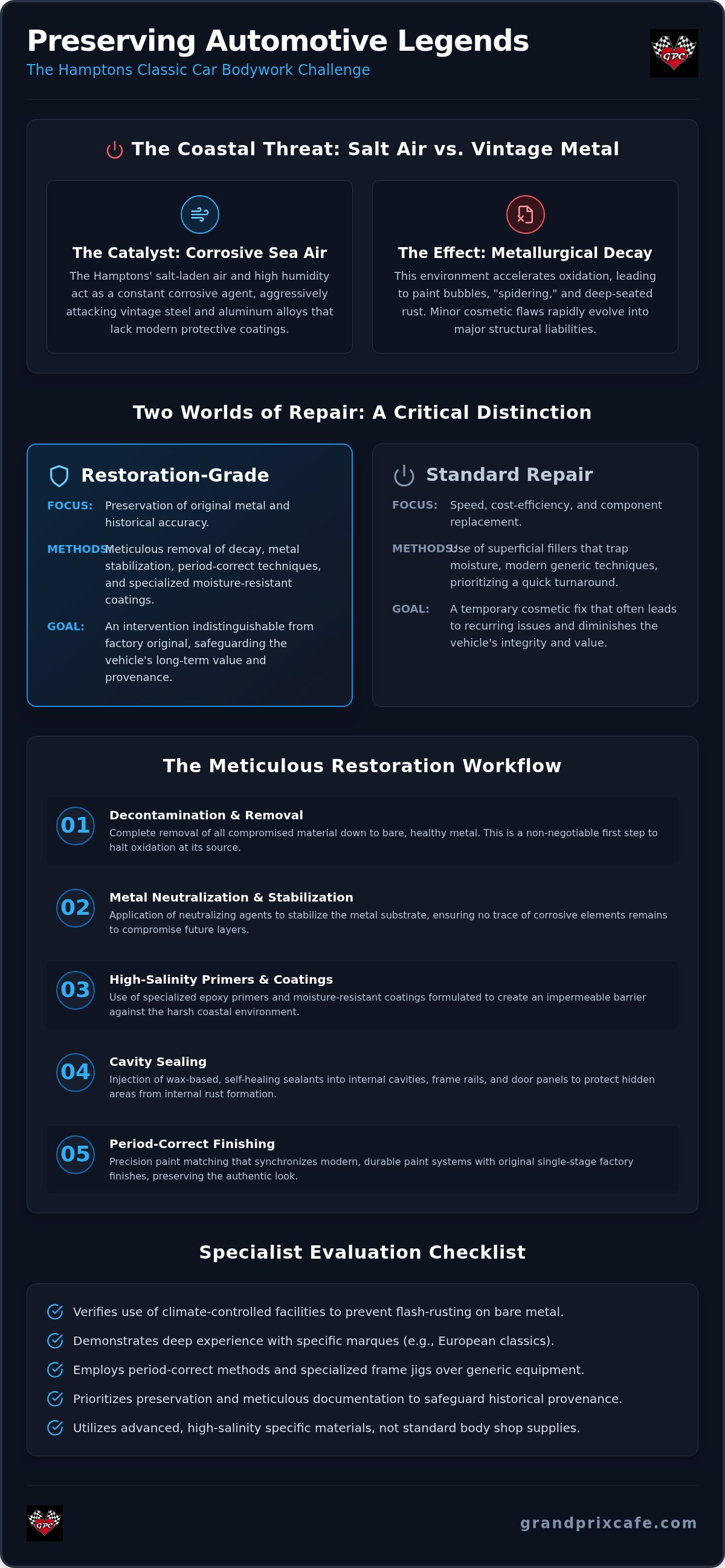
The salt-laden air of the South Fork acts as a constant corrosive agent on vintage steel and aluminum alloys. These materials lack the advanced galvanized coatings and zinc-rich primers found on contemporary vehicles. When exposed to the high humidity and salinity of the Atlantic coast, unsealed vintage metal undergoes rapid oxidation. Standard modern collision shops often fail to address these underlying needs, opting for superficial fillers that trap moisture against the metal rather than eliminating the source of decay. Professional classic car bodywork repair Hamptons requires a specialized understanding of how these environmental factors interact with aged materials.
Coastal Corrosion and Metal Integrity
Salt-air oxidation creates a unique chemical challenge for vintage chassis. Sodium chloride accelerates the electrochemical process of rusting, particularly in the deep recesses of a frame or within the hemmed edges of door panels. Early signs of trouble often manifest as small paint bubbles or "spidering" under the finish. These are rarely just cosmetic issues; they usually indicate deep-seated electrolytic corrosion where dissimilar metals, such as aluminum trim and steel bodywork, meet.
Applying "quick fixes" like plastic body fillers over active oxidation is a recipe for failure. Within months, the trapped moisture expands, leading to significant bubbling and eventual structural failure. A technical restoration requires the complete removal of compromised material and the use of neutralizing agents to stabilize the metal before any new finish is applied. It's a methodical process that prioritizes the long-term health of the vehicle over a fast turnaround.
Preserving Originality in a Sea-Air Environment
Protecting a classic in a coastal climate involves techniques that modern production cars don't require. This includes the injection of specialized wax-based sealants into internal cavities and the use of epoxy primers specifically formulated for high-salinity environments. Precision metalwork must be performed in climate-controlled facilities to prevent flash-rusting. Even a few hours of exposure to humid sea air on bare metal can compromise the adhesion of a future paint system.
The Hamptons effect on vintage metalwork is a primary driver for specialized care, as the local climate turns minor surface imperfections into structural liabilities with surprising speed. Maintaining the integrity of a collectible vehicle requires a facility designed as a sanctuary for metal, where the environment is managed as strictly as the tools used for the repair. Specialized classic car bodywork repair Hamptons ensures that the vehicle's historical record remains intact while its physical structure is fortified against the elements.
Restoration-Grade Standards vs. Standard Accident Repair
The distinction between insurance-standard repair and concours-standard restoration is fundamental to the long-term value of a vintage vehicle. Standard collision shops prioritize throughput and cost-efficiency, often utilizing methods that prioritize speed over historical accuracy. In contrast, Restoration-Grade Standards demand the preservation of the vehicle’s original metallurgical profile. For high-value assets, classic car bodywork repair Hamptons must be executed to a level where the intervention is indistinguishable from the factory’s original assembly, even to the eye of a professional appraiser.
Structural integrity remains the most critical factor in these repairs. While modern vehicles utilize sacrificial crumple zones, vintage chassis rely on specific rigid geometries. Correcting a deviated frame on a classic requires specialized jigs and a deep understanding of period manufacturing tolerances. Utilizing modern, generic pulling systems on a 1960s monocoque can cause irreparable stress fractures or permanent alignment issues. Every weld must maintain purity, avoiding the excessive use of plastic fillers that can shrink, crack, or trap moisture against the substrate over time.
Metallurgical Accuracy and Panel Beating
True restoration requires the art of hand-forming panels. Technicians utilize the English wheel and planishing hammers to match original factory lines with mathematical precision. We prioritize sourcing or fabricating replacement metal that matches the original gauge and chemical composition of the vehicle. This ensures that thermal expansion rates remain consistent across the panel, preventing future paint failure. For certain period-correct restorations, traditional lead-loading remains a superior technique for smoothing transitions, as it bonds molecularly with the steel and provides a more durable foundation than modern chemical fillers.
Documenting the Repair for Provenance
Maintaining a vehicle's market value requires a comprehensive digital and physical restoration log. We provide detailed photographic evidence of all metalwork before any primer or paint is applied. This transparency proves the structural honesty of the repair and assures future collectors that no defects are hidden beneath the finish. This meticulous data integrates seamlessly with our broader vintage car restoration in New York records. Owners seeking to preserve the historical record of their machine can rely on our specialized accident repair services to ensure every detail meets the highest technical standards.
The Technical Art of Period-Correct Paint and Finishing
The application of a final finish is the most critical phase in the preservation of an automotive aesthetic. For owners seeking classic car bodywork repair Hamptons, the challenge lies in reconciling the chemical properties of modern paint systems with the visual characteristics of historical lacquers. The Technical Art of Period-Correct Paint involves a sophisticated understanding of how light interacts with different pigment structures. While original nitrocellulose and acrylic lacquers offered a distinct, soft depth, they lacked the resilience required for modern environmental exposure.
Modern water-borne systems provide superior durability but often present a "plastic" appearance if applied without technical adjustments. Achieving a period-correct finish requires the technician to manipulate the paint’s lay-down and flow to replicate the subtle texture, or orange peel, found on factory-original panels. Over-restoring a vehicle to a mirror-flat finish can paradoxically diminish its value by signaling a lack of historical sensitivity. The goal is a finish that appears as if it's been meticulously maintained since its date of manufacture, rather than recently reconstructed.
Color Matching and Paint Chemistry
Matching the color of a vintage machine is a multi-dimensional task. While spectrophotometry offers a precise digital analysis of the current pigment, it serves only as a starting point. The artisan’s eye must account for decades of natural UV fading and the specific "shift" that occurs as paint ages. Custom mixing pigments allows for a seamless blend into existing panels, ensuring the repair remains invisible under the unforgiving light of the Long Island coast. This process requires navigating the transition from traditional high-VOC materials to modern, environmentally safe alternatives without compromising the depth or hue of the original marque.
The Finishing Process: Sanding and Buffing
The refinement of the clear coat or single-stage topcoat is a labor-intensive process involving multi-stage wet-sanding. Technicians use progressively finer abrasives to level the surface while carefully monitoring the remaining film thickness to avoid thinning the protective layer. This stage determines the final luster and clarity of the finish. The 2026 standards for vintage paint durability in Long Island's variable climate emphasize the use of advanced cross-linking resins that resist salt-induced micro-pitting while maintaining historical color depth. To further protect these investments, modern ceramic coatings can be integrated, provided they're applied with a technique that preserves a natural, non-synthetic sheen suitable for a classic silhouette.
Evaluating a Classic Car Body Shop in the Hamptons
Identifying a suitable facility for classic car bodywork repair Hamptons requires a rigorous vetting process. Collectors must look beyond the polished surfaces of finished projects to understand the underlying technical standards. A facility should demonstrate a deep familiarity with the specific metallurgical and engineering requirements of elite European marques. Porsche, Ferrari, and Land Rover each utilize distinct alloy compositions and assembly techniques that demand specialized knowledge. A shop that treats a 1960s Ferrari the same as a modern commuter car will inevitably compromise the vehicle's integrity.
In-house capabilities are a non-negotiable requirement for high-value preservation. Subcontracting delicate metalwork or paint matching often results in a fragmented historical record and inconsistent quality control. A unified facility ensures that the same technical vision guides the project from structural alignment to final buffing. Additionally, the environmental conditions during the project are critical. Assessing the facility's indoor car storage conditions is essential to prevent moisture-related setbacks during the long-term restoration process. A sanctuary for metal must be climate-controlled to maintain the stability of bare substrates.
Portfolio and Reference Verification
Request to see metalwork in progress rather than just completed vehicles. Bare metal reveals the honesty of the craftsmanship, showing whether a panel was correctly formed or merely smoothed with filler. Inquire about the shop's history with high-end auction houses or concours events. A proven track record in these arenas indicates that the facility's work meets the scrutiny of the world's most demanding judges and collectors. This level of expertise is essential when seeking specialized accident repair for vintage vehicles where provenance is at stake.
Insurance and Liability for High-Value Assets
Transparency in administrative operations is as important as technical skill. A reputable facility must carry comprehensive Garage Keepers insurance sufficient to cover multi-million dollar inventories. Owners should also discuss how the facility manages diminished value claims, as even a perfectly executed repair on a rare classic can impact its market position. Detailed estimation and billing processes provide a clear roadmap for long-term projects, preventing the financial ambiguity that often plagues restoration work. For collectors prioritizing historical accuracy and structural integrity, our facility offers a curated environment for classic car bodywork repair Hamptons. Owners may consult with our restoration specialists to review our technical standards and facility security.
Grand Prix Cafe: Curating the Future of Your Classic's Bodywork
Grand Prix Cafe operates with the understanding that every technical intervention is a permanent addition to a vehicle's historical record. Our Southampton facility serves as a controlled environment where precision restoration is executed without the variables of external environmental stress. This sanctuary for collectible metalwork ensures that every instance of classic car bodywork repair Hamptons contributes to the long-term preservation of the machine. We don't merely fix damage; we curate the physical integrity of the vehicle for the next generation of collectors.
We maintain a disciplined balance between modern structural safety and aesthetic historical accuracy. Our process integrates the specialized expertise of professional classic car mechanics with the skills of our dedicated bodywork artisans. This collaboration ensures that a vehicle's mechanical performance and structural geometry are perfectly synchronized with its visual presentation. By housing these services under one roof, we eliminate the communication gaps that often occur between separate mechanical and body shops.
Specialized Expertise for European Classics
Our team possesses deep technical experience with the unique construction methods of vintage Land Rovers, Porsches, and Italian exotics. We understand the specific nuances of monocoque versus body-on-frame architectures and the metallurgical requirements of each marque. Through an extensive international network, we source rare, original-spec parts and materials to maintain the authenticity of every repair. Our artisan team includes master panel beaters and paint specialists who view their work through the lens of historical preservation. This expertise is critical when executing classic car bodywork repair Hamptons on vehicles with complex provenance.
The Full-Cycle Collector Experience
Beyond the workshop, we manage the entire lifecycle of a vehicle's legacy. From initial repair to curated classic car sales, our standards remain consistent across all departments. Professional bodywork is a primary factor in maximizing the results of a vehicle consignment. High-quality restoration work directly correlates to a vehicle's market position and potential for long-term appreciation. Owners seeking to safeguard their investment can contact us for a discreet evaluation of their vehicle's current condition and bodywork requirements.
Securing the Legacy of Your Automotive Collection
Preservation of a vintage machine in a coastal environment requires more than routine maintenance. It demands a technical strategy that addresses the specific corrosive threats of the Atlantic air while maintaining the metallurgical integrity of the chassis. True restoration-grade standards prioritize original metal and period-correct paint chemistry over the shortcuts found in standard collision shops. This disciplined approach ensures that your vehicle remains a documented piece of automotive history rather than a compromised asset.
When selecting a partner for classic car bodywork repair Hamptons, technical vetting and facility security are paramount. Grand Prix Cafe provides a boutique restoration environment in the heart of the Hamptons, where specialized technicians for Ferrari, Porsche, and Land Rover execute every repair with an emphasis on provenance. Our integrated model ensures a seamless transition between precision metalwork, secure storage, and future sales. Schedule a Bodywork Consultation at Our Southampton Facility to ensure your vehicle receives the expert care it deserves. Protecting your investment today guarantees its historical and financial value for decades to come.
Frequently Asked Questions
Can you match the paint on a classic car that has original, faded paint?
Yes, achieving a perfect match on aged finishes requires custom pigment blending. We utilize spectrophotometry to establish a digital baseline, but the final adjustment is performed by an artisan who accounts for natural UV shift. This manual tinting ensures that the new finish harmonizes with the existing panels under all lighting conditions, preserving the vehicle's visual continuity without requiring a full respray.
How does the Hamptons' salt air affect my classic car's bodywork even if it's stored?
Coastal air contains microscopic salt particles that remain suspended in high-humidity environments. These ions penetrate unsealed internal cavities and porous older paint systems even during indoor storage. Without rigorous climate control, moisture traps these salts against the substrate, initiating electrolytic corrosion. This environmental pressure is a primary reason why classic car bodywork repair Hamptons requires specialized moisture-resistant coatings and deep-cleaning protocols.
Is it better to repair an original panel or replace it with a reproduction?
We prioritize the restoration of original panels to safeguard the vehicle's provenance. Reproduction parts often lack the correct metallurgical gauge and precise fitment of factory metal. Our technicians utilize English wheels and planishing hammers to hand-form original surfaces, ensuring the structural integrity and historical value remain intact. Replacement is reserved only for metal that's too compromised to be safely stabilized through traditional panel beating.
How long does a typical classic car bodywork restoration take?
Project durations are dictated by the complexity of the metalwork and the availability of period-correct materials. A localized structural repair might require several weeks of focused labor. A comprehensive body-off restoration can extend over several months to ensure every substrate is properly neutralized and sealed. We provide a methodical timeline after a thorough technical inspection and teardown of the affected areas.
Will accident repair significantly decrease the value of my vintage vehicle?
High-standard accident repair documented with photographic evidence can actually protect a vehicle's market position. Diminished value usually stems from non-standard techniques, such as excessive plastic fillers or incorrect welding methods. By utilizing factory-spec metallurgical processes, we ensure the repair is indistinguishable from the original assembly. This transparency provides future appraisers and collectors with the necessary proof of structural honesty and mechanical excellence.
What is the difference between single-stage and base-clear paint for a classic?
Single-stage paint integrates the pigment and gloss into a single application, providing the soft depth characteristic of vintage lacquers. Base-clear systems utilize a dedicated color layer protected by a separate transparent coat for increased durability. We select the chemistry based on the vehicle's original production standards. This ensures the final texture and luster are period-correct rather than appearing over-restored or synthetic.
Do you work with insurance companies for classic car accident claims?
We work directly with specialized insurance carriers that understand the unique valuation of collectible automobiles. Our role is to ensure the claim covers the technical requirements of a restoration-grade repair rather than a standard commercial fix. We manage the documentation and communication process to ensure all work meets the high standards required for European classics and high-performance vintage models.
How do I know if my classic car has 'hidden' rust under the paint?
Hidden oxidation often manifests as subtle surface irregularities like micro-bubbling or spidering under the finish. These "pimples" indicate that moisture has reached the metal substrate and triggered a chemical reaction. Professional classic car bodywork repair Hamptons utilizes non-destructive inspection techniques to identify these areas early. Addressing sub-surface corrosion before it perforates the metal is essential for maintaining the long-term structural health of the chassis.
Comments