


Vintage Car Bodywork Repair in the Hamptons: The Standards of Preservation
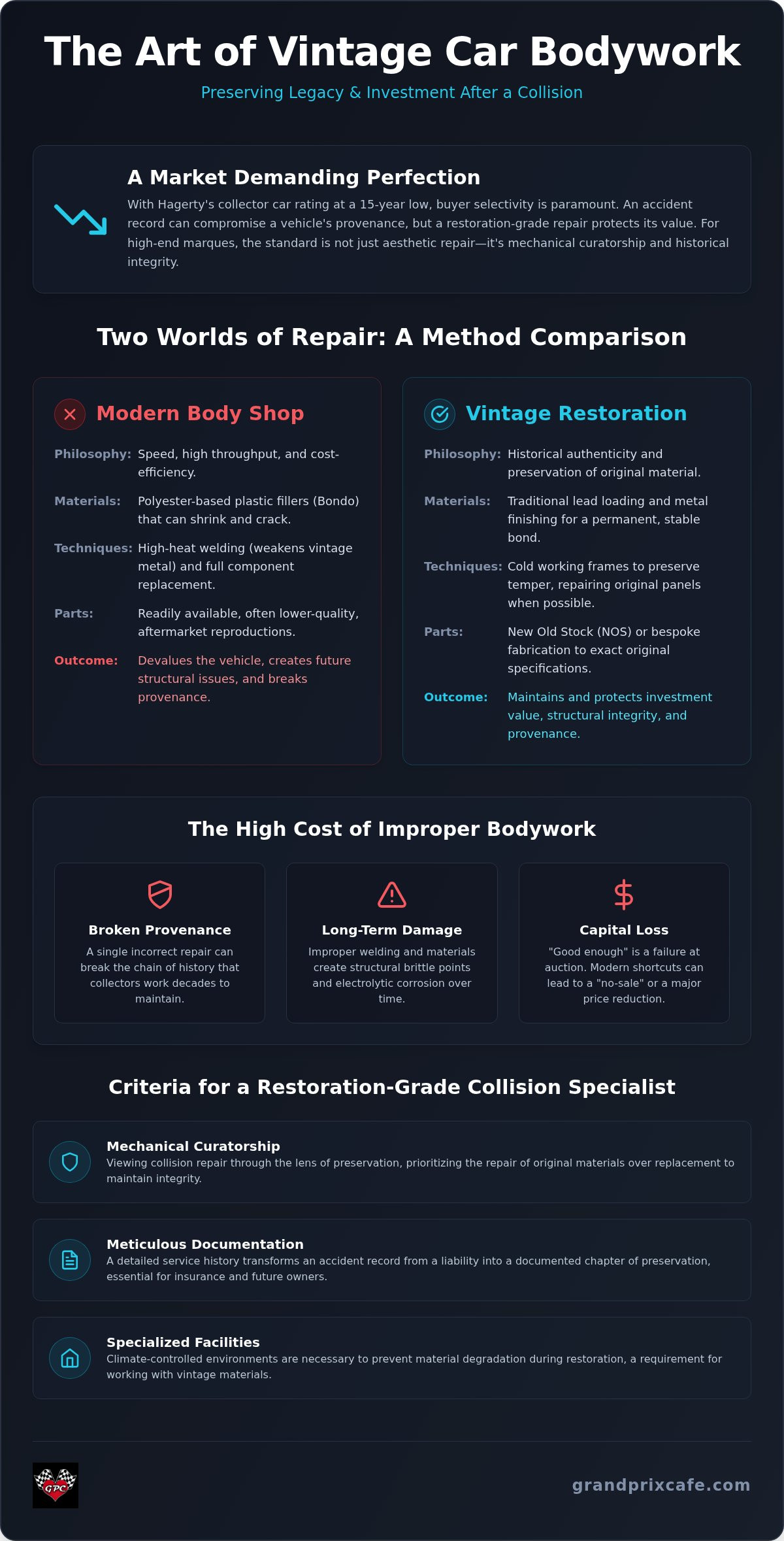
A standard collision repair fixes a dent, but a vintage car bodywork repair in the Hamptons must restore a legacy. You likely recognize that an accident record can compromise a vehicle's provenance and marketability. This anxiety is valid. In early 2026, Hagerty's collector car rating reached a 15-year low, signaling a market where buyer selectivity is paramount. When handling high-end European or British marques, the priority moves beyond aesthetics to the standard of mechanical curatorship and historical integrity.
This article details the technical requirements and valuation safeguards essential for restoring a vehicle after an accident. You'll learn how to maintain rigorous documentation and utilize period-correct methods that satisfy the requirements of agreed-value insurance policies. We will examine the specific protocols for metalwork, paint matching, and historical verification that ensure your vehicle returns to its pre-accident condition while protecting its long-term investment value.
Table of Contents
Understanding the Nuances of Vintage Car Bodywork Repair in the Hamptons
Vintage car bodywork repair in the Hamptons represents a specialized discipline distinct from standard collision services. It functions as a subset of automotive preservation rather than simple utility repair. Modern body shops prioritize throughput and cost efficiency, often relying on component replacement and synthetic fillers. These methods fail the rigorous standards of vintage car restoration. For a collectible vehicle, the bodywork is a primary component of its provenance. In a market where buyer selectivity is at a 15-year high, any deviation from period-correct standards can result in significant capital loss. Collectors in the East End and Manhattan expect repairs that are invisible to both the eye and the paint meter.
The New York classic car landscape is defined by high-value assets that require specific technical oversight. As of 2026, New York defines a historical vehicle as any manufactured more than 25 years before the current year. These vehicles aren't daily transportation; they're investments and historical artifacts. When a vintage vehicle sustains damage, the repair process must account for the specific metallurgy and assembly techniques of its era. This level of vintage car bodywork repair Hamptons requires a deep understanding of how these vehicles were originally constructed, from hand-rolled aluminum panels to timber-framed supports.
The Stakes of Improper Bodywork
Improper repairs introduce long-term liabilities. The use of non-original body panels or modern aftermarket components can permanently devalue a high-end vehicle. Many vintage marques utilize specific alloys that react poorly to modern high-heat welding techniques. This creates structural brittle points or electrolytic corrosion over time. For vehicles destined for the auction block, "good enough" is a failure. Discerning buyers and inspectors identify modern shortcuts immediately. Such findings often lead to a "no-sale" or a price adjustment that far exceeds the cost of a correct repair. A single poorly executed repair can break the chain of provenance that collectors work for decades to maintain.
Restoration-Grade Accident Recovery
Effective recovery requires an integrated approach. We view collision repair through the lens of vintage car restoration New York. The priority is always the preservation of original material. Whenever possible, we repair original body panels rather than sourcing replacements. This maintains the vehicle's matching numbers integrity. Meticulous documentation is the final step. A professional service history that details the use of period-correct methods safeguards the vehicle's valuation. It transforms an accident record from a liability into a documented chapter of the car's continued preservation. This transparency is essential for navigating agreed-value insurance claims and maintaining the trust of future owners.
Period-Correct Techniques vs. Modern Body Shop Methods
Modern collision repair relies heavily on speed and aesthetic concealment. In contrast, vintage car bodywork repair Hamptons prioritizes structural and historical authenticity. High-volume shops often utilize polyester based plastic fillers to level panels. These materials are prone to shrinkage and cracking over time. Specialized restoration grade repair utilizes metal finishing and traditional lead loading. Lead loading involves applying molten lead tin alloy to seams and joints. It creates a permanent, flexible bond that mimics the original manufacturing process of mid century European marques. This technique ensures that the repair remains stable for decades rather than years.
Sourcing components requires a similar level of scrutiny. New Old Stock (NOS) parts remain the preference for high value assets. These are original parts manufactured during the vehicle's production run but never used. Modern reproductions frequently lack the correct metal gauge or precise stamping details found in original components. When NOS parts are unavailable, bespoke fabrication becomes the only viable path to maintain integrity.
Metallurgical Integrity in Vintage Frames
Chassis alignment on a classic vehicle requires a delicate approach. Technicians must straighten frames without compromising the metal's temper. This often involves cold working techniques rather than high heat applications that can weaken vintage steel. For bespoke panel work, specialists utilize English wheels and power hammers to create compound curves from flat sheets. These tools allow for the replication of original body lines with mathematical precision. Welding standards also differ. We utilize specific riveting and spot welding patterns that align with the vehicle's production era to ensure the repair is indistinguishable from the factory assembly.
Authentic Paint and Finish Standards
Matching an aged finish is a complex technical challenge. We utilize advanced spectrophotometry to analyze the specific patina and chemical composition of the existing paint. Replicating the factory "orange peel" or texture is often more difficult than achieving a mirror finish. This texture is vital for maintaining a consistent appearance across the entire vehicle. While modern water based paints are the current standard, we can adjust application techniques to mimic the look of traditional nitrocellulose or acrylic lacquers.
Protecting these finishes is equally important. We apply protective coatings that safeguard the surface without altering the visual originality of the car. This level of detail is critical when establishing the insurance valuation for classic cars during a claim. If your vehicle has sustained damage, consult with experts who understand these professional repair standards. Proper execution ensures the vehicle remains a viable candidate for high end exhibition and investment.
Navigating Insurance and Valuation for Collectible Collision Claims
Standard insurance policies are designed for depreciating assets. They utilize Actual Cash Value (ACV) formulas that fail to account for the appreciative nature of high-end collectibles. For a vehicle receiving vintage car bodywork repair Hamptons, an Agreed Value policy is essential. This contract establishes the vehicle's worth before a loss occurs. When damage happens, the primary challenge is ensuring the settlement covers the specialized labor and time intensive processes required to meet the standards of vehicle restoration. New York collectors must often advocate for their right to choose a facility that understands these requirements. Insurance adjusters frequently suggest high-volume shops that lack the tooling for lead loading or English wheel fabrication.
Expert appraisals are critical during the adjustment phase. An independent valuation provides the technical evidence needed to justify restoration-grade labor rates. Without this, an insurer may only offer market average rates, which are insufficient for the meticulous work required to preserve a vehicle's historical integrity and auction-readiness.
Working with Specialty Insurers
A restoration-grade repair estimate differs significantly from a standard collision quote. It must detail the specific metallurgical processes and the sourcing of NOS components. If the accident impacted the drivetrain or suspension, utilizing a classic car mechanic Southampton NY ensures that mechanical curatorship remains consistent with the bodywork standards. We provide insurance adjusters with comprehensive documentation that justifies the necessity of period-correct methods. This transparency facilitates a smoother claims process and ensures that the final repair meets the expectations of future buyers and specialized auction houses.
Diminished Value Claims in New York
Inherent diminished value is the loss in market worth that remains even after a flawless repair. In the selective 2026 collector market, a damage record is a permanent entry in a vehicle's history, making high-standard vintage car bodywork repair Hamptons the only way to mitigate financial loss. New York law allows for the recovery of this loss under specific circumstances. We assist collectors by providing data-driven assessments of how an accident record impacts a vehicle's long-term value. By using the car's provenance as a baseline, we can quantify the financial gap between its pre-accident state and its post-repair valuation. This ensures that the settlement reflects the true economic impact on your investment.
Criteria for Selecting a Restoration-Grade Collision Specialist
Selecting a facility for vintage car bodywork repair Hamptons requires a framework that goes beyond standard customer ratings or proximity. A restoration-grade specialist must maintain facility standards that protect the vehicle's material integrity throughout the repair cycle. The coastal environment of the East End presents specific atmospheric challenges. Salt air and high humidity levels accelerate the oxidation of exposed steel and aluminum panels. A qualified shop provides:
Strictly climate-controlled repair and assembly areas to prevent flash rusting.
Secure, dust-free indoor car storage for vehicles awaiting assessment or components.
Advanced air filtration systems to prevent surface contamination during the finishing process.
Technician pedigree is a mandatory criterion. You should prioritize specialists with documented experience in specific marques such as Porsche, Jaguar, and the 1960s Land Rover Defender. These vehicles utilize unique assembly methods and metallurgical compositions that modern technicians don't often encounter. For owners of such marques in the UK, specialized recovery services like instantrecovery.co.uk provide the professional handling required to transport these assets safely. The shop's equipment must reflect a balance of tradition and technology. This includes traditional metalworking tools like English wheels and planishing hammers alongside modern spectrophotometry for paint matching. Transparency is the final pillar of a professional engagement. A reputable facility provides detailed, photographic progress reports. These documents serve as a permanent record of the repair's quality for future owners.
Reviewing a shop's past work reveals its commitment to invisible repairs. You should request documented examples of accident recovery on models similar to your own. Participation in Concours d’Elegance or representation at high-end auctions serves as a reliable indicator of professional standing. A true specialist focuses on maintaining originality by avoiding excessive fillers. They'll ensure that the repair is undetectable under a paint meter or borescope inspection. It's this level of precision that differentiates a curator from a technician.
Logistics and Concierge Services
While these standards are specific to collector cars, those who also manage heavy-duty or commercial vehicles can find out more about specialized body repair and professional painting for oversized assets.
The logistics of moving a non-operable vintage vehicle require specialized equipment and extreme care. A facility that offers white-glove transportation services for the Hamptons and Manhattan markets understands the inherent value of your asset. Choosing a provider that manages both accident repair vintage vehicle and ongoing mechanical service ensures a seamless transition. This integrated approach maintains a consistent service history and simplifies the management of your collection. If your vehicle requires a detailed assessment, contact our specialists to discuss our accident repair and restoration standards.
The Grand Prix Cafe Standard: Mechanical Curatorship in Accident Recovery
The philosophy of mechanical curatorship is the defining element of the Grand Prix Cafe standard. It's a commitment to preserving a vehicle's historical and mechanical integrity, regardless of the extent of the damage. For owners of European classics and iconic British models like the Land Rover Defender, this approach is essential. We treat every vintage car bodywork repair Hamptons as a continuation of the vehicle's restoration history. This ensures that repairs don't merely correct aesthetics but also reinforce the car's structural and historical value. We don't view accident recovery as a separate task from high-end restoration. Instead, we integrate these disciplines to maintain the vehicle's benchmark status in the collector market.
Boutique Service in Southampton
Our facility serves a discerning group of East End and Manhattan collectors who recognize that their vehicles are significant capital assets. We function as a boutique dealership and restoration center, providing a level of technical focus that high-volume luxury shops cannot replicate. This curated approach extends to our vehicle consignment and sales services, where provenance is the primary metric of value. By maintaining meticulous documentation and utilizing specialized technicians for European and British marques, we protect your automotive investment. Every repair stage is recorded with precision, providing future owners and auction houses with a transparent, professional history of the car's care and preservation.
Next Steps for Post-Accident Care
The recovery process begins with an initial assessment and secure, specialized transport to our Southampton facility. Upon arrival, vehicles are placed in secure, climate-controlled indoor storage to prevent environmental degradation while awaiting insurance assessment. We collaborate directly with specialty insurance providers, presenting technical data and restoration-grade estimates that justify the use of period-correct methods. This professional advocacy ensures that the settlement reflects the true cost of maintaining the vehicle's integrity. If you require discreet expertise to handle a recent incident, we're prepared to assist with the logistics and technical execution of the repair.
Protecting the legacy of a classic vehicle requires a partner who understands the nuances of historical metallurgy and documentation. Request a consultation for specialized accident repair to ensure your vehicle returns to its pre-accident condition without compromising its documented provenance or market value.
Securing the Future of Your Vintage Asset
Restoring a classic vehicle after an accident requires a transition from simple cosmetic correction to rigorous mechanical curatorship. Maintaining historical integrity through traditional metalwork and meticulous documentation ensures that provenance remains intact. This approach is essential for navigating a selective collector market and securing fair settlements from specialty insurance providers. Every detail, from metallurgical consistency to paint texture, contributes to the vehicle's long-term valuation.
Grand Prix Cafe provides the technical oversight necessary for high-standard vintage car bodywork repair Hamptons. Our facility integrates restoration expertise with collision recovery to serve the specific needs of East End and Manhattan collectors. With specialized technicians for European and British marques, an integrated restoration facility, and secure, climate-controlled storage, we ensure your vehicle is preserved against environmental and mechanical degradation. Protecting a legacy is a long-term commitment. It's a process that begins with transparency and ends with a return to pre-accident excellence. Consult with our specialized accident repair team in Southampton to discuss the preservation of your vehicle.
Frequently Asked Questions
Does a collision repair automatically lower my classic car’s value?
A collision record can lower value, but restoration-grade repair mitigates this loss. By utilizing period-correct techniques and maintaining meticulous documentation, we preserve the vehicle's provenance. In a selective market, a well-documented repair by a specialist is viewed as a necessary chapter in the car's history. This prevents the inherent diminished value that typically follows standard body shop work. Our focus on mechanical curatorship ensures the vehicle remains auction-ready and investment-grade.
Can I choose my own repair shop if I have a collector car insurance policy?
Yes, most agreed-value collector policies allow you to select your preferred facility. New York regulations support the right to repair, enabling collectors to bypass high-volume insurance network shops. Choosing a specialist for vintage car bodywork repair Hamptons ensures that the technicians understand the specific metallurgy of your vehicle. We recommend reviewing your policy to confirm that it covers specialized labor rates and the sourcing of original or New Old Stock components.
What is the difference between lead loading and using modern body fillers?
Lead loading is a traditional metal-finishing technique that uses a molten lead-tin alloy to create a permanent, flexible bond. Unlike modern polyester-based plastic fillers, lead does not shrink, crack, or absorb moisture over time. This method was the factory standard for many mid-century European marques. It requires significant technical skill but provides a seamless transition between panels that remains stable for decades. Modern fillers are often a shortcut that compromises historical integrity.
How do you match paint on a vintage car that has original patina?
We utilize advanced spectrophotometry to analyze the chemical composition and specific fade of the existing finish. Matching the color is only the first step; we must also replicate the factory texture and orange peel to ensure the repair is invisible. For cars with original patina, we apply specialized techniques to blend the new finish without creating a jarringly perfect surface. This maintains the aesthetic consistency required for high-end preservation and exhibition.
What should I do if my insurance company wants to use aftermarket parts?
You should insist on New Old Stock (NOS) or bespoke fabricated components to maintain the vehicle's authenticity. Aftermarket parts often lack the correct metal gauge and stamping precision, which can interfere with fitment and lower the car's market value. If your insurer pushes for modern reproductions, provide them with a technical assessment detailing why those parts are insufficient for a collectible asset. Restoration-grade collision repair requires materials that align with the original manufacturing specifications.
Do you provide secure storage for my car while it is awaiting repair?
Yes, we provide secure, climate-controlled indoor car storage at our Southampton facility. Vehicles awaiting assessment or repair are kept in a protected environment to prevent oxidation and environmental degradation. This is particularly important in the Hamptons, where salt air can quickly damage exposed metal. Our storage solutions are designed for year-round preservation, ensuring that your automotive investment remains in a stable state throughout the entire repair or restoration process.
How long does a restoration-grade collision repair typically take?
The duration of a restoration-grade repair depends on the extent of the damage and the availability of original components. Sourcing New Old Stock parts or performing bespoke metal fabrication naturally takes longer than standard component replacement. A comprehensive repair for a high-end European model can span several weeks or months. We prioritize accuracy and historical integrity over speed, providing detailed photographic progress reports to keep you informed of the technical milestones achieved during the process.
Are you experienced with European classic car restoration in NY?
We have extensive experience with European classic car restoration in NY, specializing in marques like Porsche, Jaguar, and the 1960s Land Rover Defender. Our technicians are trained in the specific assembly methods and mechanical requirements of these iconic vehicles. By integrating restoration standards into our vintage car bodywork repair Hamptons services, we serve as a trusted advisor for collectors. Our facility handles everything from structural metalwork to complex mechanical curatorship.
Comments