


Antique Car Repair on Long Island: A Guide to Mechanical Curatorship
- sales299631
- 1 day ago
- 11 min read
A modern diagnostic scanner is useless when facing a set of fouled points or a misaligned Zenith carburetor. For the discerning collector, antique car repair on Long Island is not merely a matter of maintenance; it is an act of mechanical curatorship. You likely recognize that your vehicle is a historical asset, yet finding a technician who respects the difference between generic modern fluids and period-correct, zinc-rich lubricants remains a significant challenge.
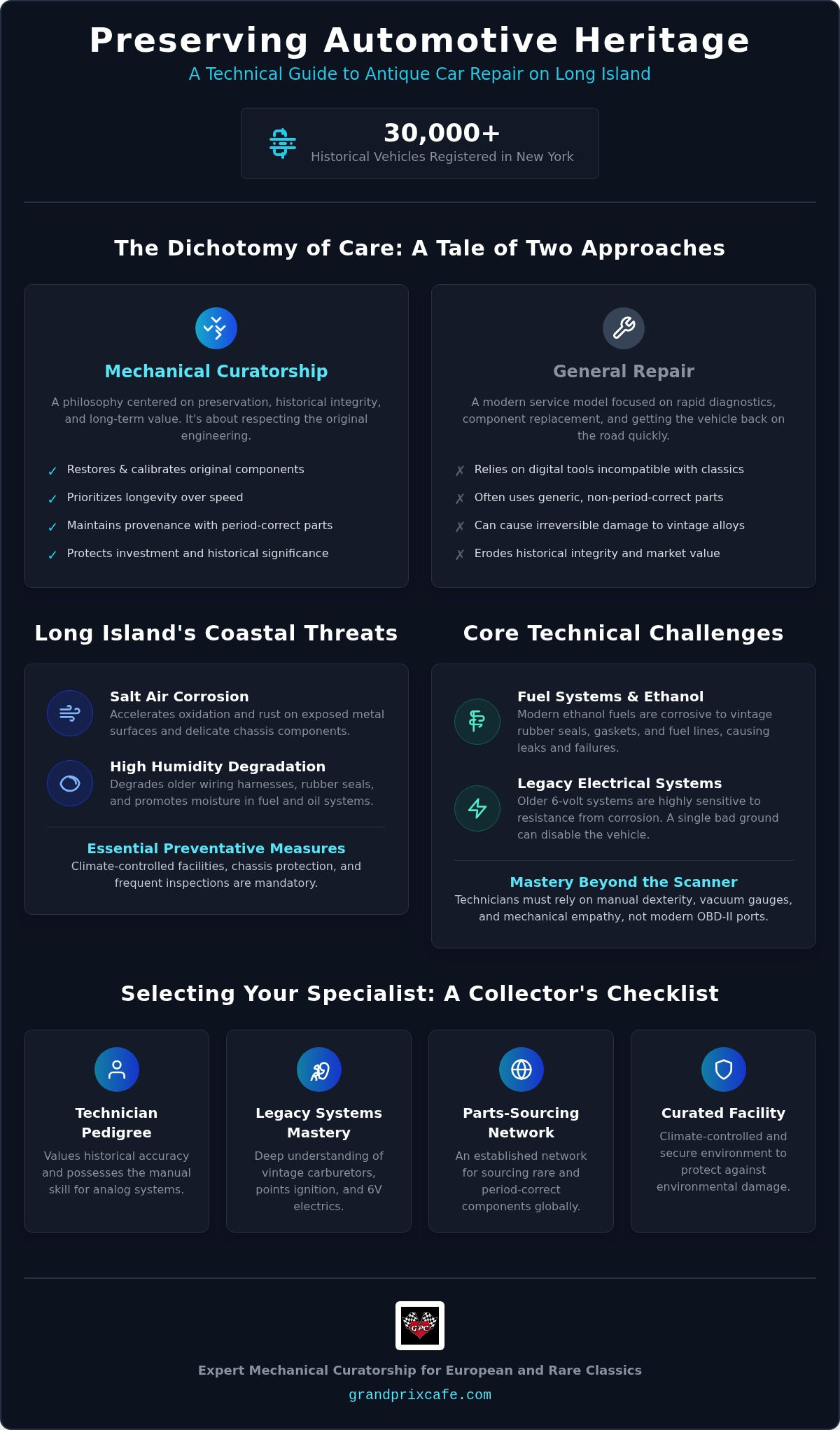
With over 30,000 historical vehicles registered in New York State, the demand for specialized expertise is high, yet the pool of qualified technicians is shrinking. This guide details the technical nuances of preserving vintage automotive engineering while ensuring your vehicle remains roadworthy for the active car show scene in the Hamptons and beyond. You'll discover how to select an expert specialist who prioritizes vehicle provenance and understands the specific requirements of European and rare classics.
Our analysis covers the essential criteria for evaluating a restoration facility, from their parts-sourcing network to their mastery of legacy ignition systems. We provide a framework for maintaining reliable mechanical performance without eroding the historical integrity of your investment.
Table of Contents
The Landscape of Antique Car Repair on Long Island
Antique car repair on Long Island is a specialized discipline centered on the preservation of mechanical heritage. It's an exacting process. Unlike modern automotive service, which prioritizes rapid component replacement and digital diagnostics, vintage curatorship focuses on the manual restoration and calibration of original parts. Maintaining historical integrity is paramount for any serious collector. With over 30,000 historical vehicles registered in New York, the demand for authentic service is significant. A vehicle's market value and historical significance depend heavily on its provenance and the consistent use of period-correct engineering. When Defining an Antique Car, one must consider both the legal definitions used by the New York DMV and the technical standards required for high-level preservation.
Mechanical Curatorship vs. General Repair
A general mechanic often lacks the specialized diagnostic equipment and manual dexterity required for obsolete fuel systems or points-based ignition. The fundamental philosophy of curatorship involves repairing for longevity rather than replacing for speed. This approach ensures that every mechanical intervention respects the original design intent of the manufacturer. For collectors, finding a classic car mechanic Southampton NY means partnering with a technician who values technical specifications over convenience. This meticulous attention to detail preserves the vehicle’s long-term investment potential. It prevents the use of incorrect fluids or modern parts that can cause irreversible damage to vintage seals and alloys.
Long Island Environmental Factors
The geography of the South Fork and surrounding areas presents unique challenges for vintage automotive health. Coastal air is laden with salt and high humidity. These elements accelerate oxidation on exposed metal surfaces and degrade delicate electrical connections in older wiring harnesses. Successful antique car repair on Long Island must include protocols that specifically address these environmental stressors. Chassis protection and frequent inspections of rubber seals are mandatory for vehicles frequently driven in the Hamptons. Climate-controlled facilities are essential for maintaining the structural and mechanical health of a rare classic. Local expertise ensures that maintenance schedules account for the specific humidity cycles and seasonal temperature shifts found along the Atlantic coast. This proactive approach prevents the slow degradation that often occurs in non-specialized storage or repair environments.
Technical Challenges: Why Antique Vehicles Require Specialized Expertise
Modern automotive shops rely on OBD-II ports and digital scanners to identify faults. These tools are useless when addressing the analog engineering of the 1950s through the 1970s. Antique car repair on Long Island requires a transition from software-based diagnostics to manual mechanical empathy. This field is a disciplined technical craft, mirrored by the academic standards of the Automotive Restoration Technology Program at McPherson College. Technicians must understand the physical relationship between vacuum pressure, spark intensity, and fuel atomization without the aid of a computer interface.
Fuel Systems and the Modern Ethanol Challenge
Modern ethanol-blended fuels present a significant risk to vintage engines. Ethanol is hygroscopic and corrosive; it attracts moisture and degrades the natural rubber seals and gaskets found in period-correct fuel systems. Over time, this causes fuel pump diaphragms to fail and carburetor needles to stick. Tuning multi-carburetor setups, such as triple Webers or twin SU units, involves precise synchronization using vacuum gauges and a trained ear for engine harmonics. Vapor lock occurs when fuel in the lines turns to gas due to excessive heat, disrupting the pump's ability to deliver liquid fuel to the engine. Preventing these issues requires a technician who understands both historical engineering and modern chemical interactions.
Electrical Systems and Ignition Timing
Many pre-1960s vehicles utilize 6-volt electrical systems that are highly sensitive to resistance. A single corroded ground can render a starting system inoperable. Managing these systems involves more than just battery maintenance; it requires the precise adjustment of points and condensers within a mechanical distributor. Setting the dwell and timing is a tactile process that dictates the engine's entire power band. In European classics, original wiring harnesses often feature insulation that becomes brittle and fails with age. Maintaining Concours-level integrity means sourcing period-correct components or carefully fabricating replacements that match the original factory specifications. When sourcing New Old Stock (NOS) parts becomes impossible, the ability to perform specialized car service through custom fabrication is the only way to preserve a vehicle's provenance.
The challenge of sourcing obsolete components often leads to compromise in general repair shops. A specialized curator avoids these shortcuts. They understand that every non-period part reduces the vehicle's historical value and mechanical reliability. This commitment to technical accuracy ensures that a vintage Porsche or Mercedes-Benz performs exactly as it did when it left the assembly line.
Criteria for Selecting an Antique Repair Specialist on Long Island
Selecting a facility for antique car repair on Long Island requires a departure from standard consumer metrics. A high-volume garage operates on a model of rapid turnover and generic service. In contrast, a curated studio functions as a technical gallery where the focus remains on the individual vehicle. The environment should be clean, organized, and dedicated to long-term preservation. You must evaluate the technician’s pedigree with specific marques. A specialist who understands the nuances of a Porsche air-cooled engine may not possess the same depth of knowledge regarding a Jaguar V12 or a Mercedes-Benz mechanical fuel injection system. Technical expertise is rarely universal. It's earned through decades of experience with specific engineering lineages and manufacturer-specific assembly methods.
The Importance of Specialized Tooling
Antique vehicles often feature fasteners and thread patterns that predate modern standardization. British classics frequently require Whitworth tools, while European and domestic models utilize Metric or SAE specifications respectively. Using an incorrectly sized wrench or a modern impact tool on a rare, soft-alloy fastener can cause permanent damage. A professional specialist maintains a comprehensive inventory of specialized tooling to ensure every component is handled according to original factory standards. When a part is no longer available in the global market, the facility must have the capability for in-house fabrication. The ability to create a custom bracket or turn a new bushing on a lathe is a fundamental requirement for maintaining rare domestic and European marques.
Documentation and Provenance Preservation
A meticulous paper trail is essential for maintaining the market value of a high-end classic. Every intervention should be recorded with detailed logs, including specific fluid types, torque specifications, and photographic evidence of the work in progress. This documentation serves as a formal record of the vehicle's mechanical history. It provides future owners with confidence in the work performed and the parts used. The mechanic acts as a temporary steward of the vehicle’s history, ensuring that its story remains intact through every service interval. This level of detail is a hallmark of professional vintage car restoration New York. Transparency in the repair process reflects a deep respect for the vehicle's heritage and the owner's long-term investment goals.
Maintenance vs. Repair: Protocols for the Active Collector
Many owners confuse restoration with maintenance. While a full restoration establishes a baseline, antique car repair on Long Island requires a proactive seasonal strategy to ensure consistent roadworthiness. For the active collector, the goal is to prevent mechanical failure before it occurs during a weekend excursion. This is especially critical for vehicles subjected to the fluctuating temperatures and stop-and-go traffic typical of the South Fork. Mechanical curatorship involves a disciplined approach to fluid management and component exercise that differs significantly from modern vehicle service.
Fluid choice is a non-negotiable aspect of vintage engine health. Modern synthetic oils often lack the high-pressure additives required for older engine designs. Zinc-additive oil is a specialized lubricant containing dialkyldithiophosphate (ZDDP) that provides a critical sacrificial layer of protection for flat-tappet camshafts. Using generic modern oil can lead to rapid cam lobe wear and eventual engine failure. Similarly, cooling systems must be optimized for modern traffic conditions. This often involves the installation of high-efficiency radiators or specialized fans that maintain period-correct aesthetics while preventing overheating during summer drives on the LIE.
The Seasonal Service Checklist
Spring start-up requires a methodical technical inspection. Technicians must check for fuel leaks caused by dried gaskets and inspect tires for flat spots or sidewall cracking from winter storage. Winterization is equally vital. This process involves stabilizing the fuel system and ensuring the engine is protected against internal corrosion during the off-season. A thorough checklist includes:
Inspection of all rubber fuel lines for ethanol-induced degradation.
Testing of brake fluid for moisture content to prevent caliper seizing.
Battery load testing and connection cleaning for 6-volt and 12-volt systems.
Verification of cooling system pressure and thermostat operation.
Addressing Mechanical Decay in Stored Vehicles
Mechanical systems degrade through disuse. Seals and gaskets rely on regular lubrication to remain pliable. When a vehicle remains stationary for extended periods, these components dry out and shrink, leading to persistent leaks upon restart. Exercising the mechanical components through regular, controlled heat cycles is the best method of preventing mechanical decay. This ensures that oil reaches the upper cylinder walls and transmission seals remain saturated. If your vehicle has been stationary or requires a seasonal evaluation, contact us for professional car service at our Southampton facility.
Mechanical Curatorship at Grand Prix Cafe
Grand Prix Cafe operates as a specialized studio in Southampton, serving as a hub for antique car repair on Long Island. Our facility provides a gallery-like environment where technical precision meets historical preservation. We focus on European and rare domestic marques. Every vehicle receives service tailored to its specific engineering lineage. By integrating repair, restoration, and year-round indoor car storage, we offer a comprehensive solution for collectors in the Hamptons and Manhattan. This unified model ensures that a vehicle's provenance remains intact through every phase of ownership. Our Southampton facility acts as a convenient hub for collectors who demand meticulous attention to detail and technical authority.
Specialized Accident Repair and Servicing
Structural integrity is the primary concern when addressing accident repair for vintage vehicles. Unlike modern cars with modular components, antique chassis require manual realignment and period-correct bodywork. Our technicians utilize traditional metal-shaping methods to restore panels without compromising historical aesthetics. We prioritize safety by ensuring that all structural repairs meet rigorous standards. These repairs must align with original factory specifications. This balance between modern safety and historical accuracy is essential for preserving a vehicle’s long-term value. We manage the complexities of sourcing rare European components, navigating the specific lead times required for authentic parts to maintain mechanical integrity.
A Tailored Experience for the Discerning Owner
Collectors benefit from a single partnership that manages classic car sales, specialized servicing, and secure storage. This integrated model allows for a holistic understanding of a vehicle's mechanical history. We develop personalized maintenance plans based on your driving habits and the vehicle’s specific needs. Whether you require a seasonal tune-up for a Porsche or a comprehensive engine overhaul for a vintage Mercedes-Benz, our approach is rooted in transparency. Every technical intervention is documented. We provide clear logs and photographic evidence of the work performed, ensuring the paper trail for your investment remains complete.
Our Southampton studio is equipped with the specialized diagnostic tools and traditional machinery required for high-end curatorship. To discuss the specific requirements of your collection, schedule a technical consultation at our facility. We provide the expertise necessary to maintain the high standards of antique car repair on Long Island. Our commitment to mechanical curatorship protects your investment. It ensures your vehicle performs with the reliability intended by its original designers while meeting the demands of modern driving conditions.
Preserving Your Mechanical Heritage
Maintaining an antique vehicle requires more than simple mechanical skill; it demands a commitment to historical accuracy and technical precision. Professional antique car repair on Long Island ensures that your vehicle remains a reliable asset while preserving its original engineering provenance. Collectors must prioritize specialized fluid management and period-correct ignition timing to combat the unique environmental stressors found along the Atlantic coast. By selecting a partner who understands the nuances of European and rare domestic marques, you protect both the performance and the market value of your investment.
Grand Prix Cafe provides the specialized expertise necessary for high-end curatorship. Our Southampton facility offers a secure environment for comprehensive restoration, accident repair, and year-round indoor storage. Our expert technicians focus on the technical details that define automotive excellence, from carburetor synchronization to structural realignment. This integrated approach ensures that every aspect of your vehicle's health is managed with professional transparency.
Consult with our specialized technicians at Grand Prix Cafe to discuss a tailored maintenance plan for your collection. Your vehicle deserves the highest standard of professional care.
Frequently Asked Questions
How is antique car repair different from modern vehicle service?
Antique car repair involves manual diagnostics and the restoration of original components rather than software-based part replacement. Modern vehicles rely on digital sensors and modular assemblies. Vintage engineering requires a technician to interpret physical feedback, such as engine harmonics and vacuum pressure. This discipline prioritizes mechanical longevity and historical accuracy. It's a tactile process that preserves the vehicle's unique character and provenance through specialized manual labor and expert technical knowledge.
Why do antique cars need special oil additives like zinc?
Vintage engines with flat-tappet camshafts require zinc-rich lubricants to prevent catastrophic metal-to-metal wear. Modern engine oils have reduced levels of Zinc Dialkyldithiophosphate (ZDDP) to protect catalytic converters in newer cars. Without this sacrificial layer, the high-pressure contact between the cam lobe and lifter will lead to rapid component failure. Using specialized oils ensures that legacy internal components remain protected during both high-load driving and long-term seasonal storage.
Can you source original parts for 50-year-old European cars on Long Island?
Sourcing authentic components for 50-year-old European marques is possible through a specialized global network of New Old Stock (NOS) suppliers and dedicated collectors. When original parts are obsolete, professional facilities on Long Island utilize in-house fabrication to create period-correct replacements. This ensures that every repair maintains the vehicle's technical integrity. Expertise in European parts logistics is essential for collectors who require authentic spares for Porsche, Jaguar, or Mercedes-Benz models.
Is it safe to drive my antique car in modern Long Island traffic?
It's safe to drive an antique car in modern traffic provided the cooling and braking systems are optimized for contemporary conditions. Many vintage vehicles require high-efficiency radiators or upgraded fans to manage the stop-and-go patterns of the Long Island Expressway. Regular inspections of the braking system, including the verification of fluid integrity and caliper operation, are mandatory. Professional antique car repair on Long Island ensures your vehicle meets safety standards without compromising historical aesthetics.
How often should a vintage car be serviced if it is rarely driven?
A vintage car should receive professional service at least twice per year, regardless of the mileage accumulated. Fluids such as brake oil and coolant degrade over time and can become corrosive if left stagnant. Seasonal inspections allow technicians to identify dried seals, fuel system oxidation, or battery discharge before they lead to significant mechanical failure. This cadence ensures that the vehicle remains roadworthy for car shows and exhibitions throughout the Hamptons.
What should I look for in a classic car mechanic near the Hamptons?
You should prioritize a technician with documented expertise in your specific marque and access to specialized legacy tooling. A reputable facility near the Hamptons functions as a curated studio rather than a high-volume garage. Look for transparency in their documentation process, including detailed logs and photographic records of every repair. The presence of climate-controlled storage and a focus on mechanical curatorship indicates a commitment to the long-term preservation of high-end automotive assets.
Does a mechanical repair affect the value of my collectible car?
Proper mechanical repair performed with period-correct components protects and often increases the value of a collectible car. Conversely, using generic modern parts or incorrect fluids can erode the vehicle’s provenance and market appeal. Maintaining a comprehensive paper trail of all technical interventions is vital for resale value. Discerning buyers value a vehicle that has been maintained by a specialist who respects the original engineering specifications and manufacturer standards.
Can Grand Prix Cafe handle both mechanical repair and bodywork?
Grand Prix Cafe provides an integrated service model that includes both specialized mechanical repair and period-correct bodywork. Our Southampton facility is equipped to manage complex accident repair for vintage vehicles, ensuring structural integrity while maintaining historical aesthetics. This unified approach allows for seamless coordination between the mechanical and aesthetic aspects of a restoration. We offer a single point of contact for collectors who require expert antique car repair on Long Island and secure storage.
Comments