


Classic Car Investment Guide New York: 2026 Framework
- sales299631
- 11 minutes ago
- 11 min read
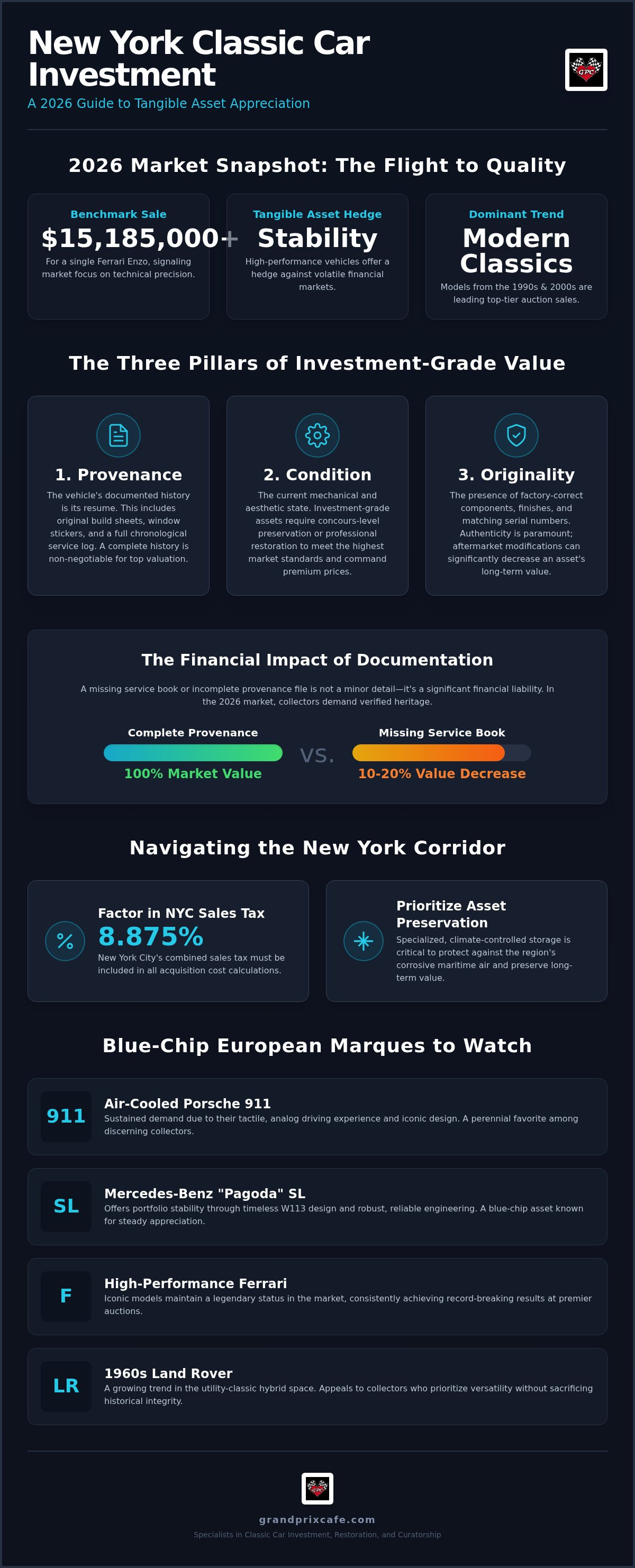
The 2026 auction season saw a single Ferrari Enzo command over $15,185,000, signaling a market that rewards technical precision over mere speculation. While traditional financial assets face ongoing volatility, the tangible nature of a high-performance vehicle offers a unique hedge, provided the collector understands the specific demands of the region. This classic car investment guide New York provides the framework necessary to navigate a landscape where the corrosive maritime air and complex tax structures can erode value if not managed with professional oversight.
You likely recognize that a classic is more than a machine; it's a historical artifact that requires meticulous stewardship. We'll show you how to identify blue-chip European models, particularly the "Modern Classics" from the 1990s and 2000s that now dominate top-tier sales. You'll learn to establish a local network for preservation and mechanical curatorship to ensure your asset appreciates over the long term. This guide covers the essential 2026 metrics, from New York City's 8.875% combined sales tax to the critical role of climate-controlled storage in the Hamptons.
Table of Contents
The New York Classic Car Market: Why Tangible Assets Matter in 2026
Sophisticated investors prioritize tangible assets that offer both utility and historical significance. A classic car fulfills these requirements. Unlike digital or paper assets, a physical vehicle possesses intrinsic mechanical value. In the New York corridor, high-net-worth individuals increasingly view European marques as stable components of a diversified portfolio. This shift reflects a desire for assets that remain unaffected by the volatility of traditional markets. This classic car investment guide New York identifies why mechanical integrity serves as the primary baseline for valuation in the current economic cycle.
Defining Investment-Grade Vehicles
Distinguishing between a recreational vehicle and an investment-grade asset requires a technical eye. While Defining a Classic Car involves age and historical context, investment grade relies on the "Three Pillars": provenance, condition, and original specifications. Rarity alone doesn't guarantee appreciation. A vehicle must possess a documented history and mechanical integrity to command premium prices. Collectors in the Hamptons and Manhattan now favor curated boutique acquisitions where every serial number and service record is verified. Hobbyist cars may provide enjoyment, but only assets with verified heritage survive the scrutiny of a 2026 valuation.
The 2026 Market Outlook for NY Collectors
The New York market demonstrates unique resilience compared to national averages. Recent 2026 auction results, such as the record $159 million achieved at the Pebble Beach sale, influence regional expectations. Local collectors are moving toward "Modern Classics" from the 1990s and 2000s, yet the 1960s-1980s high-performance era remains the gold standard. The demand for high-quality European classic car restoration NY services has increased as collectors seek to bridge the gap between driver-quality and concours-level condition. Strategic acquisition in this region requires an understanding of both the 8.875% combined sales tax in New York City and the long-term benefits of professional curatorship.
Mechanical integrity is no longer optional. A vehicle with compromised components or undocumented repairs cannot sustain its value in a "flight to quality" market. Current trends indicate that investors are moving away from speculative buying. Instead, they're focusing on the long-term preservation of high-performance European models like Porsche, Mercedes-Benz, and Ferrari. Success in the New York corridor depends on establishing a relationship with a Southampton-based hub that understands the technical nuances of these marques. By focusing on mechanical excellence, collectors can secure an asset that offers both aesthetic prestige and reliable long-term growth.
Selection Criteria: Identifying Blue-Chip Automotive Opportunities
Identifying blue-chip assets requires a rigorous analytical framework. This classic car investment guide New York emphasizes the "Three Pillars" of selection to ensure long-term value appreciation:
Provenance: The documented ownership history and heritage of the vehicle.
Condition: The current mechanical state and aesthetic preservation.
Originality: The presence of factory-correct components and finishes.
These factors determine if a vehicle is a legitimate investment-grade asset or merely a recreational object. The "Provenance File" acts as the vehicle’s resume. It should include the original window sticker, build sheets, and a chronological log of all mechanical work. Previous ownership by notable figures or participation in significant events can also impact the asset's market value. As noted in Data on Aging Autos, vehicles are being retained for longer durations, making documented maintenance even more critical for older assets. A missing service book can decrease a vehicle's value by 10% to 20% in the current market.
Marque-Specific Investment Nuances
European marques remain the New York gold standard. Air-cooled Porsches, specifically the 911 series, continue to see sustained demand due to their tactile, analog driving experience. Vintage Mercedes-Benz SL models, particularly the W113 "Pagoda," offer stability through timeless design and robust engineering. We also see a growing 1960s Land Rover restoration New York trend. These utility-classic hybrids appeal to collectors who prioritize versatility without sacrificing historical integrity. High-performance models from Ferrari also maintain a floor for valuation due to their limited production numbers and racing pedigree.
Technical Vetting and Inspections
Technical vetting is non-negotiable for high-value acquisitions. Matching numbers ensure the engine, transmission, and chassis are original to the vehicle's production date. This verification requires the expertise of a specialized classic car mechanic Southampton NY. A pre-purchase inspection (PPI) uncovers hidden mechanical decay, structural issues, or non-original modifications that devalue the asset. Technical specifications, such as a specific gearbox or factory color code, often dictate long-term desirability. Originality is the presence of factory-correct components and finishes. For those seeking to evaluate a potential acquisition, professional classic car sales expertise provides the necessary vetting to avoid costly errors. Following this classic car investment guide New York ensures that every acquisition meets the high standards required for asset growth.
The ROI of Restoration: Enhancing Value Through Mechanical Curatorship
Restoration is often misunderstood as a sunk cost. In reality, it acts as a strategic lever for asset appreciation. This classic car investment guide New York identifies mechanical curatorship as the primary method for moving a vehicle from "driver" quality to "concours" status. The valuation delta between these two categories can be substantial. A frame-off restoration involves the complete disassembly of the vehicle, allowing for the inspection and refurbishment of every component. This level of detail ensures structural integrity and mechanical longevity. These are critical metrics for high-value European assets in the 2026 market.
Strategic Restoration vs. General Repair
Strategic restoration differs from general maintenance by focusing on marketability and historical accuracy. It requires a deep understanding of vintage car restoration New York standards. General repairs address immediate mechanical failures. Strategic restoration restores the vehicle to its factory-original state using period-correct materials and technical processes. Specialized accident repair for vintage vehicles is also essential. It preserves the chassis alignment and structural safety that modern facilities often overlook. Collectors must maintain a balance. A vehicle should be period-correct, avoiding an "over-restored" appearance that diminishes its historical character.
Case Study: European Excellence
The financial impact of curatorship is most visible in marques like Porsche and Ferrari. A documented restoration by a specialized facility can increase asset value by 20% to 40%. This process adds significant depth to the Provenance File. Every photograph, invoice, and technical specification recorded during the restoration serves as evidence of the vehicle's condition. For a vintage Porsche, utilizing factory-specification finishes or original interior materials can be the difference between a record auction price and a stagnant listing. High-quality restoration transforms a depreciating machine into an appreciating historical artifact. It ensures the asset remains competitive in a market that increasingly demands technical perfection.
Asset Preservation: The Role of Specialized Storage in New York
New York's climate presents a direct threat to automotive preservation. This classic car investment guide New York identifies seasonal fluctuations as a primary driver of mechanical decay. While high-performance European models are engineered for durability, they aren't immune to the oxidative stress of the Northeastern corridor. Professional storage isn't merely about space; it's about the technical management of the vehicle's environment. A collector's ability to maintain an asset's condition rating depends heavily on the quality of its off-season housing.
The Hazards of Improper Storage
Humidity is the most persistent risk for vintage assets in the New York region. Excess moisture compromises delicate vintage upholstery and accelerates the degradation of complex electrical systems. Stagnant engines represent a different set of challenges. When a vehicle remains stationary for extended periods, fluids can acidify and internal seals often lose their elasticity. This leads to a state of mechanical decay where the engine's internal components suffer from a lack of consistent lubrication. Professional facilities mitigate these risks through active monitoring and periodic fluid analysis. Maintaining a stable, climate-controlled temperature prevents the condensation cycles that trigger hidden corrosion in frame rails and body cavities. These technical safeguards are essential for preserving the matching numbers integrity discussed in earlier sections.
Hamptons-Specific Preservation
Collectors in the Southampton region face the specific challenge of maritime air, often referred to as the "coastal tax." The high salt content in the atmosphere is highly corrosive to metal surfaces and factory-original finishes. This environmental factor often necessitates extensive classic car bodywork restoration NY services if the vehicle is left exposed to the elements for even a single season. For this reason, luxury car storage Hamptons solutions are a non-negotiable requirement for serious investors. A specialized facility provides more than shelter; it implements a strict classic car maintenance New York schedule. This protocol includes regular tire pressure adjustments, battery conditioning, and controlled mechanical exercising of the vehicle. This process ensures that all seals remain lubricated and the braking systems do not seize. This proactive approach preserves the asset's condition and prevents the value-eroding effects of the coastal climate. Secure your investment today by utilizing our specialized year-round indoor car storage in Southampton to maintain your vehicle's market-ready status.
Strategic Divestment: The Grand Prix Cafe Framework
A successful investment cycle concludes with a strategic exit. This classic car investment guide New York emphasizes that divestment timing is as critical as the initial purchase. Collectors should evaluate their portfolio every 24 to 36 months to determine if an asset has reached its peak valuation. Market shifts, such as the 2026 trend toward "Modern Classics," might suggest a reallocation of capital from traditional blue-chip models to high-performance vehicles from the 1990s. High-value assets require a discreet, boutique transaction environment to preserve market integrity and avoid the price degradation associated with overexposure in public auctions.
Maximizing Liquidity and Value
Investors must choose between immediate liquidity and maximum market yield. Outright vehicle purchase offers the advantage of a guaranteed, immediate transaction. This path is ideal for collectors seeking to rebalance their portfolio without the typical 60 to 90-day cycle of a traditional sale. Conversely, professional vehicle consignment services leverage an established global network of qualified buyers to secure a premium return. This process begins with a specialized appraisal to ensure the asking price reflects verified 2026 market data. Consignment allows for a curated presentation, utilizing the vehicle's technical provenance and restoration history to attract discerning buyers who value mechanical excellence over a bargain.
The Grand Prix Cafe Advantage
Managing a high-value automotive portfolio is most efficient when using a single-source facility. Our Southampton location functions as a hub for the entire investment lifecycle. By integrating year-round storage, mechanical restoration, and classic car sales Southampton NY into a single ecosystem, we ensure every asset is market-ready at all times. This local expertise provides a competitive edge. We understand the regional nuances of the New York market and the specific logistical demands of the Hamptons. We prioritize long-term stewardship and historical integrity over high-volume transactions, ensuring your assets are presented with the prestige they deserve.
The 2026 framework for automotive investment demands a methodical approach to both preservation and divestment. Whether you're seeking to liquidate a single asset or build a diverse collection of European marques, professional oversight is the variable that secures growth. Consult with our specialists to build your automotive portfolio.
Securing Your Automotive Legacy in 2026
Success in the regional market requires a shift from speculative acquisition toward technical stewardship. This classic car investment guide New York has outlined the critical role of provenance and mechanical curatorship in maintaining long-term asset value. Investors must prioritize climate-controlled preservation to mitigate regional environmental risks while establishing a clear exit strategy for liquidity. By focusing on originality and documented maintenance, you'll ensure your collection remains a viable tangible asset for years to come.
Grand Prix Cafe serves as a specialized hub for this entire lifecycle. With decades of expertise in European classic car restoration and sales, we provide the technical oversight necessary for high-value portfolios. Our premier climate-controlled storage facility in Southampton preserves your vehicle's integrity; meanwhile, our discreet consignment services offer a professional path for divestment. Whether you're entering the market or rebalancing an existing collection, our team provides the precision required for automotive growth. Explore our curated inventory of investment-grade classic cars. We look forward to assisting you in the preservation of your automotive legacy.
Frequently Asked Questions
Is a classic car a better investment than traditional stocks in 2026?
A classic car functions as a tangible asset that often remains uncorrelated with stock market volatility. In 2026, high-quality European models have demonstrated significant resilience against inflation. While stocks offer higher liquidity, a physical vehicle provides intrinsic value through mechanical integrity and historical significance. Success depends on following a classic car investment guide New York to identify models with high appreciation potential. Investors should view these vehicles as long term hedges within a diversified portfolio.
What are the most investment-worthy European classic cars for New York collectors?
Air-cooled Porsches and vintage Mercedes-Benz SL models remain the gold standard for New York collectors. We also see a significant shift toward "Modern Classics" from the 1990s and 2000s, which now dominate top-tier auction sales. Limited production Ferrari models continue to command premium prices due to their racing pedigree. These marques offer the technical stability and historical integrity required for a secure investment in the current 2026 market framework.
How does professional restoration affect the resale value of a classic car?
Professional restoration significantly increases an asset's marketability by elevating its condition to concours standards. A documented, high-quality restoration can increase a vehicle's value by 20% to 40% depending on the marque. It's critical to maintain a balance between period-correct finishes and mechanical excellence. This process adds depth to the provenance file, providing future buyers with verified evidence of the vehicle's structural integrity. Strategic restoration transforms a standard vehicle into a premium investment-grade asset.
Why is climate-controlled storage essential for classic car investments in the Hamptons?
The maritime environment in the Hamptons presents a high risk of corrosion due to salt air and humidity. Climate-controlled storage is the only method to prevent the "coastal tax" from devaluing your asset. These facilities maintain stable temperatures to prevent condensation and protect delicate vintage upholstery. Year-round indoor housing is a non-negotiable requirement for serious collectors in Southampton who wish to avoid the high costs of premature bodywork restoration.
Should I choose outright purchase or consignment when selling my classic car?
The choice depends on your requirements for liquidity versus total return. Outright vehicle purchase provides immediate capital, which is ideal for rebalancing a portfolio quickly. Professional consignment services are better suited for those seeking maximum market yield. Consignment utilizes a global network of qualified buyers and a curated presentation to secure a higher price point. Both options are viable strategies within a comprehensive classic car investment guide New York for high-value collectors.
What documentation is required to prove the provenance of an investment-grade vehicle?
Provenance is established through a comprehensive file including original build sheets, window stickers, and chronological service records. Documented ownership history and racing pedigree also add significant value. For European marques, factory certificates of authenticity are essential to verify matching numbers and original specifications. This documentation serves as the vehicle's resume, providing the transparency required for a high-value transaction in 2026. A missing service book can decrease an asset's value by 20%.
How often should a classic car be serviced to maintain its investment value?
Investment-grade vehicles require annual mechanical inspections regardless of mileage. Fluids should be analyzed and replaced regularly to prevent acidification and internal component damage. Regular mechanical exercising is also necessary to keep seals lubricated and prevent the braking systems from seizing. A proactive maintenance schedule ensures the vehicle remains in market-ready condition. This technical oversight is a core component of mechanical curatorship and is essential for preserving long-term asset growth.
Can I invest in a classic car with a budget under $50,000 in New York?
While entry-level investments are possible, $50,000 is below the threshold for most blue-chip European marques in concours condition. Collectors with this budget often focus on "Modern Classics" from the late 1990s or high-quality utility-classic hybrids. It's important to account for the 8.875% combined sales tax in New York City and the ongoing costs of professional storage. Technical vetting remains essential to ensure the vehicle doesn't have hidden mechanical decay that exceeds its market value.
Comments