


Collision Repair for Classic Cars in New York: Standards of Preservation
A classic car can be made roadworthy again and still lose what makes it historically significant. After a collision, the repair method matters as much as the visible result. If you’re researching “collision repair classic car New York,” you’re likely weighing period-correct work, possible changes in value, and how an insurer will assess your vehicle’s significance.
Those concerns are well founded. A vintage vehicle’s provenance, original materials, and restoration history all help determine how damage should be assessed and repaired. The goal is not simply to remove visible damage. It is to address the collision while preserving the car’s structural and historical integrity, with a clear record of the work.
This article explains how to assess repair choices, document work, and assemble valuation evidence for an insurance claim. It also compares period-correct and modern methods so you can choose an approach that reflects your car’s condition and intended use. At Grand Prix Cafe in Southampton, accident repair draws on the same restoration standards used to return vintage vehicles to their original condition.
Table of Contents
Understanding Collision Repair for Classic Cars in New York
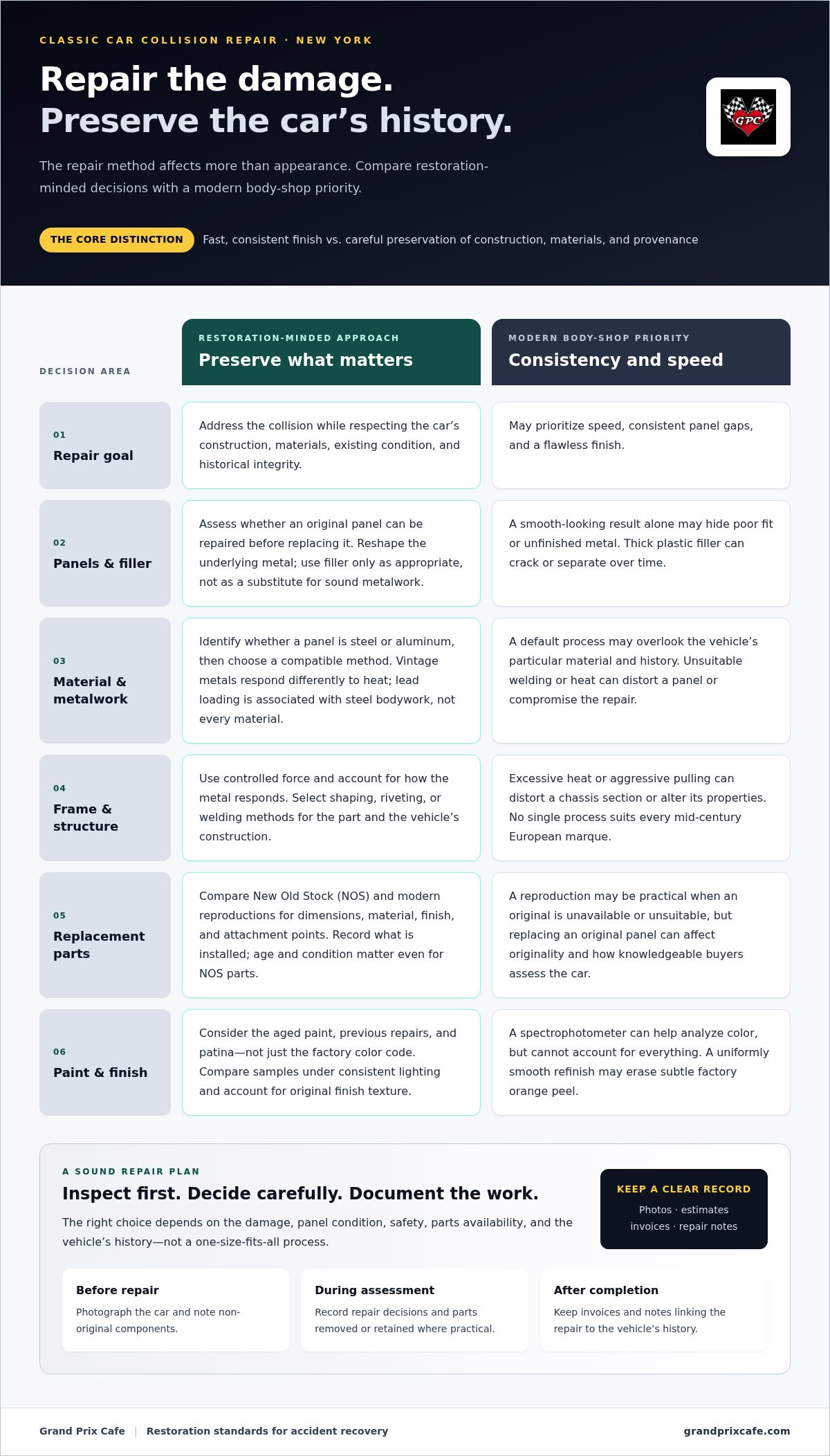
Collision repair for a vintage vehicle is a specialized form of restoration. The work must address damage while respecting the car’s construction, materials, and existing condition. A modern repair process may prioritize speed, consistent panel gaps, and a flawless finish. Collector-grade work also considers whether a method alters original material, hides earlier repairs, or changes details that help establish the vehicle’s history.
That distinction matters for New York owners who drive, display, or preserve their cars. Collectors in Southampton, Westhampton, East Hampton, and Sag Harbor may have vehicles with very different construction and repair histories. European classics and British vehicles such as 1960s Land Rovers each have distinctive engineering and body details. A sound repair plan starts with inspecting the individual car, rather than assuming that a damaged panel or structure should always be handled the same way.
Provenance is the documented history of a vehicle, including its ownership, condition, and past work. It helps explain why the car is significant and supports a credible account of its current state. Photographs, invoices, and repair notes can connect accident recovery to that history. For an overview of restoration principles and the distinction between restoration and modification, see Automotive Restoration.
The Stakes of Improper Repair
Replacing an original panel with a reproduction or modern part can affect originality and how knowledgeable buyers assess the car. Replacement is not automatically the wrong choice: safety, damage severity, and parts availability also matter. The decision should be recorded and justified. Welding requires similar care. Vintage steel and aluminum respond differently to heat, so an unsuitable process can distort a panel or compromise the repair. A repair that looks acceptable at first glance may leave questions about fit, material, and the car’s history.
Restoration-Grade Accident Recovery
Restoration standards bring a broader view to collision work. As part of vintage car restoration in New York, accident repair considers what can be preserved before deciding what must be replaced. An original body panel may be repairable, but the right choice depends on the damage and the panel’s condition. A useful service record captures the assessment, repair decisions, parts used, and completed work.
Owners can help maintain that record by keeping pre-repair photographs, estimates, invoices, and notes about non-original components. Record removed or retained parts where practical. Together, these details connect the car’s earlier history with its post-accident condition, instead of leaving future owners to guess what changed.
At Grand Prix Cafe in Southampton, accident repair is informed by restoration work on high-end vintage models. That perspective is particularly relevant when damage involves distinctive construction or historically important details. The aim is a considered repair that addresses the collision without treating the vehicle as an ordinary modern body-shop job.
Period-Correct Techniques vs. Modern Body Shop Methods
Classic bodywork calls for decisions based on the car’s materials and history, not a default process designed for modern production vehicles. Metal finishing restores a panel’s shape before paint. Thick plastic filler can hide poor fit or unfinished metal, and may crack or separate over time. Filler has a place in repair, but it should not replace careful reshaping of the underlying panel.
Lead loading, a traditional way to fill and blend minor surface transitions, is associated with steel bodywork. It is not a universal solution for vintage materials. Aluminum panels need methods suited to their alloy and condition; using lead without considering material compatibility can create problems. First identify the panel material and condition, then choose a repair method that preserves it and provides a stable foundation for finishing.
Metallurgical Integrity in Vintage Frames
Chassis straightening requires controlled force and an understanding of how the metal responds. Excessive heat or aggressive pulling can distort a section or alter its properties. English wheels and power hammers can shape replacement sections or bespoke panels, but the right tool depends on the part and the fit required. Riveting and welding methods also vary with construction, so no single process suits every mid-century European marque.
Parts decisions deserve the same scrutiny. New Old Stock (NOS) parts were made for the vehicle’s period, but age, storage, and condition still matter. Modern reproductions may be practical when originals are unavailable or unsuitable. Compare dimensions, material, finish, and attachment points, and record what is installed. The Automotive Restoration Market Organization (ARMO), a SEMA council focused on the restoration industry, is a relevant resource for understanding the field’s preservation focus.
Authentic Paint and Finish Standards
Matching aged paint takes more than finding the factory color code. Nitrocellulose lacquer, acrylic finishes, and modern water-based systems differ in application and appearance. A spectrophotometer can help analyze color, but it cannot by itself account for fading, previous repairs, or patina. Samples and visual comparison under consistent lighting provide additional information.
Texture matters, too. Factory finishes may show subtle orange peel that a uniformly smooth modern refinish would erase. Protective coatings and clear layers should suit the intended finish, since added gloss or thickness can change the appearance. The aim is a coherent repair, not an isolated panel that looks conspicuously newer than the rest of the car.
For collision repair classic car New York owners should weigh originality, material compatibility, and intended use together. Grand Prix Cafe applies restoration standards to accident repair for high-end vintage models in Southampton. Learn more about classic car accident repair and restoration at Grand Prix Cafe.
Navigating Agreed Value Insurance and Diminished Value
Insurance terms shape how a classic car is valued and repaired after a collision. Standard liability coverage addresses the policyholder’s responsibility for injury or property damage to others. It is different from coverage for the owner’s own vehicle. A collector policy may insure a car at an agreed value set by the owner and insurer in advance. Under that arrangement, the agreed amount applies to a total loss, subject to the policy’s terms, rather than being reduced for depreciation in the same way as actual cash value coverage.
New York’s total-loss threshold is also relevant to claim discussions. Under Department of Financial Services Regulation 64, a vehicle is considered a total loss when repair costs equal or exceed 75% of its pre-loss actual cash value. For a rare car, a standard estimate may not capture the significance of original parts, specialist labor, or documented restoration history. Presenting those details helps make the repair scope and valuation easier to assess.
Working with Specialty Insurers
Submit a clear estimate that separates structural, mechanical, and finish work, supported by photographs and relevant records. Ask the adjuster to document how disputed items, replacement parts, and supplemental damage are handled. Shop choice depends on the policy and claim circumstances, so keep communications in writing. Mechanical damage may require marque-specific knowledge; classic car mechanical service in Southampton can address the technical needs of vintage vehicles.
Keep a claim file with the initial condition, estimate revisions, parts records, invoices, and completion photographs. These records can help future buyers or auction specialists understand what the accident affected and how the car was returned to service. Grand Prix Cafe combines accident repair and restoration for high-end vintage models in Southampton, bringing restoration standards into the repair process.
Diminished Value Claims in New York
Inherent diminished value is the market-value loss that can remain after a vehicle has been properly repaired because its accident history is now part of its record. The effect depends on the car, damage, repair quality, and market evidence; it should not be assumed from a generic percentage. New York permits third-party diminished-value claims against an at-fault driver’s insurer. First-party claims under your own policy are generally not covered unless the policy specifically provides for them.
An independent appraisal can compare the vehicle’s pre-loss value with its post-repair market position and explain the basis for the difference. Provide the appraiser with prior valuation records, provenance, photographs, and repair documents. New York’s property-damage limitation period, including diminished-value claims, is generally three years from the loss. Because policy language and claim facts matter, review the applicable documents and seek legal advice for case-specific questions.
For collision repair classic car New York owners, provenance is practical evidence, not merely background. A detailed record of ownership, restoration, and condition can support a more informed discussion of repair standards and value after an accident.
Key Criteria for Selecting a Vintage Collision Specialist
A restoration-grade collision facility stands out through its decisions, not simply its surroundings. The work should account for the car’s construction, prior repairs, original components, and intended use. When comparing collision repair classic car New York options, focus on relevant model experience, a reasoned repair plan, clear records, and the ability to address body and mechanical damage.
Facility conditions matter, especially if a vehicle cannot be repaired immediately or must wait for parts. Grand Prix Cafe provides secure indoor storage for vehicles awaiting parts or assessment. Storage protects the car from exposure while its condition and repair needs are considered. A controlled environment may also matter for sensitive finishes and materials, but specific storage conditions should not be assumed without evidence.
Technician experience should relate to the vehicle’s marque and construction. Porsche, Jaguar, and Land Rover models each have distinct body, trim, and mechanical details. Grand Prix Cafe specializes in high-end vintage models, including European classics and 1960s Land Rovers. Traditional metalworking skills and appropriate modern diagnostic tools can both be valuable, depending on the damage. The method should fit the vehicle rather than force every repair through one standard process.
Vetting the Portfolio
Relevant examples are more informative than a broad claim of luxury-car experience. A portfolio of similar accident repairs can show how panel alignment, trim fit, and finish transitions were handled. Concours or auction work may offer useful context, but participation alone does not establish repair quality. Look for clear documentation of the damage, repair choices, and finished result. “Invisible” should mean visually coherent, not undocumented or concealed from the vehicle’s records.
Progress photographs help show how a repair developed, particularly when hidden damage appears after disassembly. A transparent record can include the initial inspection, newly discovered damage, parts decisions, and completed work. This supports informed discussions between the owner, specialist, and insurer. It also gives future buyers a service history they can assess, instead of leaving them to infer what happened from a polished exterior.
Logistics and Integrated Repair
A non-operable classic needs transport suited to its condition and ground clearance. Before moving it, note visible damage and loose components, and preserve any available pre-transport photographs. Coordinating body and mechanical work can also help connect the assessment when an impact affects suspension, steering, or other systems. Grand Prix Cafe brings these considerations together through accident repair and restoration work for vintage vehicles.
For owners in Southampton, Westhampton, East Hampton, and Sag Harbor, as well as collectors in Long Island and Manhattan, attentive service means clear communication, careful handling, and respect for the vehicle’s provenance. Grand Prix Cafe provides specialized accident repair for vintage vehicles as part of a restoration-led approach. For an assessment grounded in vintage-car repair and restoration, discuss classic car accident repair with Grand Prix Cafe.
The Grand Prix Cafe Standards for Accident Recovery
At Grand Prix Cafe, accident recovery is guided by mechanical curatorship: treat each vehicle as a distinct piece of automotive history, not as a collection of damaged panels. The assessment considers the car’s construction, condition, and restoration history before repair decisions are made. This connects accident repair with long-term preservation, with the aim of returning the vehicle to its pre-accident condition while respecting its character.
That perspective is particularly relevant to European classics and iconic British models, including 1960s Land Rovers. Their materials, body construction, and mechanical systems call for careful evaluation rather than a generic repair sequence. Grand Prix Cafe brings accident repair and restoration expertise together for high-end vintage models at its Southampton facility. For owners seeking collision repair classic car New York, a restoration-led process makes the reasoning behind repair choices clearer and easier to document.
Boutique Service in Southampton
Grand Prix Cafe serves collectors in the East End and Hamptons from Southampton, with a boutique setting shaped around classic and sports cars. Its work spans vehicle sales, service, restoration, storage, and accident repair. This broader perspective helps inform the repair discussion with the vehicle’s condition and history in mind. Manhattan collectors can also consider the Southampton facility when planning care for a vintage vehicle.
Documentation is part of preservation. A useful repair record can include the initial condition, photographs, assessment findings, parts decisions, and completed work. These details maintain continuity in the vehicle’s service history and give future owners a clearer account of its care. Vehicles awaiting parts or assessment can be kept in secure indoor storage during that stage of the process.
Next Steps for Post-Accident Care
Start by recording the vehicle’s condition and gathering available ownership, service, restoration, and insurance documents. If the car is not safe to drive, arrange transport appropriate to its condition. An initial assessment can establish visible damage and identify areas that need closer inspection. Grand Prix Cafe applies restoration standards to accident repair and prepares documentation that supports communication with the insurer.
Insurance decisions remain subject to the policy and claim circumstances. Keep estimates, photographs, and repair records together, and share relevant information with the adjuster as the work is assessed. Clear documentation explains why a repair method or part choice suits the particular vehicle; it does not guarantee an insurer’s approval of every item.
Owners seeking a measured, restoration-led response after an accident can request a consultation for specialized accident repair at Grand Prix Cafe in Southampton. A careful assessment is the starting point for recovery that respects both the car’s mechanical condition and its history.
Set the Standard for the Next Chapter
Before authorizing work, decide what a successful outcome means for your car. You may want to preserve original details wherever practical, or prioritize regular use while retaining the vehicle’s defining character. State these priorities early and have them reflected in the repair plan, parts decisions, and records. Bring current photographs, relevant service history, and policy documents so the discussion starts with the vehicle’s condition and your goals.
For collision repair classic car New York owners, the next step is an assessment based on the individual vehicle, not a generic estimate. Grand Prix Cafe brings specialized technicians for high-end vintage models together with restoration and collision repair in Southampton. Secure indoor storage is available for vehicles awaiting parts or assessment.
When you’re ready to discuss the vehicle’s history, damage, and repair priorities, consult with our specialized accident repair team in Southampton. Contact Grand Prix Cafe to begin with a careful assessment of your classic car.
Frequently Asked Questions
Does a collision repair automatically lower my classic car’s value?
No, an accident does not automatically produce the same loss in value for every classic. Buyers may consider the severity of damage, repair quality, originality, and the car’s history. Compare relevant pre- and post-accident market evidence rather than applying a generic percentage. For collision repair classic car New York owners, an independent appraisal and dated photographs can help explain the vehicle’s condition and support a more informed valuation.
Can I choose my own repair shop if I have a collector car insurance policy?
Your options depend on your policy and the circumstances of the claim. Before authorizing work, review the policy’s repair-facility language and ask the insurer to explain any preferred-shop process in writing. If you want a specialist to assess the vehicle, provide the adjuster with the shop’s estimate and supporting details. Keep records of discussions and approvals, especially if the proposed repair scope or parts differ from the specialist’s assessment.
What is the difference between lead loading and using modern body fillers?
Lead loading uses a lead-based body solder to fill and shape suitable metal areas; modern body fillers are compounds applied over prepared surfaces. Both require correct preparation and skilled application. Lead presents health risks and needs careful handling, while excessive filler can conceal rather than correct panel distortion. The underlying metal and location of the damage matter. Lead loading is not appropriate for every material, particularly aluminum, so the method should suit the specific panel.
How do you match paint on a vintage car that has original patina?
Matching aged paint requires more than selecting the original factory code. Fading, oxidation, past touch-ups, and exposure can make adjacent panels appear different. A useful assessment compares the finish in consistent lighting and may use test samples on an inconspicuous area before paint is applied. Avoid polishing or treating the surface before assessment, since that can change its appearance. Agree on the repair goal in advance: blend with existing patina or refinish a larger area.
What should I do if my insurance company wants to use aftermarket parts?
Ask for an itemized estimate that identifies each proposed replacement part and whether it is original equipment, aftermarket, or used. New York’s 2026 repair disclosure requirements call for written disclosure of planned replacement parts and signed consent before non-OEM parts are installed. Discuss concerns about fit, material, or originality with the adjuster before work proceeds, and retain the estimate and written responses with your claim records.
Do you provide secure storage for my car while it is awaiting repair?
Yes. Grand Prix Cafe provides secure, year-round indoor car storage in Southampton for vehicles awaiting parts or assessment. This can be useful when a classic is not safe to drive or repair planning is still underway. Arrange transport appropriate to the vehicle’s condition, and record its state before it leaves the accident location. Storage and repair planning can then proceed together without leaving the car outdoors.
How long does a restoration-grade collision repair typically take?
There is no reliable timeline without assessing the vehicle. Duration depends on the extent of damage, the work needed after disassembly, parts sourcing, repair approvals, and the finish required. A straightforward panel repair differs from damage involving structure, trim, or mechanical components. Ask for a written estimate that separates known work from items that may change after inspection. Request updates when newly discovered damage or parts delays affect the schedule.
Are you experienced with European classic car restoration in NY?
Yes. Grand Prix Cafe in Southampton specializes in restoration and accident repair for high-end vintage models, including European classics and 1960s Land Rovers. Restoration experience informs its approach to collision work, where model-specific construction and original details matter. The Southampton facility serves collectors across the East End and local areas including Westhampton, East Hampton, Sag Harbor, Long Island, and Manhattan.
Comments