


Fuel injection conversion for vintage cars: costs and upgrades
An EFI conversion is more than a carburetor swap. A fuel injection conversion for vintage cars replaces carbureted fuel delivery with injectors managed by an electronic system that relies on sensors and a compatible fuel supply. The work may also require changes to fuel lines, the tank setup, and the exhaust for an oxygen sensor.
It’s reasonable to expect modern drivability from an upgrade, but the right setup depends on the engine, the car’s condition, and how much originality you want to retain. This guide explains the differences between throttle-body and individual-runner EFI, the fuel-system and sensor upgrades each may need, and how self-learning compares with manual tuning. It also covers installation-cost factors, helping you understand the work involved before deciding whether the conversion suits your car.
Table of Contents
Benefits of converting a classic car from carburetion to EFI
Electronic fuel injection meters fuel through injectors, using sensor inputs and electronic control. A carburetor meters fuel mechanically through passages and jets. The practical difference is how fuel delivery responds to engine conditions, not simply the age of the hardware. The first cars with electronic fuel injection in America appeared in 1968: the Volkswagen Squareback and Fastback. A fuel injection conversion for vintage cars can suit an owner seeking electronic control for regular driving.
One benefit can be easier cold starting. With a carburetor, a driver may need to keep the engine running with the accelerator for 45 seconds. EFI can avoid that routine by controlling fueling electronically. One carbureted engine reportedly needed to idle at 1200 rpm to avoid stalling at lights and junctions. EFI adjusts fuel delivery as conditions change, but it won’t repair mechanical faults.
Compact aftermarket throttle-body systems draw on OEM designs used in the ’80s and ’90s. These units place four injectors inside housings shaped like carburetor float bowls, preserving a familiar appearance. Individual-runner injection instead delivers fuel near each intake runner. The choice affects hardware, fuel supply, and tuning. For a fuel injection conversion for vintage cars, match the system to the engine and the vehicle’s intended use.
What fuel injection conversion kits are available for vintage cars? Common choices include compact throttle-body kits and individual-runner systems, with aftermarket EFI setups available for builds up to 1,000 hp. Throttle-body units can retain a carburetor-like appearance, while individual-runner systems use separate intake paths.
How do I choose a fuel injection system for my engine and vehicle? Match the system to the engine configuration, power needs, available space, and intended use. Before modifying the engine, address problems such as poor compression or a leaking gasket. EFI cannot fix mechanical faults. A car driven regularly may have different priorities from one kept mainly for display.
Starting and drivability aren’t the only considerations. A conversion can change a car’s originality, which matters especially for a show car. North American manufacturers stopped selling new carbureted cars and trucks 30 years or more ago, but that history doesn’t make EFI right for every vintage vehicle. A well-preserved show car may be better served by retaining its original system. A regularly driven car may benefit more from electronic fuel control.
Can fuel injection conversions affect emissions compliance, inspections, or vehicle registration? EFI hardware alone does not establish whether a particular vehicle meets applicable emissions criteria or registration requirements. Those depend on the vehicle and the rules that apply to it, so consider compliance separately before modifying the car.
What are common EFI conversion problems and safety risks? Incorrect fuel pressure, unsuitable hose, and exhaust leaks can compromise operation. Ordinary carburetor fuel hose can burst under injection pressure, creating a fuel-leak hazard. An exhaust leak can also distort oxygen-sensor readings. When planning a fuel injection conversion for vintage cars, assess the fuel lines and exhaust condition from the outset.
Fuel system upgrades for high-pressure injection
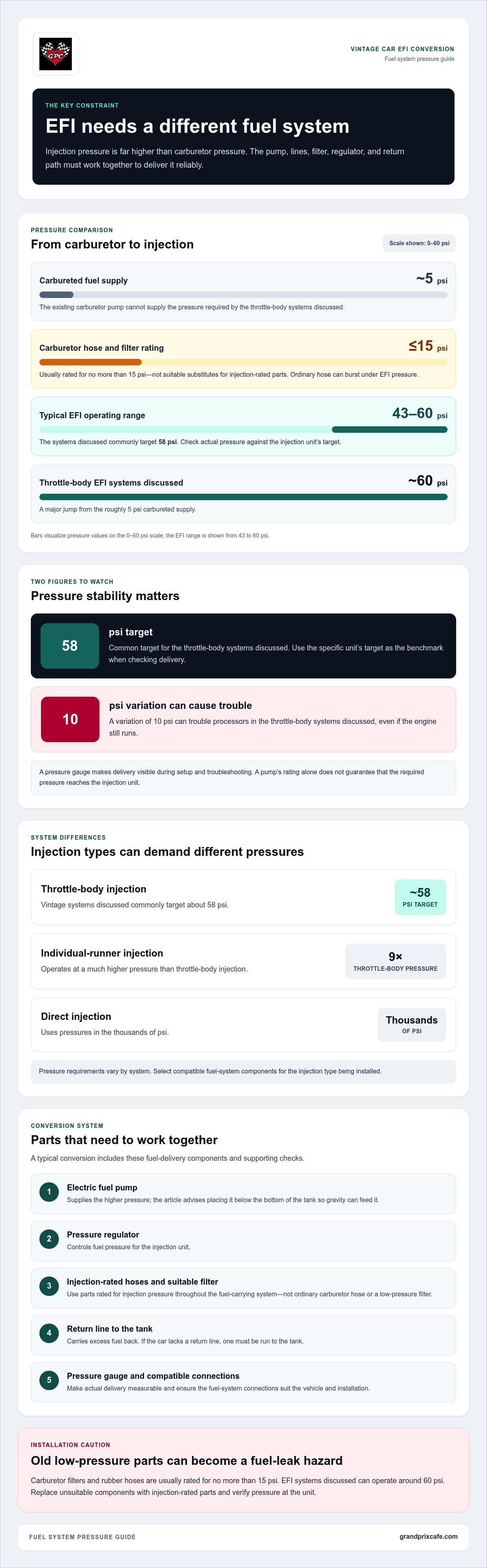
A carbureted fuel system supplies around 5 psi, while vintage throttle-body EFI systems need roughly 60 psi. That pressure difference means the pump, lines, filter, and return path must work as one system.
Pressure, Hoses, and Filters
EFI pressure is the force that delivers fuel consistently to the injectors. Typical EFI operating pressure ranges from 43 to 60 psi, while the systems discussed commonly target 58 psi. Individual-runner injection operates at 9X the pressure of throttle-body injection; direct injection uses pressures in the thousands of psi.
Those requirements affect every fuel-carrying component. Carburetor filters and rubber hoses are usually rated for no more than 15 psi, so they are not suitable substitutes for injection-rated parts. Use fuel-injection-rated hose sections throughout the system. Ordinary carburetor hose can burst under EFI pressure, turning an outdated line into a fuel-leak hazard.
Monitoring Fuel Pressure
Fuel-pressure monitoring checks whether the pump and regulator maintain the pressure the injection unit needs. A variation of 10 psi can trouble the processors in the throttle-body systems discussed, even when the engine still runs.
A pressure gauge makes the system’s actual delivery visible during setup and troubleshooting. Compare the reading with the unit’s target, usually 58 psi for the systems discussed, rather than assuming the pump’s rating guarantees that pressure at the unit. A clogged filter, restrictive line, or weak pump can reduce delivery. Stable readings help distinguish pressure problems from sensor or tuning faults.
Parts for the Conversion
What parts are needed to convert a vintage car from carburetion to fuel injection? A typical conversion needs an EFI unit, an electric fuel pump, a pressure regulator, injection-rated hoses, a suitable filter, and a return line. It also needs a way to monitor pressure and fuel-system connections compatible with the vehicle.
The existing carburetor pump supplies around 5 psi, so it cannot provide the roughly 60 psi required by the throttle-body systems discussed. An electric pump should sit below the bottom of the tank, allowing gravity to feed it. If the car lacks a return line, one must run back to the tank. These components work together: the pump supplies fuel, the regulator controls pressure, and the return path carries excess fuel back.
Choose parts as a matched system, not as isolated upgrades. Confirm the injection unit’s pressure target, then select the pump, regulator, filter, hose, and fittings to support it. A 58 psi target leaves little room for pressure variation, and ordinary carburetor lines can undermine the installation. The tank arrangement also matters because pump placement affects fuel supply. Taken together, these details determine whether the conversion can deliver steady pressure to the EFI unit.
Oxygen sensor placement and exhaust leaks
An EFI conversion depends on accurate sensor readings and reliable fuel delivery. In a vintage car, exhaust condition, oxygen-sensor angle, pump location, and the return-line route all affect how the system operates.
The oxygen sensor measures exhaust oxygen so the EFI system can adjust fueling. Conversion kits may include an oxygen sensor and an engine coolant temperature sensor. Installing the oxygen sensor requires tapping into one bank of the exhaust system. Choose a position where it can sample that bank’s exhaust and remain accessible for wiring and service.
Angle matters. Install the oxygen sensor at a minimum angle of 10 degrees to help prevent condensation from fouling it. A sensor positioned poorly can collect moisture, affecting its readings. The sensor’s location should also account for the exhaust layout, clearance, and wiring route. Those details are especially relevant on older vehicles, where exhaust components and routing may differ from modern factory arrangements.
Classic exhaust systems may not be sealed 100 percent from the cylinder heads to the exhaust tips. A leak can let outside air reach the sensor and distort its reading. The EFI controller may then interpret that reading as a fueling problem and adjust the mixture incorrectly. Inspect the exhaust path before relying on sensor feedback, particularly around joints and connections near the tapped section.
Electric fuel-pump placement matters in a vintage installation. Position the pump below the bottom of the fuel tank so gravity can feed it and support a steady fuel supply. Keep the pump away from direct exhaust heat, and consider heat exposure when routing or mounting fuel lines. A sound layout allows fuel to reach the pump while keeping it clear of nearby hot exhaust components.
The return line completes the fuel circuit by carrying fuel back to the tank. If the car lacks one, the conversion requires a line from the injection system to the tank. Route it securely, away from hot exhaust sections and moving parts. Plan its path around the tank and underbody, avoiding sharp bends that complicate installation.
Think of the sensor and fuel plumbing as connected parts of one conversion. For example, an oxygen sensor installed at the correct 10-degree minimum angle still can’t provide reliable feedback if an exhaust leak admits outside air. Likewise, a correctly routed return line doesn’t compensate for a pump positioned above the tank. Review the exhaust, pump position, and tank connections together before finalizing the installation.
Self-learning versus manual tuning
EFI tuning determines how the controller delivers fuel as engine conditions change. A self-learning system uses sensor feedback to adjust its fuel map, while manual tuning relies on a calibrator to make deliberate changes. Both methods need a suitable initial setup. The engine configuration, sensor readings, and base calibration all affect how well each approach works.
A wideband lambda sensor can provide feedback to help guide fuel tuning. At fixed engine-load and RPM conditions, it can target a 14.7:1 air-fuel ratio. The system compares the measured exhaust mixture with its target, then adjusts fuel values in the corresponding map area. This helps refine those operating points, but the target applies to the stated conditions, not every possible combination of load and RPM.
Self-learning can reduce repeated manual adjustments across the conditions a car encounters. It works best when the ECU has sound baseline settings and receives reliable sensor data. For example, a classic engine’s map should reflect its displacement, camshaft, intake arrangement, and fuel system. Incorrect inputs or a poorly configured base map can lead to unsuitable corrections instead of a precise calibration.
Manual tuning gives the calibrator direct control over fuel delivery and, where supported, ignition timing. This approach can account for a vintage engine’s specific components and operating behavior. It also lets the calibrator assess the effects of changes rather than relying only on automated corrections. The trade-off is that adjustments require technical knowledge and careful interpretation of sensor readings across the map.
Self-learning and manual tuning can work together. A tuner can establish the base calibration, let the ECU refine fueling at fixed load and RPM points, then review the resulting map and make deliberate changes. A wideband sensor provides useful feedback, but it cannot determine whether every adjustment suits the engine. This matters on modified engines, where a standard target may not suit every operating condition.
Ignition control is a separate consideration from fuel-map learning. One forum participant estimated that ignition-only upgrades delivered 75% of the advantages of full fuel injection on a Lotus twin-cam. That is an individual estimate, not a universal result, but it illustrates why some owners compare mappable ignition with a complete EFI installation. The choice depends on whether the goal is improved ignition control, electronic fuel delivery, or both.
For a vintage car, weigh tuning options against the intended use and engine specification. A self-learning system can support ongoing fuel adjustments, while manual calibration gives direct control over setup decisions. A combined approach uses both, letting sensor feedback inform further tuning without replacing it.
Conversion costs and professional installation
The kit is only one part of an EFI conversion budget. These figures describe different scopes and should not be added automatically.
What are the steps to install an EFI conversion kit? Assess the engine and system compatibility, install the EFI hardware, adapt fuel delivery, fit sensors, connect the ECU, and calibrate the engine. Finish by checking fuel pressure, connections, sensor signals, and engine operation under changing loads.
Installation labor depends on the vehicle’s existing layout. Accessible intake and tank connections can simplify the work, while restricted space or aged components may require fabrication or repair. A fuel injection conversion for vintage cars may need a pump, regulator, return line, pressure-rated hose, suitable filter, and fittings matched to the system.
Exhaust and electrical work also affect the scope. The oxygen sensor needs a suitable location and threaded fitting, while wiring must reliably connect the ECU, sensors, injectors, and pump. Calibration requires a base setup suited to the engine. Self-learning can refine fueling in supported conditions, while manual tuning allows direct adjustments. Include these labor and setup needs in the project estimate, rather than budgeting for the kit alone.
Before comparing estimates, define the work: kit, fuel-system parts, fabrication, wiring, exhaust changes, tuning, and troubleshooting. The project price depends on the vehicle and is provided after a quote request; cost factors include parts, modifications, and calibration. To discuss your vintage car, contact Grand Prix Cafe.
Grand Prix Cafe: Car Service
Grand Prix Cafe provides car service for classic and vintage vehicles in Southampton and the surrounding Long Island area. If you’re considering an EFI conversion, the engine’s condition is an important part of the decision. Addressing existing mechanical issues before changing fuel delivery helps you plan the work with a clearer understanding of the car.
Use this guide to frame your next steps: assess the engine, decide how much originality matters, and understand the fuel-system and tuning work involved. Grand Prix Cafe’s car service supports ongoing classic-car maintenance in Southampton and across Long Island. Classic Car Sales and Vehicle Consignment Services may also suit you if your plans for the vehicle change.
For car service or to discuss your classic car, contact Grand Prix Cafe in Southampton.
Make the Next Move With the Car in Mind
Before committing to a fuel injection conversion for a vintage car, decide what you want the vehicle to be: a regular driver, a preserved original, or a car you may sell. That purpose gives the technical choices direction and helps keep modifications in line with the vehicle’s future.
Grand Prix Cafe provides car service for classic-car owners in Southampton and the surrounding Long Island area. If your plans change, Classic Car Sales and Vehicle Consignment Services offer other ways to approach ownership. Choose the next step that fits the car’s condition and your priorities.
For a considered conversation about your vehicle and its next chapter, contact Grand Prix Cafe about your classic car. A clear plan can help you move forward with confidence.
Frequently Asked Questions
What are these new systems?
Aftermarket EFI systems replace carburetor-based fuel metering with electronically controlled injectors. Throttle-body systems position injectors at the intake, while individual-runner setups deliver fuel closer to each cylinder. A conversion also uses an electronic controller to interpret sensor inputs and manage fuel delivery. For a vintage engine, consider how each design suits its intake, intended use, and desired level of modification.
How much does a fuel injection conversion cost, including installation?
These estimates describe different cost scopes, so don’t add them automatically. Installation costs depend on the vehicle’s fuel-system layout, fabrication, wiring, and calibration requirements.
Is EFI or carburetor better for a vintage car?
EFI can suit owners who prioritize electronic fuel control and frequent driving; a carburetor may suit those who value original equipment and period-correct presentation. The decision depends on the car’s role, condition, and historical significance. For example, a show-focused vehicle may be better kept with its carburetor, while a regularly driven car may justify EFI. Neither system compensates for engine faults or poor maintenance.
Can a vintage car's stock fuel tank and fuel lines support EFI?
Sometimes, but the existing tank and lines must suit the selected EFI system. Assess the tank’s condition and pickup design, pump placement, and whether a return line can run back to the tank. Existing carburetor hose and filters may not tolerate injection pressure. For a car driven around Southampton or Long Island, plan the fuel plumbing as part of the conversion instead of assuming the original hardware is compatible.
What wiring, sensors, and ECU are required for an EFI conversion?
A typical setup needs an ECU, wiring harness, oxygen sensor, and engine coolant temperature sensor. The ECU uses sensor signals to manage fuel delivery; some aftermarket systems also use a wideband lambda sensor for tuning feedback. Wiring must reliably connect the controller, sensors, injectors, and fuel pump. Poor grounds, damaged connectors, or wires routed near heat can cause faults that resemble fueling problems.
What tuning or calibration is required after installing fuel injection?
Calibration sets the ECU parameters for the engine and its components. After installation, tuning should account for idle, steady cruising, and changes in engine load. The calibrator uses sensor readings to identify where fueling needs adjustment, then checks how the engine responds. Self-learning can assist with corrections, while manual tuning provides direct control over map changes and setup decisions.
What are the reliability, performance, and fuel economy benefits of EFI conversions?
EFI can improve starting consistency and adapt fuel delivery as operating conditions change. That may make a car easier to use in varying conditions, but it does not guarantee better fuel economy or more power. Results depend on engine health, calibration, and system fit. A worn engine, leaking exhaust, or incorrect setup can undermine performance, so consider the car’s condition alongside the conversion’s purpose.
Comments