


Air-Cooled Porsche Service on Long Island: What Owners Should Know
A useful service plan for an air-cooled Porsche starts with what has already been done to the car, not just its model or mileage. Its condition, history, and intended use all help determine what to assess. Routine maintenance may be straightforward, while earlier repairs or age-related concerns can call for closer inspection. That context matters when seeking air-cooled Porsche service Long Island.
This guide explains what makes service for an air-cooled Porsche distinct and what information helps shape a practical plan. You’ll learn how to distinguish routine maintenance and repair from restoration, prepare useful details about the car, and understand why an assessment should account for its individual condition and records.
Based in Southampton, Grand Prix Cafe provides car servicing, restoration, and accident repair for classic and high-end vehicles. The guidance below applies to owners throughout Southampton, Westhampton, East Hampton, Sag Harbor, Long Island, and Manhattan who want to make informed decisions about a classic Porsche.
Table of Contents
Why Air-Cooled Porsche Service on Long Island Calls for a Considered Approach
Good service starts with the individual car, not a generic maintenance checklist. An air-cooled Porsche’s design, condition, service history, and intended use all shape what it needs. A classic driven regularly may call for a different assessment from one returning to the road after a period in storage. Considering those details helps owners approach air-cooled Porsche service Long Island with a clearer sense of what to discuss.
What makes an air-cooled Porsche different to service?
In an air-cooled engine, airflow over the engine helps carry heat away, rather than relying on a liquid-coolant system and radiator. Porsche 911s and 356s are familiar examples, though the needs of a particular car depend on its model year, original specification, modifications, and current condition. Porsche’s 911 history provides context on its air-cooled engines and the model’s evolution.
That history has practical implications. A maintenance plan should reflect the car in front of the technician, including its records and how it’s used, rather than assume that every classic follows the same schedule as a modern daily driver. Use documentation for the specific model as the reference for service intervals and procedures.
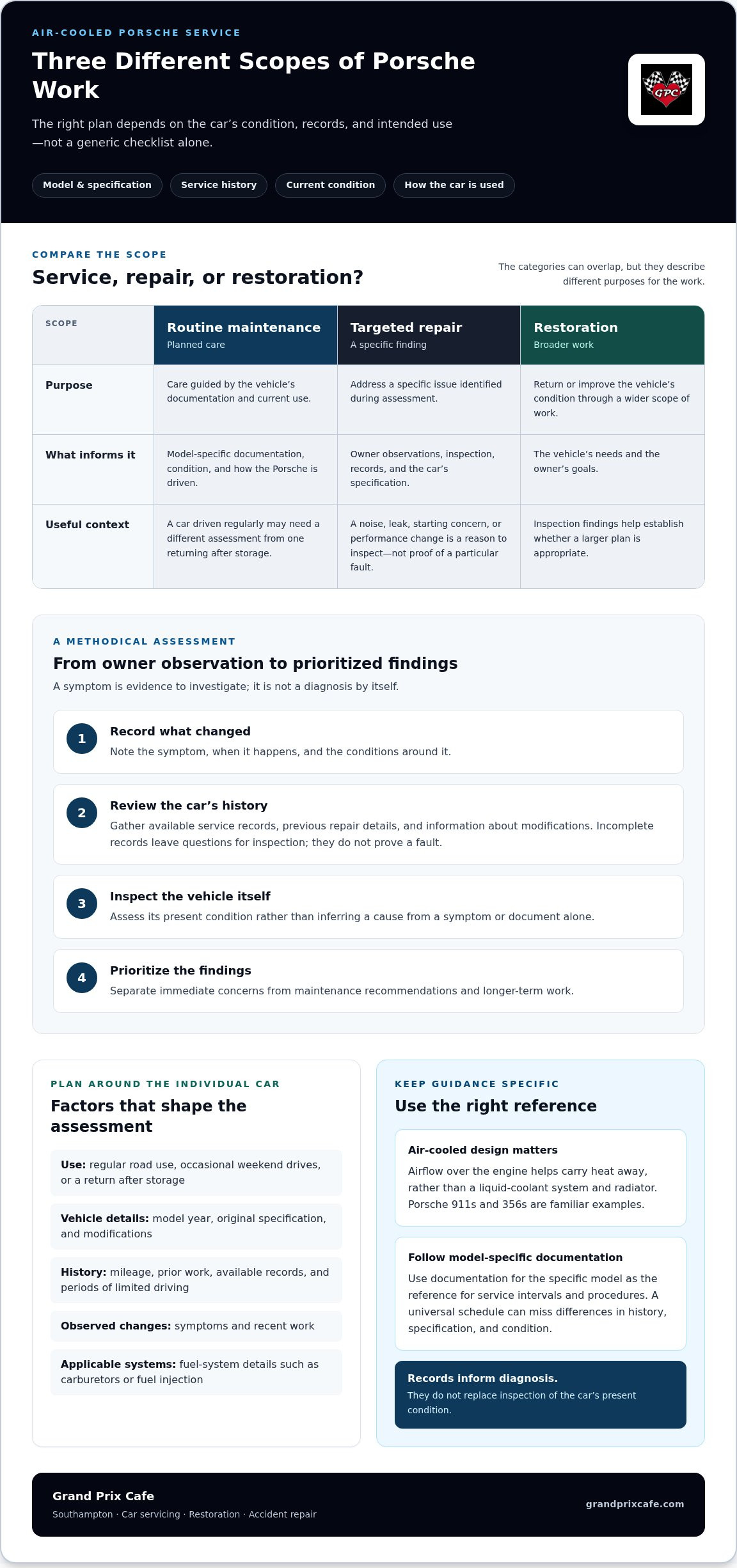
Air-cooled Porsche service is maintenance and repair guided by the car’s design, condition, and history, not a standard checklist alone.
It also helps to distinguish the work being considered:
Routine maintenance covers planned care based on the vehicle’s documentation and current use.
Diagnosis investigates a reported change or concern through observation and inspection.
Repair addresses a specific finding.
Restoration involves broader work to return or improve the vehicle’s condition, with the scope shaped by its needs and the owner’s goals.
These categories can overlap, but they aren’t interchangeable. Inspection findings help establish whether a concern calls for maintenance, a focused repair, or a larger restoration plan.
Which Long Island owners benefit from specialist attention?
Specialist attention can be useful whether you drive a classic regularly, reserve it for weekends, or are preparing it to return to the road. A new noise, fluid leak, starting concern, or change in performance is a reason to arrange an inspection, not proof of a particular fault. Note when the symptom occurs and any recent work so the assessment has useful context.
For owners in Southampton, Westhampton, East Hampton, Sag Harbor, and across Long Island, Grand Prix Cafe is a Southampton automotive center serving classic and high-end vehicles. Its car servicing, restoration, and accident repair address different needs while keeping the vehicle’s condition and history central to the work.
How Air-Cooled Porsche Systems Shape Maintenance and Diagnosis
A useful service plan is specific to the car. Model and specification provide a starting point, while mileage, storage, driving patterns, prior work, and present condition help determine what deserves attention. Two cars from the same year may have different histories or modifications, so a universal checklist or interval can miss important context.
Why service history matters on a classic Porsche
Records can show which work was completed, which parts or systems were changed, and when the car saw regular use or a long period of limited driving. Incomplete records don’t prove a fault, but they can leave questions for an inspection to address. Bring available invoices and notes, along with a clear account of recent symptoms. A model-specific reference, such as the Porsche Club of America’s 911 SC guide, can also help place a car within its particular generation.
Service history informs diagnosis, but it can’t replace inspection of the car’s present condition.
What can influence an air-cooled Porsche service plan?
How the car is used matters. Regular road use, occasional weekend drives, and a return to service after storage present different contexts. Mileage, storage conditions, specification, modifications, and observed changes also inform the assessment. Fuel-system details, such as carburetors or fuel injection, should be considered when they apply to that specific vehicle.
A methodical diagnosis moves through four steps:
Owner observations: Record what changed, when it happens, and under what conditions.
Vehicle history: Review available records, previous repairs, and modifications.
Inspection: Assess the car itself rather than infer a cause from a symptom or document.
Prioritized findings: Separate immediate concerns from maintenance recommendations and longer-term work.
This sequence helps keep recommendations proportionate. A noise, leak, or change in starting behavior is evidence to investigate, not a diagnosis by itself. Consider findings alongside the vehicle’s specification and appropriate technical references. Service intervals and procedures should follow model-specific documentation and verified guidance, not a schedule applied indiscriminately across every air-cooled Porsche.
For owners considering air-cooled Porsche service Long Island, Grand Prix Cafe’s Southampton location provides car servicing for classic and high-end vehicles, with restoration and repair needs considered in the context of the car. Explore classic-car service in Southampton when planning care for a vehicle with a distinct history.
Service, Repair, or Restoration: Choosing the Right Scope for Your Porsche
These terms describe different levels of work. A car may need routine upkeep, investigation of a specific concern, or a broader restoration plan. Separating the scopes helps owners explain their priorities and avoid treating every symptom as evidence that a major project is needed.
When is routine service different from repair?
Routine service is planned care. Repair begins with a change that needs investigation. A new noise, leak, starting concern, or performance change can prompt an inspection, but none identifies its own cause. Describe when the symptom occurs, whether it has changed, and any relevant recent work. Inspection findings, not assumptions, should determine whether a repair is recommended and how narrowly it can be scoped.
For owners seeking air-cooled Porsche service Long Island, this distinction supports a focused discussion. The concern can be assessed alongside the car’s records and overall condition before next steps are set. The golden era of air-cooled Porsches includes distinct models and specifications, another reason to consider the particular vehicle rather than assume one plan fits all.
When might restoration become part of the conversation?
Restoration is broader than resolving one symptom. It may address the vehicle’s overall condition, integrity, and the owner’s goals for its future. A service or diagnostic visit can identify concerns and help clarify priorities without committing the owner to restoration. If findings point to a wider scope, that work can be considered as a separate project. Grand Prix Cafe’s overview of vintage car restoration in New York explains this broader approach.
Sequence matters. Findings can help distinguish work to address first from maintenance that can be planned and longer-term restoration objectives. Owners weighing those categories can also consult this classic car mechanic service guide for related mechanical-care context. A clear scope keeps decisions grounded in the car’s needs and the owner’s priorities.
Preparing for Air-Cooled Porsche Service in the Hamptons
A clear account of the car’s use and history gives a service discussion a stronger starting point. For owners arranging air-cooled Porsche service Long Island, preparation doesn’t require a technical diagnosis. Record what you’ve observed and gather the details that help put the concern in context.
What information should owners bring to a service discussion?
Gather the information you have, even if the vehicle’s history is incomplete. Separate what you’ve personally noticed from explanations offered by a previous owner or technician. A symptom’s timing and conditions can help frame inspection priorities without establishing its cause.
Identify the car. Note its model, model year, and known specification. Include modifications or changes from its original configuration.
Bring available records. Service invoices, prior repair notes, and maintenance records can show what work has been completed.
Describe the concern. Record what changed, when it began, how often it occurs, and the driving conditions at the time.
Summarize recent work. Note recent service, repairs, or modifications. Their timing is useful context, but doesn’t establish that they caused the concern.
Explain the use pattern. Mention whether the car is driven regularly, used seasonally, or returning to the road after a period of limited use.
Specific observations are more useful than guesses. For example, describe when a sound occurs or how a starting concern has changed instead of assigning a mechanical cause before inspection.
How can seasonal use affect service planning?
A Porsche used regularly around Long Island has a different use history from a weekend car driven mainly during warmer months. Time in storage, frequency of outings, and the conditions in which the car is kept can all help frame what an inspection should consider. They aren’t diagnoses on their own, and they don’t establish a universal maintenance requirement.
Share the timeline plainly: when the car was last driven, how often it has been used, and whether its use or storage pattern changed. Recommendations should still reflect the individual vehicle’s condition and appropriate model-specific guidance. Avoid applying a general storage or service prescription without considering the car’s specification and history.
Grand Prix Cafe is based in Southampton and serves classic and high-end vehicles across the Hamptons and Long Island. Owners can plan classic-car service in Southampton with relevant records and observations ready for a more informed discussion.
Air-Cooled Porsche Service at Grand Prix Cafe in Southampton
For Long Island owners considering air-cooled Porsche service, a local setting makes it easier to discuss the car’s needs. Grand Prix Cafe is a Southampton automotive center serving classic and high-end vehicles across the Hamptons and the wider Long Island area, as well as Manhattan. Its work includes car servicing, restoration, and accident repair, giving owners a place to discuss the appropriate scope of care for their vehicle.
A local setting for classic-car service
Classic vehicles benefit from an approach that takes their condition and history into account. At Grand Prix Cafe, service, repair, and restoration address distinct needs, even when they concern the same car. Routine servicing covers maintenance; repair responds to a specific finding; restoration involves a broader project shaped by the vehicle’s condition and the owner’s objectives.
This perspective is useful whether a Porsche is driven regularly, reserved for occasional outings, or being assessed after a change in condition. Rather than assume the scope from a symptom alone, start with what you’ve observed and what is known about the car. That keeps the discussion centered on the vehicle without presuming a cause or recommending a larger project before its needs are understood.
Plan your next service conversation
Before discussing the car, gather its model and year, available service records, notes on prior work, and a concise description of any concern. Include when a symptom occurs, whether it has changed, and how the Porsche is used. If your records are incomplete, share what you do know. Distinguishing firsthand observations from previous diagnoses helps keep the discussion grounded.
Your goals matter, too. You may be seeking routine service, attention to a particular concern, or an assessment of broader restoration needs. Sharing those priorities helps frame the next practical step. Grand Prix Cafe’s Southampton location is a local resource for classic-car owners in the Hamptons and across Long Island.
To discuss your vehicle’s service needs with Grand Prix Cafe, share your Porsche’s details and service history.
Make a Thoughtful Plan for Your Porsche
Care for an air-cooled Porsche starts with the individual car. Its model, condition, records, and use help shape a useful service plan. A new symptom is a reason to investigate, not a diagnosis; inspection findings can help distinguish routine maintenance from a targeted repair or broader restoration.
Before discussing service, gather the records you have and describe the concern, when it occurs, and how the car is driven or stored. That context can help keep the conversation focused on the vehicle’s needs and your priorities.
For owners seeking air-cooled Porsche service Long Island, Grand Prix Cafe is a Southampton-based automotive center serving classic and high-end vehicles. Its work includes car servicing, restoration, and accident repair for vintage vehicles.
Discuss your air-cooled Porsche service needs with Grand Prix Cafe and take the next step with your car’s history and goals in view. A clear, considered plan can help you care for your Porsche with confidence.
Frequently Asked Questions
What is different about servicing an air-cooled Porsche?
An air-cooled Porsche relies on airflow to carry heat away from the engine rather than a liquid-coolant system and radiator. Its service needs depend on the specific model, year, specification, modifications, condition, and service history. That’s why routine care shouldn’t be based on a modern-car checklist alone. Use vehicle-specific documentation to guide maintenance recommendations, and treat changes in sound, starting, or performance as reasons to investigate rather than diagnoses.
How often should an air-cooled Porsche be serviced?
There isn’t one service interval that applies to every air-cooled Porsche. Follow the maintenance schedule in the documentation for the specific model and consider its current condition, mileage, history, and use. A car driven regularly may have a different service context from one used occasionally or returning to the road after storage. If records are incomplete, an inspection can help establish the car’s present condition and inform a practical plan.
Can a general mechanic service an air-cooled Porsche?
A general mechanic may be able to service one, but broad automotive experience alone doesn’t establish familiarity with a particular air-cooled Porsche’s design and specification. Service recommendations should reflect the vehicle’s documentation, condition, and history. For Long Island owners, Grand Prix Cafe in Southampton provides car servicing for classic and high-end vehicles, along with restoration and accident repair. A focused assessment helps distinguish scheduled care from work prompted by a specific concern.
What should I tell a mechanic before an air-cooled Porsche inspection?
Share the car’s model and year, available service records, prior repair notes, and any modifications. Describe what you’ve observed, when it happens, how often, and under what driving conditions. Mention recent work and whether the car is driven regularly, seasonally, or after a period of limited use. Separate firsthand observations from an earlier diagnosis. These details give the inspection useful context without presuming what caused the concern.
How do I know whether my Porsche needs service, repair, or restoration?
Routine service is planned maintenance based on the vehicle’s needs and model-specific guidance. Repair addresses a particular concern after diagnosis identifies what requires attention. Restoration is a broader project shaped by the car’s condition and your goals for it. A new noise, leak, or change in performance is a reason to investigate, not evidence by itself that restoration is needed. Inspection findings and your priorities help define the appropriate scope.
Where can I get air-cooled Porsche service on Long Island?
Grand Prix Cafe is a Southampton, New York, automotive center serving classic and high-end vehicles in the Hamptons and across Long Island, including owners in Southampton, Westhampton, East Hampton, and Sag Harbor. Its work includes car servicing, restoration, and accident repair for vintage vehicles. Owners can bring the car’s records, details, and concerns to frame a focused service discussion. Grand Prix Cafe also serves owners from Manhattan seeking classic-car care.
Can seasonal use or storage affect air-cooled Porsche maintenance?
Yes. Seasonal driving and time in storage are useful context when planning an inspection, but neither automatically indicates a fault or a particular maintenance need. Share when the Porsche was last driven, how often it’s used, how long it was stored, and whether its use pattern has changed. Recommendations should still be based on the car’s current condition and model-specific documentation, rather than a universal storage or service prescription.
Comments