


How to get a classic car started after storage in Southampton
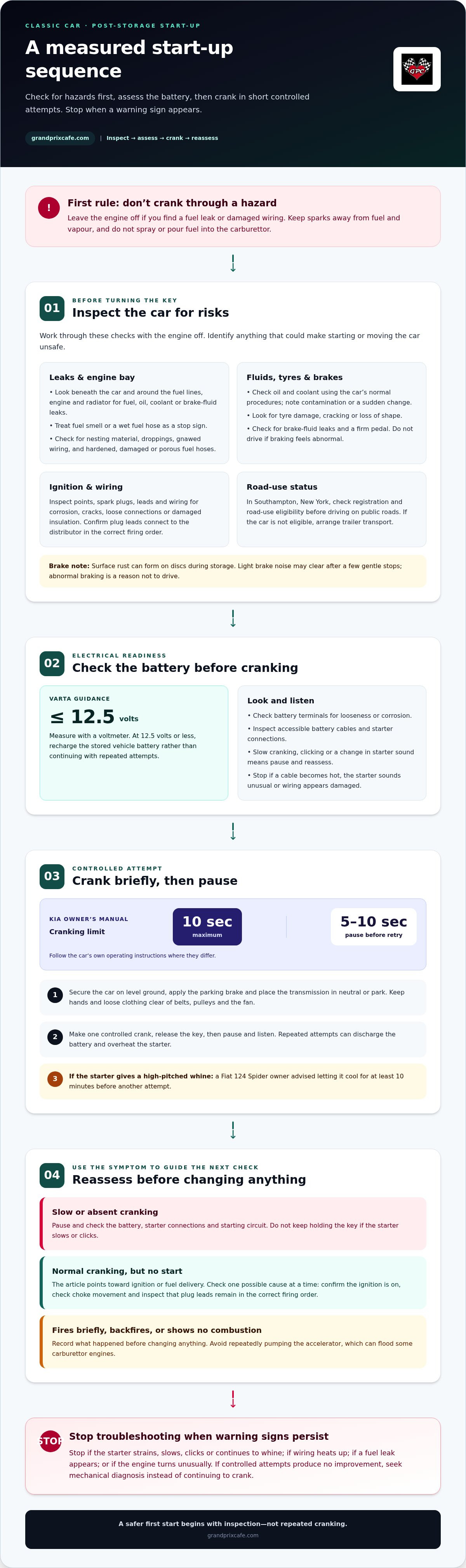
A stored classic that won’t start should be checked before you keep cranking it. For classic-car help in Southampton when a car won’t start after storage, begin with visible leaks, the battery, fuel hoses and the choke, then investigate fuel delivery and ignition if those checks are sound. According to VARTA, recharge a stored vehicle battery when its voltage is 12.5 volts or less.
A flat battery is a common suspect, but stale fuel, hardened hoses, or a carburettor that isn’t drawing fuel can also stop a classic car from starting after storage. Brief idling is not a reliable storage routine: either drive the car until it reaches operating temperature or leave it stored.
This guide walks through a measured start-up sequence, explains how to narrow down common fuel and carburettor faults, and shows when to stop troubleshooting. It also covers preparing a classic for storage without relying on short idle runs, so the next start begins with sensible checks rather than guesswork.
Table of Contents
Pre-start checks for leaks, rodents, fluids, tyres, brakes, and battery
Before turning the key, inspect the car from the ground up and identify anything that could make starting unsafe. Work through the checks in sequence, and leave the engine off if you find a fuel leak or damaged wiring.
In Southampton, New York, check the car’s registration and road-use status before driving on public roads. If it isn’t eligible for road use, arrange trailer transport instead.
Inspect the ignition points, spark plugs, and wiring for corrosion, cracks, loose connections, or damaged insulation. Check that the spark-plug leads connect to the distributor in the correct firing order and that the ignition points are clean and properly connected.
Check for leaks, rodents, fluids, tyres and brakes
Before starting the engine, inspect the ground around and beneath the car. Look for fresh fuel, oil, coolant, or brake-fluid leaks, and check the engine bay for nesting material, droppings, or gnawed wiring. Hardened, damaged, or porous fuel hoses need attention before the engine runs.
Use a light to inspect beneath the engine, fuel lines, and radiator. Treat a fuel smell or wet fuel hose as a reason to stop, not as a fault to investigate with the engine running.
Check the oil and coolant levels using the car’s normal procedures. Look for signs of contamination or a sudden change from the car’s known condition.
Inspect each tyre for visible damage, cracking, or loss of shape. Check the brakes for fluid leaks and confirm the pedal feels firm before moving the car.
Surface rust can form on brake discs during storage. Light brake noise may clear after a few gentle stops, but do not drive if braking feels abnormal.
Inspect the battery and starter
Check the battery terminals for looseness or corrosion, then assess the battery before attempting to start. VARTA advises recharging a stored vehicle battery when its voltage is 12.5 volts or less. Repeated cranking can drain a weak battery and place extra strain on the starter, especially when the engine doesn’t fire.
Use a voltmeter to measure battery voltage before cranking. At 12.5 volts or less, recharge the battery rather than continuing with repeated attempts.
Listen to the starter during a brief attempt. Slow cranking, clicking, or a change in sound suggests you should pause and reassess instead of holding the key.
Inspect accessible battery cables and starter connections for looseness or corrosion. Stop if a cable becomes hot, the starter emits an unusual sound, or wiring appears damaged.
Safe cranking and starting a carburettor car
Start only when the car is secure, the checks are complete, and the transmission is in neutral or park. Troubleshoot in short, controlled stages. Stop if the starter strains, wiring heats up, fuel leaks, or the engine makes an unusual noise.
Crank safely and allow the starter to cool
Turn the ignition key for a brief attempt, then release it and listen to the starter. A Kia owner’s manual sets a ten-second cranking limit and recommends a 5 to 10 second pause before another attempt. Follow the car’s own operating instructions where they differ, and don’t hold the key continuously while the engine fails to fire.
Secure the car on level ground, apply the parking brake, and place the transmission in neutral or park. Keep loose clothing and hands clear of belts, pulleys, and the fan while cranking.
Use a controlled crank of no more than ten seconds, then pause for 5 to 10 seconds before reassessing. Repeated attempts can discharge the battery and overheat the starter, leaving less power for diagnosis.
Listen for a change in sound. If the starter produces a high-pitched whine, a Fiat 124 Spider owner advised letting it cool for at least 10 minutes before another attempt.
Stop cranking if the starter slows, clicks, or continues to whine. A pause won’t correct a mechanical fault, poor electrical connection, or inadequate battery charge.
Troubleshoot the starting problem safely
Check one possible cause at a time rather than changing several settings between attempts. Normal cranking without the engine firing points toward ignition or fuel delivery; slow or absent cranking calls for attention to the starting circuit. Keep sparks away from fuel and vapour, and don’t spray or pour fuel into the carburettor.
Confirm the ignition is switched on and the choke operates as intended for the car. Avoid pumping the accelerator repeatedly, which can flood some carburettor engines.
Check that spark-plug leads remain connected in the correct firing order. Inspect accessible wiring for loose connections or damaged insulation, and leave live ignition testing to someone equipped to perform it safely.
Notice whether the engine fires briefly, backfires, or shows no sign of combustion. Record the symptom before changing anything; it helps distinguish fuel delivery from ignition faults.
Stop and seek mechanical diagnosis if controlled attempts produce no improvement, fuel leaks appear, or the engine turns unusually. Persistent cranking can compound battery and starter strain without resolving the underlying problem.
For future storage, consider year-round indoor car storage as a way to keep the vehicle housed between drives.
Fuel delivery and carburettor priming after storage
Trace fuel delivery from the pump to the carburettor before changing any adjustments. A weak supply, sticking choke mechanism, or carburettor fault can each prevent combustion.
Check the choke movement. Operate the control while observing the mechanism. On the relevant carburettor design, the choke should pull the main jet holders down. If the holders don’t move, inspect the linkage for disconnection, binding, or incorrect adjustment before attempting another start.
Listen to the electric fuel pump. Switch on the ignition and note whether an SU pump operates consistently. Erratic operation can result from burned internal contacts; badly burned contacts should be replaced. Don’t assume the sound alone proves fuel is reaching the carburettor. A pump can operate while delivery remains inadequate.
Inspect accessible fuel lines and connections. Follow the line from the tank toward the pump and carburettor. Look for loose fittings, visible damage, or signs of leakage. A damaged or porous hose can compromise delivery, so don’t continue cranking with a suspected leak. Avoid adjusting the carburettor to compensate for a supply fault.
Assess fuel flow before dismantling components. A fuel-delivery test can be made by disconnecting the hose to the carburettors, placing its end in a petrol can, and switching on the ignition. This exposes petrol, so leave the test to a mechanic if you can’t control the procedure and contain the fuel safely. The observed flow helps distinguish pump delivery from a carburettor-side problem.
Prime only by the method suited to the car. Carburettor layouts differ, so identify the correct priming procedure for the specific model before operating a hand primer or altering a linkage. Don’t pour petrol into the carburettor throat. If the float chamber isn’t filling, find the cause rather than forcing fuel into the intake.
Separate fuel faults from ignition faults. If the pump delivers fuel and the choke moves correctly, further cranking may not solve the problem. Check the next diagnostic stage instead of repeatedly adjusting mixture screws. A fault in ignition, carburettor condition, or fuel passage may need direct inspection.
Note each observation, including pump behaviour, choke movement, and whether fuel reaches the carburettor. These details help focus diagnosis and avoid replacing parts without evidence.
Keep this check focused on what it establishes: with the hose disconnected from the carburettors and its end placed in a petrol can, switching on the ignition lets you observe the fuel pump’s flow. Treat this as an observation of delivery through the hose, not as a carburettor adjustment or priming method. Record whether fuel flows during the check. This helps direct attention toward fuel delivery or the carburettor, but does not by itself identify every possible cause of a starting problem. Separating this observation from adjustments helps assess the supply before changing settings, and avoids treating the presence or absence of flow as a reason to force fuel into the intake.
Storage preparation and periodically starting the car
Prepare a classic car for the length and conditions of its storage, not just for its next start. Use these steps to record its condition and establish a consistent routine.
Record the car’s baseline before storage. Note how the engine starts, how it idles, and whether there are existing leaks or unusual sounds. Keep the notes with the car’s service records. At the next inspection, compare its condition with that record instead of relying on memory.
Review the fuel system and battery condition. Inspect hoses, connections, and accessible wiring before the car is left unused. Check battery condition as part of the preparation, and decide how it will be maintained during storage. A starting problem can be harder to diagnose if the car’s last known condition was never recorded.
Choose a storage routine before leaving the car. One Fiat 124 Spider owner reported avoiding a later starting problem by starting the car monthly during winter storage. Treat that as one owner’s experience, not a universal maintenance schedule. The vehicle’s design, condition, and storage environment all affect what routine makes sense.
Don’t confuse a brief start with a completed warm-up. A Fiat 124 Spider owner reported a smooth start after an absence of 8 weeks, having started the car before leaving and after returning. Another owner reported running the car for 2 minutes before leaving. These are individual accounts, not proof that short idling suits every classic.
Consider model-specific behaviour during long storage. One Fiat 124 Spider owner reported that the 1.4 L Multi-Air engine can lose oil compression during extended storage. That experience illustrates why engine design matters. Record the model and any known storage-related characteristics, then follow the appropriate maintenance procedure for that car.
Set a clear inspection point for the return. Before restarting, repeat the visual checks and note any changes since storage. If the car has stood through winter, compare fuel-system, battery, and engine observations with the original record. This gives each start attempt a purpose and helps identify a developing fault early.
Treat owner reports as context, not as a substitute for the car’s maintenance requirements. The practical choice is to leave the vehicle stored or give it a complete, appropriate warm-up, rather than starting it briefly without a plan.
Why brief winter idling can harm a stored car
Choose a routine that either leaves the car undisturbed or brings it fully up to temperature on a drive. Starting it every few weeks for a brief idle can leave the engine only partly warmed while adding another cold-start cycle.
Avoid short idle-only runs. The guide advises against starting a stored classic every few weeks just to let it idle briefly. A brief run may warm the engine unevenly and leave moisture in the system, rather than completing a proper operating cycle. If you can’t take the car for a suitable drive, leaving it stored is the advised alternative.
Understand what “fully warm” means. A rising temperature gauge alone doesn’t show that every part of the engine and exhaust has reached operating temperature. On a short stationary run, coolant may warm before the oil and exhaust system. Choose a drive that allows the car to reach full operating temperature, rather than switching off as soon as it starts running smoothly.
Don’t treat a reported schedule as a universal rule. One Fiat 124 Spider owner said their dealer recommended running the stored car for about 15 minutes every 2 weeks. That is a reported recommendation, but the guide’s general advice is against brief idling every few weeks. Use the vehicle’s maintenance guidance and storage plan, not an isolated anecdote, to shape the routine.
Decide before winter begins. Write down whether the car will remain stored or receive a proper warm-up drive. Check that the route and conditions allow safe operation before setting out. If the vehicle can’t be driven appropriately, don’t start it merely to hear it run; keep it stored and follow its preparation routine.
Record each storage decision. Note the date of the last full drive, the next inspection, and any change in starting behaviour. If a later no-start occurs, the record helps distinguish a new fault from a recurring storage pattern. Avoid using repeated short starts as a substitute for diagnosis.
Prepare the car for the chosen approach. Before leaving it stored, complete the relevant checks for its fuel system, battery, and condition. Before a full warm-up drive, confirm it is safe to operate. The purpose is a considered routine, not repeated cranking or idling without a clear maintenance reason.
For a storage plan that avoids unnecessary brief starts, consider year-round indoor car storage.
One Fiat 124 Spider owner reported starting after nearly 6 months, following repeated 10-second cranking attempts with pauses. Another owner reported a start after 8.5 months on attempt 30, cooling the starter between attempts.
Grand Prix Cafe: Car Service
Grand Prix Cafe provides car service for owners whose classic remains difficult to start after storage. Turn to the service when initial checks haven’t identified the fault, the fuel or ignition system needs further assessment, or continued cranking risks adding strain. A clear record of symptoms, storage conditions, and completed checks can help focus the assessment.
For a car between drives, year-round indoor car storage provides a dedicated place to keep it during storage periods. Car service addresses maintenance needs when they arise. These options suit different stages of ownership: preparation and preservation, followed by assessment if a starting fault persists.
To discuss car service for your classic, contact Grand Prix Cafe.
Make the next start a considered one
A stored classic needs a diagnosis based on its condition, not repeated starting attempts. If your classic car won’t start after storage, help in Southampton starts with a clear account of what happens during cranking, what you have inspected, and how the car was stored. This gives the next assessment a useful starting point.
Grand Prix Cafe provides car service for owners dealing with a persistent starting fault. Its classic car sales and vehicle consignment services can also help owners considering a change in their relationship with a vehicle. Choose the next step that fits your car and your plans for it.
Contact Grand Prix Cafe for help with your classic car. A careful approach can put you on a sound path toward its next drive.
Frequently Asked Questions
What are the most common reasons a classic car won't start after long-term storage?
Common causes include faults in the fuel, ignition, or battery systems, as well as insufficient engine compression. If your classic car won’t start after storage, help in Southampton can begin by identifying whether the engine cranks, fires briefly, or shows no sign of combustion. That distinction narrows the diagnostic path. Valve clearances that are too small or absent can also reduce compression and prevent starting.
How can I check stale fuel, clogged fuel lines, and a stuck carburetor after storage?
Check the storage record for the fuel’s age and any previous running problems. Look for deposits in accessible fuel-system components, and note whether the carburettor’s moving parts operate freely without force. If the engine still won’t run, have the carburettor passages and fuel lines assessed together, since a restriction can resemble a carburettor fault. Avoid probing precision jets with wire, which can alter their openings.
What should I check before cranking a classic car that has been stored for years?
Alongside basic safety checks, review the car’s maintenance history for the last oil service, engine work, and known starting issues. Check the model’s workshop guidance for any procedure needed before its first start after prolonged inactivity. Some engines may need oil pressure primed before starting, as reported in a Fiat 124 Spider case. Don’t treat that example as universal; engine design determines the correct preparation.
Which Southampton mechanics specialize in classic or vintage car repairs?
For Southampton owners looking for help when a classic car won’t start after storage, Grand Prix Cafe provides car service for high-end and vintage models. Its automotive services also include car restoration, making it a local option when a stored classic needs diagnosis or repair beyond basic owner checks. Describe the car’s model, storage history, and symptoms to help frame the service it needs.
Comments