


Benefits of Professional Car Storage vs. a Home Garage
The benefits of professional car storage vs garage depend on more than whether a vehicle is kept indoors. Temperature and humidity, security, oversight, maintenance needs, and how often you want access all matter, especially for a classic or collectible car.
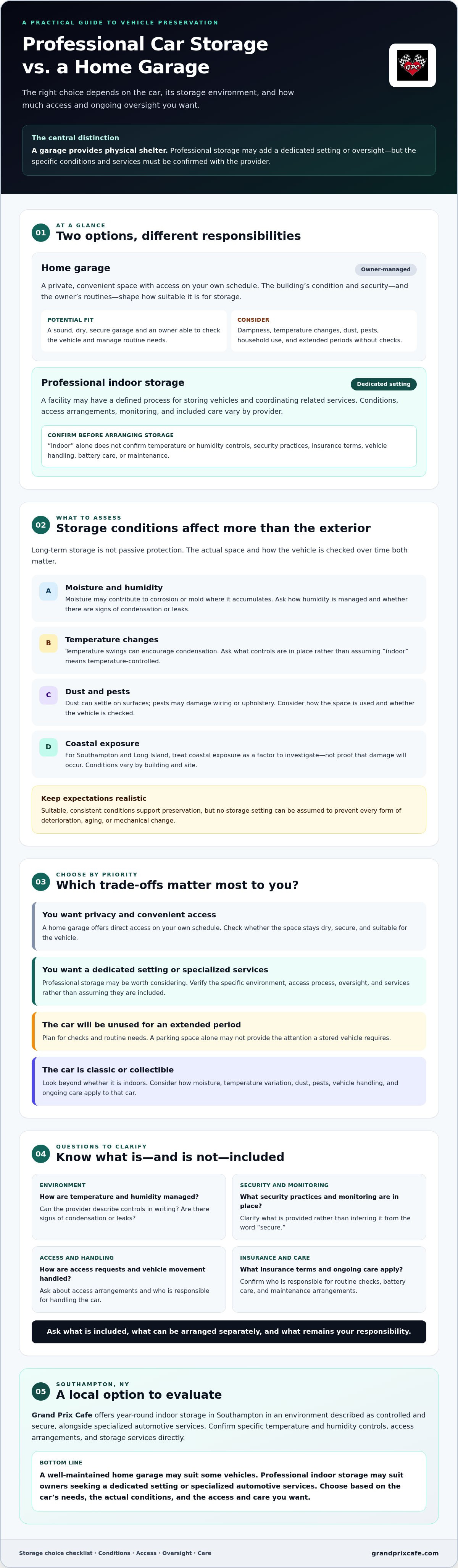
A home garage offers privacy and convenience, with access on your own schedule. Its conditions and security depend on the building and how it is used, and a car left unused for an extended period may need more attention than a parking space alone provides. Professional storage offers a dedicated setting, but conditions, access arrangements, and included services vary by provider.
This guide compares the protection, oversight, and practical trade-offs of both options. It also outlines questions to ask about temperature and humidity, monitoring, insurance, vehicle handling, access, and maintenance. Grand Prix Cafe in Southampton offers year-round indoor storage in a controlled, secure environment, alongside specialized automotive services. Whether you store a car in Southampton, Westhampton, East Hampton, Sag Harbor, elsewhere on Long Island, or travel from Manhattan, your decision should fit the car’s needs and the access you want.
Benefits of Professional Car Storage vs Garage: Table of Contents
Professional Car Storage vs. a Garage: What Is the Real Difference?
Professional car storage is a dedicated service for keeping vehicles at a facility. With a home garage, the owner manages the space and the vehicle’s routine needs, including checks on the car and storage conditions. Either option can work. The right fit depends on the vehicle’s value and condition, the setting, and how much responsibility you want to manage yourself.
A garage provides physical shelter; professional storage may add oversight, but the scope of that oversight must be confirmed. “Indoor” describes where a vehicle is kept. It does not, by itself, confirm temperature or humidity controls, monitoring, insurance terms, access arrangements, battery care, or maintenance. Ask what is included, what can be arranged separately, and what remains your responsibility.
What professional car storage can add beyond enclosed parking
A dedicated facility may have a defined process for storing vehicles and coordinating related services. Ask how the provider handles vehicle movement, routine checks, access requests, and maintenance arrangements. Grand Prix Cafe in Southampton offers year-round indoor storage in an environment described as controlled and secure. Confirm specific environmental controls and storage services directly, rather than assuming they are part of the arrangement. For more context on selecting a facility, see this professional indoor car storage guide.
Storage is also different from repair. Preserving a vehicle’s original components is not the same task as restoring or replacing them. This overview of vehicle preservation and restoration explains the distinction. Choose storage that supports the vehicle’s condition and intended care, but don’t assume a facility automatically includes maintenance.
When a home garage may be a reasonable choice
A sound, dry, secure garage may suit an owner who can check the vehicle and manage its routine needs. Garages differ, though. Dampness, temperature changes, dust, pests, and household use can all affect whether a space is suitable, particularly during extended storage. A garage used for household equipment or frequent access may expose the car to different conditions than a dedicated, well-maintained space.
When weighing the benefits of professional car storage vs garage, consider who will manage the details. A home garage gives you direct access and control. Professional storage may suit owners seeking a dedicated setting or access to specialized automotive services, provided the conditions and responsibilities are clear before they make arrangements.
How Storage Conditions Affect a Classic or Collectible Car
Long-term storage is not passive protection. Conditions around a vehicle can affect its finish, metal components, interior materials, and overall condition. Moisture may contribute to corrosion or mold where it accumulates. Temperature swings can encourage condensation, while dust can settle on surfaces and pests may damage wiring or upholstery. The risk depends on the car and the space, so no storage setting should be assumed to prevent every form of deterioration.
Consistent, suitable storage conditions support preservation, but they cannot stop every form of aging or mechanical change. Hagerty’s expert car storage tips offer further guidance on preparing a classic for storage, including attention to humidity. When comparing the benefits of professional car storage vs garage, look beyond whether the vehicle is indoors. The key questions are whether the actual environment suits the car and how it will be checked over time.
Humidity, temperature changes, and coastal exposure
Southampton and Long Island’s coastal setting makes it sensible to ask about moisture and conditions at the specific site. Proximity to the coast alone does not establish that a car will be damaged; buildings and exposure vary. Ask how temperature and humidity are managed, whether the facility can describe its controls in writing, and whether there are signs of condensation or leaks. Grand Prix Cafe describes its year-round indoor storage environment as controlled and secure. Confirm specific temperature and humidity controls directly.
Dust, pests, and the condition of the storage space
A clean, maintained space can reduce exposure to dust and make signs of leaks or pests easier to notice. That does not mean every facility or home garage is pest-proof. Ask how often the storage area is inspected and what pest-management practices are in place. At home, check for gaps, stored materials, and evidence of moisture or pests. Consider whether the garage’s everyday use could affect the car.
A cover may help limit dust, but it is not automatically appropriate for every vehicle. The material, fit, and condition of the car’s finish matter; trapped moisture or an abrasive cover can cause problems. Confirm the right approach for the specific vehicle rather than covering it by default. Owners considering year-round indoor storage in Southampton can review Grand Prix Cafe’s automotive services and ask about facility-specific conditions.
Compare Professional Storage and a Home Garage by Your Priorities
The choice is not simply between a facility and a driveway. Consider how often you use the vehicle, its condition, and who will manage its care during storage. A suitable home garage may be enough if you can check the car regularly. A professional facility may suit someone seeking a dedicated storage setting or access to specialized automotive services. Neither option removes the need to understand the conditions and responsibilities involved.
Which option fits your vehicle and storage period?
Match the arrangement to the car’s value, condition, frequency of use, and planned storage duration. A vehicle driven regularly may call for a different balance of access and oversight than a seasonal car that will sit unused for an extended period. Consider current needs, including known mechanical or preservation concerns, and seek specialist advice where appropriate. The benefits of professional car storage vs garage depend on the vehicle and the arrangements available, not on a universal rule for every collector.
What convenience and oversight mean in practice
A home garage usually keeps the vehicle immediately accessible to its owner. At a facility, access depends on its procedures, so ask how visits or vehicle retrieval are arranged before deciding. Likewise, don’t assume staff will move, check, or service a car unless the provider confirms those responsibilities. Grand Prix Cafe offers year-round indoor storage in a controlled, secure environment, as well as car service. Confirm directly which arrangements apply to your vehicle. Owners considering broader mechanical care can read about a classic car mechanic in Southampton.
Questions to Ask Before Choosing Car Storage in the Hamptons
A clear agreement matters as much as the storage space. Before choosing a provider, ask how the vehicle will be stored, who is responsible for its care, and what happens when you need access. Request written details about services, vehicle handling, and additional arrangements so you can compare them with your car’s needs and your own insurance terms.
Facility conditions, access, and responsibility
“Controlled environment” can mean different things. Ask for specifics rather than assuming temperature or humidity are monitored. For a facility in Southampton or elsewhere in the Hamptons, an in-person discussion can also help you assess the location and plan for seasonal access.
Conditions: What does the stated environment mean in practice? Are temperature or humidity monitored, and can the provider share details in writing?
Access and movement: What are the access hours and procedures? Who may move the vehicle, under what circumstances, and how is that handling documented?
Security: What security practices are in place, and what monitoring, if any, is provided? Ask for an accurate description rather than relying on general assurances.
Insurance: What coverage or insurance requirements apply to the storage arrangement? Review the terms with the provider and your own insurer, including any coverage boundaries.
Responsibilities: Which checks and care tasks fall to the owner, and which, if any, are part of the service? Have the division of responsibility recorded in writing.
Maintenance and preparation during storage
Preparation depends on the vehicle’s condition, mechanical requirements, and how long it will be stored. Ask a qualified specialist what is appropriate for your car rather than relying on a universal storage checklist. Clarify whether maintenance is available, arranged separately, or outside the storage service. Confirm any agreed work and related responsibilities before leaving the vehicle.
Vehicle preparation: What steps are recommended for this specific car and storage period?
Maintenance: Is car service available, and if so, what does it include? Don’t assume battery care or other routine work is included unless confirmed.
Additional arrangements: Are there handling instructions, access procedures, or owner-supplied items to agree on in advance?
These questions make the benefits of professional car storage vs garage easier to assess. The relevant difference lies in the confirmed conditions, access, and responsibilities, not the label alone. Discuss your vehicle’s storage needs and seasonal access plans with Grand Prix Cafe’s car storage team in Southampton.
Choosing Professional Car Storage in Southampton, NY
A well-maintained home garage may be sufficient if it provides a suitable setting and you can manage the vehicle’s routine needs and checks. Professional storage is worth considering if you want a dedicated indoor setting or would like to discuss storage alongside specialized automotive services. The benefits of professional car storage vs garage depend on your car, its condition, storage period, and the specific policies and conditions you confirm.
How Grand Prix Cafe’s storage service may fit your needs
Grand Prix Cafe offers year-round indoor vehicle storage in Southampton in an environment it describes as controlled and secure. That description does not specify temperature or humidity controls, monitoring, access procedures, insurance terms, or care included with storage. Ask about these details directly and confirm which services are separate. Owners in Southampton, East Hampton, Westhampton, Sag Harbor, and elsewhere on Long Island can inquire about whether the service fits their vehicle and plans. For those coming from Manhattan, consider how the facility’s location and access arrangements fit your routine.
Storage, maintenance, restoration, and accident repair are distinct services. Grand Prix Cafe offers these automotive services, but that does not mean they are included in storage or automatically arranged together. Confirm availability, scope, and responsibilities before making plans. Knowing what the storage arrangement covers helps you compare it fairly with the care you can provide at home.
A practical next step for Hamptons-area collectors
For a useful discussion, share the vehicle type, its current condition, intended storage period, and any known care requirements. Ask about facility conditions, access and handling policies, insurance considerations, and the exact scope of storage and any additional services. Reviewing these details directly can help you decide whether professional storage or your home garage better suits the car.
If you’re considering indoor storage in Southampton, contact Grand Prix Cafe to discuss your vehicle and storage needs. Ask about the facility and its policies before deciding whether the arrangement is right for you.
Choose Storage That Fits Your Car and Your Routine
The right place for a valuable car depends on its condition, how long it will be stored, and how much access and oversight you need. A sound, well-maintained home garage may be suitable if you can manage routine checks. Professional storage is worth considering if you want a dedicated indoor setting, but confirm the facility’s conditions, access policies, insurance terms, and responsibilities before deciding.
The benefits of professional car storage vs garage come down to the specific arrangements, not the label. Grand Prix Cafe offers year-round indoor vehicle storage in Southampton, New York, in an environment described as controlled and secure. It also provides specialized maintenance, restoration, and accident repair. These are distinct services, so confirm their availability and scope rather than assuming they are included with storage.
Discuss your vehicle’s type, condition, intended storage period, and care requirements before making arrangements. Discuss your vehicle storage needs with Grand Prix Cafe and ask about the facility details that matter to your decision. With clear information, you can choose an arrangement that suits both your car and your routine.
Frequently Asked Questions
Is professional car storage better than keeping a car in a garage?
Not in every case. The better choice depends on the vehicle, the storage conditions, and the care you can provide. A suitable home garage may offer convenient access and adequate shelter. A professional facility may suit owners seeking a dedicated setting or access to specialized automotive services. To assess the benefits of professional car storage vs garage, compare confirmed conditions, oversight, access policies, and responsibilities rather than assuming one option is always superior.
Can a home garage protect a classic car long term?
Yes, a home garage can be suitable for long-term storage if it’s dry, well-maintained, and appropriate for the vehicle. Check for leaks, condensation, dust, and signs of pests, and consider how household use affects the space. The owner also needs a plan for routine checks and vehicle care. A garage’s suitability depends on its actual condition, not simply the fact that it’s enclosed.
What should I look for in a professional car storage facility?
Look for clear written information about the storage environment, access procedures, vehicle handling, security practices, insurance requirements, and owner responsibilities. Ask whether temperature or humidity is monitored, and what “controlled environment” means at that specific facility. Confirm which services are included and which must be arranged separately. For Southampton-area owners, location and seasonal access needs may also shape whether a facility is practical.
Does professional car storage include maintenance?
Not necessarily. Storage and maintenance are distinct services, so ask the provider whether car service is available, arranged separately, or outside the storage agreement. Confirm the scope in writing rather than assuming routine checks, battery care, or other work is included. Grand Prix Cafe offers year-round indoor storage in Southampton as well as car service, restoration, and accident repair. Ask directly which services are available for your vehicle and situation.
How does coastal weather affect car storage on Long Island?
Coastal proximity makes it sensible to consider moisture and changing conditions, but it doesn’t prove that a particular vehicle or property will experience damage. Exposure varies by building and location. For a car stored on Long Island, ask about leaks, condensation, ventilation, and how temperature or humidity are managed. A home garage also deserves inspection. Assess the actual storage space rather than relying on coastal location alone.
Is indoor car storage the same as climate-controlled storage?
No. “Indoor” indicates that a vehicle is stored inside, but it doesn’t establish that temperature or humidity are controlled or monitored. Ask the provider to explain the facility’s environmental conditions and confirm any specifications in writing. Grand Prix Cafe describes its Southampton storage environment as controlled and secure, but specific temperature and humidity controls should be verified directly before making a decision.
What should I ask before storing a classic car in Southampton, NY?
Ask about environmental conditions, access and vehicle movement, security practices, insurance terms, and who is responsible for care during storage. Confirm whether maintenance is available and whether it’s included or arranged separately. Share the car’s type, condition, and intended storage period so the provider can address relevant questions. Owners comparing options in Southampton, Westhampton, East Hampton, Sag Harbor, Long Island, or Manhattan should also consider location and access needs.
Comments