


Classic Car Battery Tending Service in Westhampton: Protect Your Vehicle Between Drives
A battery maintainer can help preserve charge, but it can’t diagnose a failing battery. For owners looking for a classic car battery tending service Westhampton, that distinction matters: a car parked between seasonal drives needs care suited to its battery and condition, not simply a charger left connected.
It’s understandable to worry that a cherished car may not start when the next drive arrives, especially when you’re away and can’t check on it regularly. Older electrical systems, long periods of limited use, and coastal conditions all make attentive preservation important. Battery tending is one part of that care, alongside knowing when a battery needs proper diagnosis.
This article explains what responsible tending involves, how to assess equipment compatibility, and when a charging issue may point to a deeper fault. Grand Prix Cafe, based in Southampton, provides specialized classic-car servicing and year-round indoor storage for collectors in Westhampton and surrounding communities. Battery care fits into a broader plan for keeping a seasonal vehicle ready for its next drive.
Table of Contents
Classic Car Battery Tending in Westhampton: What the Service Is For
Classic-car battery tending means maintaining a suitable state of charge while a vehicle is driven infrequently or remains stored. It addresses one part of seasonal vehicle care: a battery can lose charge while a car sits, even when it isn’t being started. The right approach takes account of the battery, electrical system, and storage circumstances instead of assuming every car needs the same routine.
Why an infrequently driven classic car needs battery attention
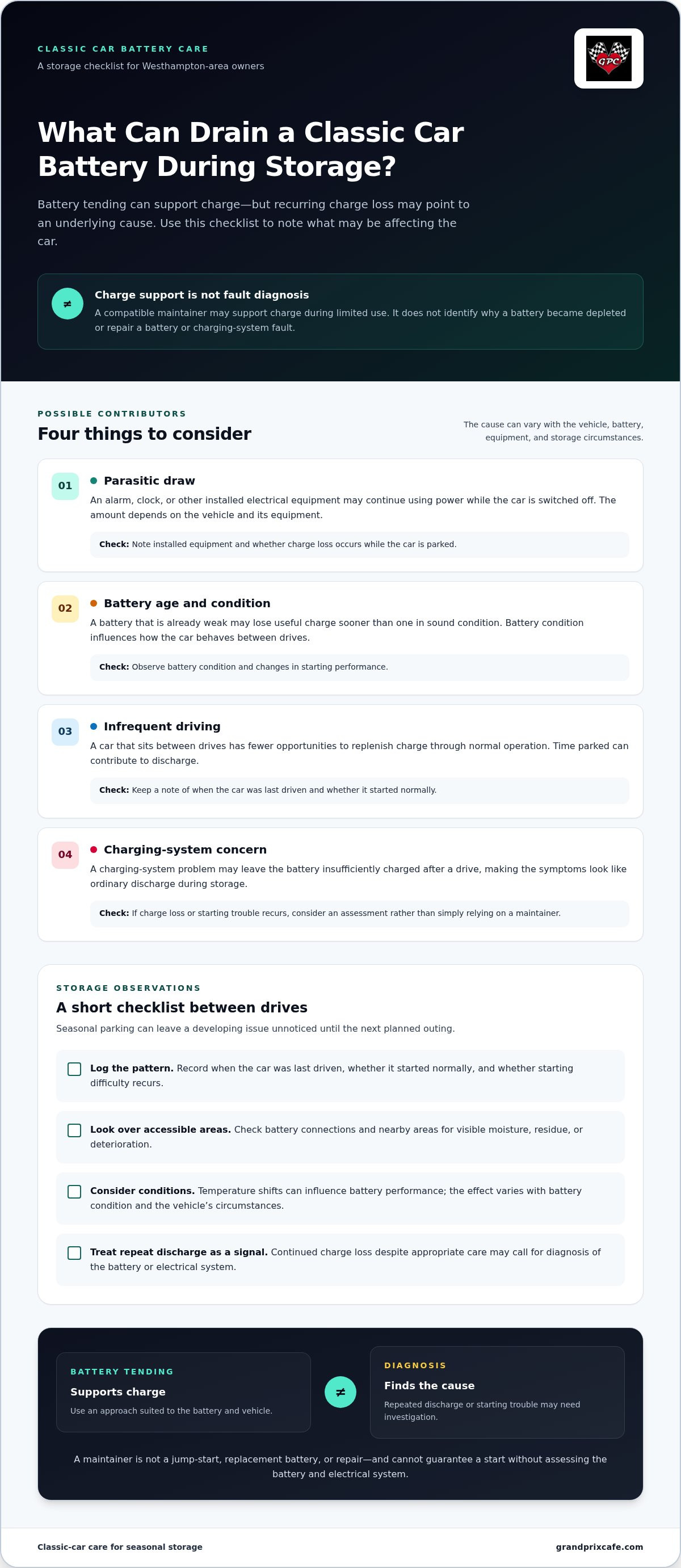
Time parked can contribute to discharge, and some vehicles continue to draw a small amount of power while switched off. An alarm, clock, or other installed equipment may use electricity between drives. The amount and effect vary. Battery age and condition, vehicle design, electrical modifications, and how often the car is driven all influence its needs. A battery that holds charge well in one car may behave differently in another.
Understanding the automotive battery helps clarify why charge maintenance is only one part of care. Batteries can lose charge during inactivity, but recurring discharge may have another cause. Notice how the car behaves between drives and record any changes in starting performance. These observations can help distinguish routine storage needs from a developing fault.
Battery tending versus charging or repairing a fault
A compatible maintainer is designed to support charge during periods of limited use. It isn’t a jump-start, a replacement battery, or a repair. A jump-start may help a car start temporarily, while charging a depleted battery is a separate task that calls for suitable equipment and procedures. Neither action, on its own, identifies why the battery became depleted.
Repeated discharge or starting trouble calls for investigation rather than simply relying on a maintainer. The battery may be worn or damaged, or an electrical load or charging-system issue may be involved. Diagnosis looks for the cause, while routine tending supports charge when the system and battery are suitable for that approach. No tending method can guarantee a start without assessing the battery and electrical system.
For classic vehicles, battery care is most useful as part of attentive maintenance, not as a substitute for addressing a fault. Grand Prix Cafe serves Westhampton-area collectors from Southampton, with specialized classic-car servicing and maintenance that can put battery concerns in the broader context of the vehicle’s condition.
What Can Drain a Classic Car Battery During Westhampton Storage?
A battery that loses charge while a classic car is parked may be responding to normal electrical demand, a change in battery condition, or a fault that needs attention. Identifying the cause matters: connecting a maintainer may support charge, but it won’t explain repeated discharge.
Parasitic draw, battery condition, and charging-system concerns
Parasitic draw is current used by a vehicle while it’s switched off. An alarm, clock, or other electrical equipment can continue drawing power while the car sits. Some draw may be expected, but the amount depends on the vehicle and its equipment.
Battery age and prior condition are separate considerations. A battery that’s already weak may lose useful charge sooner than one in sound condition. Infrequent driving can also mean the car has fewer opportunities to replenish charge through normal operation. A charging-system problem may leave the battery insufficiently charged after a drive, making the symptoms look like ordinary discharge during storage.
If a battery repeatedly loses charge despite appropriate care, the pattern may signal a fault that needs diagnosis, not simply more tending. Note how long the car has been parked and whether starting difficulty recurs. Those details can help distinguish an isolated low charge from a continuing electrical or battery concern.
Seasonal parking near Westhampton
Seasonal use can leave a developing issue unnoticed. A car may sit between drives in Westhampton or elsewhere in the Hamptons, and the owner may not discover a change until the next planned outing. Temperature shifts can influence battery performance, though their effect varies with the battery’s condition and the vehicle’s circumstances.
Coastal moisture is another reason to include a visual check in storage care. Inspect accessible battery connections and surrounding areas for visible moisture, residue, or deterioration. Storage conditions and the car’s previous care both matter, so don’t assume every vehicle will show the same signs.
Keep a simple record of when the car was last driven, whether it started normally, and any visible changes around the battery. If charge loss continues, consider it alongside a proper assessment of the vehicle rather than treating tending as a substitute for diagnosis. Grand Prix Cafe serves classic-car owners from Southampton, and its classic-car maintenance services place battery concerns within broader vehicle care.
Choosing a Battery-Tending Approach for Your Classic Car
The right approach depends on the car’s condition, how it’s stored, and how often someone can check on it. Periodic checks, a compatible maintainer, and professional vehicle service each have a role. None is right for every classic.
Periodic owner checks: Observe battery condition and starting behavior, and follow the vehicle’s guidance. This can suit an owner who can visit the car regularly, but checks alone don’t maintain charge or identify every electrical fault.
A compatible maintainer: Equipment designed for the installed battery can support charge during limited use. Its suitability depends on the battery and vehicle, and it won’t repair a weak battery or faulty circuit.
Professional vehicle service: A specialist can consider battery care alongside the vehicle’s broader condition. This is useful when the car has unusual wiring, recurring starting problems, or needs a closer assessment.
What to consider before using a battery maintainer
Start by identifying the installed battery type and reviewing the vehicle guidance. Then check the equipment instructions for compatibility with the battery’s chemistry and voltage. Don’t assume a device appropriate for one car is suitable for another, and don’t improvise settings that aren’t specified by its manufacturer.
Vintage electrical systems may include older wiring or later modifications. Their condition and configuration can affect whether connecting charging equipment is appropriate. If the vehicle and equipment guidance don’t establish compatibility, an individual assessment is a prudent step. Battery-care decisions for classic cars should account for these differences rather than apply one routine to every vehicle.
When battery tending is not enough
A low battery may need suitable charging, while a battery that no longer holds charge may need replacement. The symptoms can overlap, so repeated no-start events or rapid discharge shouldn’t be treated as proof that the car simply needs longer on a maintainer. Visible battery damage or unusual electrical behavior also warrants assessment. Stop using equipment if the battery or connections appear damaged, and follow the manufacturer’s safety instructions.
Professional diagnosis can help separate battery condition from wiring or charging-system concerns. For a closer look at specialist care, read about professional classic-car service in Southampton. Grand Prix Cafe serves Westhampton-area owners from Southampton, connecting battery concerns with attentive maintenance for classic and high-end vehicles.
A Practical Battery-Care Routine for Classic Cars in Westhampton
A consistent routine makes it easier to spot changes before the next drive. The details should reflect the vehicle, battery, and storage conditions, rather than follow a fixed schedule that may not suit every classic.
Before the vehicle sits for an extended period
Record the battery type and any known starting or charging concerns. Review the vehicle guidance and the battery and equipment manufacturers’ instructions before connecting a maintainer. If the battery’s condition or the car’s electrical system is uncertain, have the vehicle assessed before relying on a storage routine.
Use this sequence as a starting point:
Assess: Look for visible signs of damage or deterioration. Note any recent starting difficulty or unexplained loss of charge.
Review: Check vehicle and battery guidance, then confirm that the maintenance equipment is suitable for the battery and vehicle.
Maintain: Follow the equipment instructions. Don’t improvise settings or use equipment that doesn’t match the specified battery requirements.
Recheck: Observe the battery’s visible condition and the car’s behavior during storage, then record any changes.
Maintenance equipment must match the vehicle and battery specifications; a routine that suits one classic may not suit another.
While the classic car is parked
Set inspection timing according to how often the car is used, the battery’s known condition, and the storage circumstances. A vehicle that sits for an extended period may warrant a different check-in plan from one driven regularly. Follow equipment instructions for monitoring, and keep a simple note of observations and starting behavior.
Keep visual checks cautious. Look for obvious changes around accessible areas, but don’t handle exposed wiring, damaged connections, or other components that may be unsafe. Stop and arrange an assessment if you notice unusual heat, visible damage, warning signs, or repeated discharge. Repeated charging attempts can mask the pattern without identifying its cause.
Battery care is only one part of preparing a car for storage. The broader plan may also include the vehicle’s environment and condition. For Hamptons owners considering professional indoor car storage in Southampton, Grand Prix Cafe offers year-round indoor storage alongside classic-car servicing. Battery care should fit into this wider preservation approach.
For attentive storage and vehicle care, explore Grand Prix Cafe’s classic-car services.
Classic-Car Battery Tending Service Near Westhampton with Grand Prix Cafe
For classic-car owners in Westhampton, battery care is most useful when considered as part of the vehicle’s overall condition. Grand Prix Cafe is a Southampton-based automotive specialist serving classic-car owners across Westhampton and the Hamptons. Its specialized classic-car servicing and maintenance provide a local resource for considering battery concerns alongside broader vehicle-care needs.
Battery care as part of classic-car maintenance
A battery that needs attention may simply require appropriate charge maintenance, or it may point to a weak battery, an electrical draw, or another fault. An individual assessment helps distinguish routine tending from an issue that calls for repair. That means considering the battery and the vehicle’s electrical system rather than applying one routine to every classic.
Battery care also fits within regular servicing. A collector might mention that a car has been slow to start after storage, or that its battery repeatedly loses charge. Those details help put the concern in context. If assessment identifies a wider mechanical or electrical need, servicing or repair can address it. Restoration is relevant when the vehicle’s condition calls for restoration work, not simply because the battery needs attention.
Battery tending should account for how the vehicle is used and stored, while recognizing that tending supports charge rather than resolving every underlying problem. Grand Prix Cafe brings specialized classic-vehicle experience to the broader maintenance conversation.
Service and storage support for Hamptons-area collectors
Grand Prix Cafe’s Southampton location serves collectors in Westhampton and surrounding Hamptons communities. For a vehicle driven seasonally or kept off the road between outings, year-round indoor storage can form part of a wider preservation plan. Storage and maintenance work together: the right care depends on the car’s condition and the owner’s plans for it.
Whether the concern is repeated charge loss, a planned period of storage, or general classic-car upkeep, a considered service approach can help clarify what the vehicle needs. Owners can explore Grand Prix Cafe’s classic-car services and discuss care suited to their vehicle.
Keep Your Classic Ready for Its Next Drive
Battery tending can support a classic car during periods of limited use, but it isn’t a substitute for diagnosing repeated discharge or starting trouble. The right approach depends on the battery, vehicle wiring, equipment instructions, and storage conditions. A simple routine of assessing the battery, following vehicle guidance, maintaining charge appropriately, and rechecking its condition makes care more deliberate.
For owners looking for a classic car battery tending service Westhampton, Grand Prix Cafe serves Westhampton and the Hamptons from its Southampton location. Its specialized classic and high-end vehicle servicing and year-round indoor storage connect battery care with the broader needs of seasonal and stored vehicles. Grand Prix Cafe also serves collectors in East Hampton, Sag Harbor, Long Island, and Manhattan.
Give your car care suited to its condition and the way you use it. Explore Grand Prix Cafe’s classic-car services and take the next step toward thoughtful preservation.
Frequently Asked Questions
What is classic car battery tending?
Classic-car battery tending means maintaining a suitable charge while a vehicle is driven infrequently or stored. It helps address charge loss during periods of limited use, but it doesn’t repair a failed battery or diagnose an electrical fault. For owners looking for a classic car battery tending service Westhampton, the approach should account for the vehicle’s battery, electrical system, and storage conditions. Needs can vary from one classic to another.
Can I leave a battery maintainer connected to a classic car?
Only if the maintainer is suitable for the installed battery and the vehicle’s guidance allows its use. Check the battery type, voltage, wiring condition, and equipment manufacturer’s instructions before connecting it. Don’t assume a maintainer appropriate for a modern vehicle is suitable for a vintage car, particularly if its wiring has been modified. If you’re unsure about compatibility or see damage, have the vehicle assessed before using charging equipment.
How often should a classic car battery be checked in storage?
There isn’t one inspection interval that suits every stored classic. Timing should reflect how often the vehicle is used, the battery’s condition, and its storage circumstances. Follow the maintainer instructions if one is connected, and set checks that let you notice changes in visible condition or starting behavior. Owners storing vehicles around Southampton, Westhampton, or elsewhere in the Hamptons can keep a simple record of checks and any signs of charge loss.
What causes a classic car battery to go flat while parked?
A parked battery can lose charge through electrical loads that remain active while the car is off, such as a clock, alarm, or other equipment. Battery age or poor prior condition, infrequent use, and a charging-system issue can also contribute. These causes can produce similar symptoms. If a vehicle in Westhampton or another Hamptons community repeatedly loses charge despite appropriate care, arrange diagnosis instead of relying on repeated charging alone.
Is a battery maintainer different from a battery charger?
Yes. A charger is generally used to restore charge to a depleted battery, while a maintainer is intended to support charge during periods when the vehicle isn’t driven. Some equipment may combine functions, so the name alone doesn’t establish that it suits a particular car. Check the manufacturer’s instructions and match the equipment to the battery and vehicle. Don’t use a maintainer to mask repeated discharge or a suspected electrical fault.
Can cold or damp conditions affect a classic car battery near Westhampton?
Temperature changes can affect battery performance, though the effect depends on the battery’s condition and the vehicle’s circumstances. Damp storage conditions also make sensible visual inspection worthwhile, especially around accessible battery areas and connections. Don’t handle exposed or damaged electrical components. For cars stored in Southampton, Westhampton, East Hampton, or Sag Harbor, consider the actual storage environment and the vehicle’s condition rather than assuming every car faces the same effects.
When should I get professional classic-car battery service?
Seek professional assessment for repeated no-start events, rapid discharge, visible battery damage, unusual heat, or unexpected electrical behavior. These signs may point to a battery that can’t hold charge or a fault elsewhere in the electrical or charging system. Grand Prix Cafe provides specialized classic-car servicing from Southampton for owners in Westhampton and the Hamptons. An assessment can help distinguish routine charge maintenance from a condition that needs repair.
Comments