


Classic Car Consignment vs. Private Sale: A Collector’s Guide to Maximum Value
- sales299631
- 1 day ago
- 12 min read
The assumption that bypassing a commission is the only way to maximize profit often leads to a lower net return for the collector. When evaluating classic car consignment vs private sale, the visible fees of a professional service frequently outweigh the hidden costs of a solo transaction. Selling a vintage vehicle independently requires more than just a digital listing. It demands technical expertise to defend an asking price and the patience to filter unqualified tire-kickers who disrupt your daily schedule.
You likely value your time as much as the mechanical provenance of your machine. Managing security risks from strangers at your home or handling complex cross-border paperwork can quickly erode the satisfaction of a successful sale. At Grand Prix Cafe, we recognize that a curated environment and rigorous mechanical vetting are essential for high-tier transactions. This guide provides the clarity needed to protect your asset's value and your own schedule. We will examine the logistical, financial, and security differences between these two methods to ensure your next transaction is handled with the precision it deserves.
Table of Contents
The Evolution of Classic Car Sales: Strategy Over Transaction
The collector car market has transitioned from a hobbyist's pursuit into a sophisticated asset class. For owners of high-tier marques, the choice between classic car consignment vs private sale is no longer just about convenience; it's about protecting the financial integrity of a significant investment. Professional consignment serves as a formal representation of an asset, where a specialist acts as the custodian of the vehicle's history and mechanical narrative. In 2026, the market has entered a correction phase that favors transparency over hype. Buyers now demand a rigorous "burden of proof" that includes comprehensive documentation and verifiable provenance before committing to a purchase.
The role of a specialist dealer has evolved to bridge the gap between a seller's expectations and the cautious reality of modern buyers. This shift from simply "listing a car" to "curating a sale" ensures that a vehicle is positioned correctly within its specific market niche. Whether dealing with a vintage Land Rover or a modern classic Porsche, the strategy must prioritize technical accuracy and historical significance.
Understanding the Consignment Model
A professional consignment process differs fundamentally from the high-volume approach of traditional dealerships. While a standard dealer focuses on rapid inventory turnover, a boutique firm like Grand Prix Cafe emphasizes the individual merit of each vehicle. Having a physical presence in a curated Southampton showroom provides a level of legitimacy that digital listings cannot replicate. In 2026, provenance and mechanical history are the primary drivers of value. A specialist facility ensures these data points are presented clearly to informed collectors who value mechanical integrity as much as aesthetic condition. This model relies on a discreet, professional environment where serious buyers can inspect vehicles without the pressures of a typical sales floor.
The Private Sale Landscape in New York
Managing a high-value transaction in Manhattan or the Hamptons presents unique logistical and security challenges. Private sellers often find that the logistics of managing multiple showings and vetting inquiries can be overwhelming. The rise of online auction platforms has paradoxically increased the requirement for professional pre-sale preparation. Buyers now expect a vehicle to be "auction-ready," which necessitates mechanical vetting and professional detailing before the first photograph is taken. For high-net-worth individuals, a private treaty sale often carries a psychological barrier. These buyers prefer the security and professional distance provided by an established facility. The complexity of classic car consignment vs private sale becomes evident when considering the effort required to defend an asking price against a discerning, technically-minded audience.
The Hidden Costs and Risks of a Private Classic Car Sale
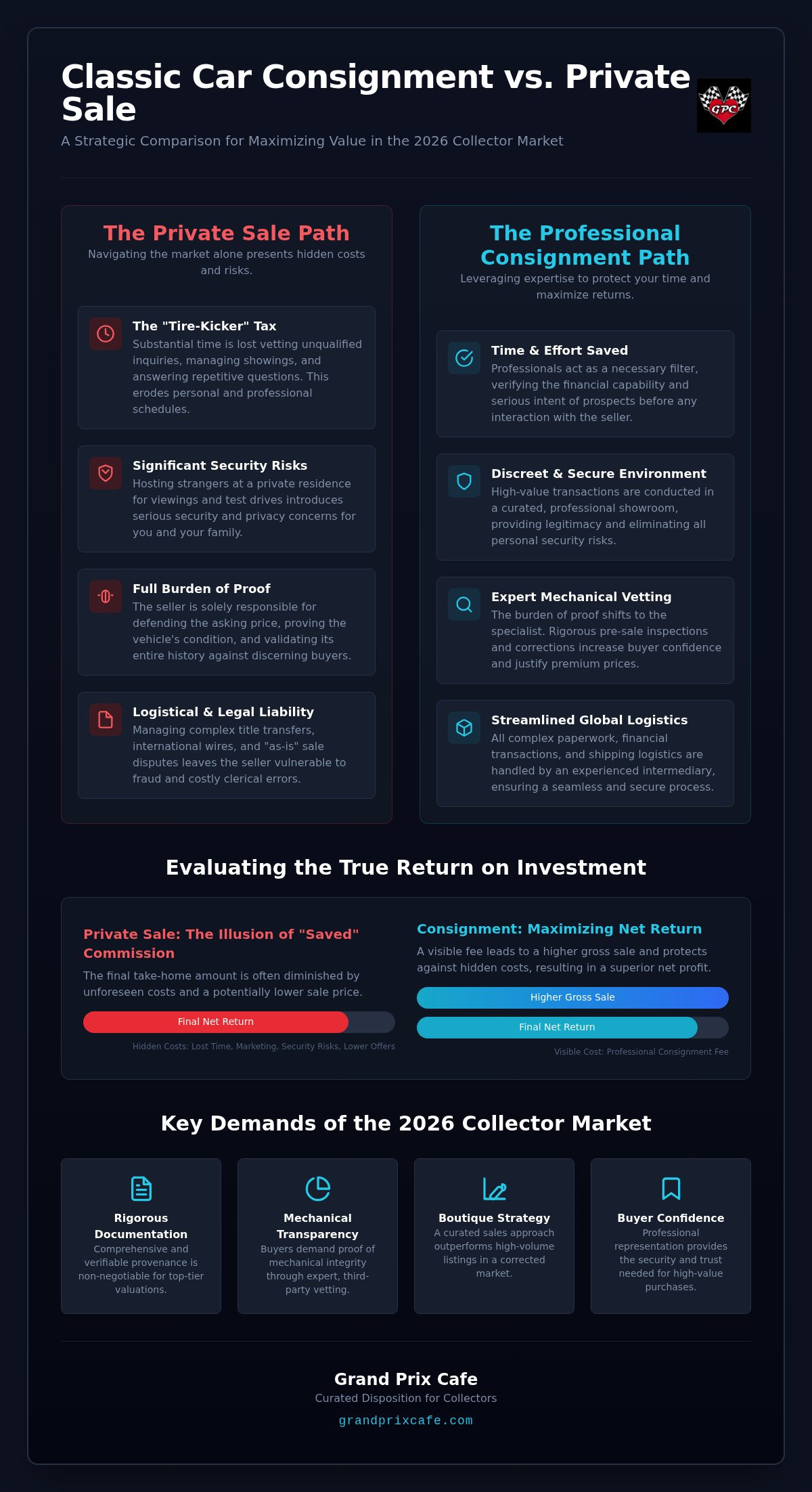
The decision to sell a vehicle independently is often driven by the desire to retain the full sale price. However, the financial reality of classic car consignment vs private sale reveals that the "saved" commission is frequently offset by significant hidden costs. Private sellers must manage the entire lifecycle of the transaction, from initial marketing to the final transfer of title. When comparing classic car consignment vs private sale, one must account for the legal and logistical liabilities that a professional intermediary is designed to absorb.
The 'Tire-Kicker' Tax: Quantifying Wasted Time
Selling a six-figure vintage vehicle attracts a high volume of inquiries, yet few represent qualified buyers. A private seller spends hours responding to technical questions, providing additional documentation, and scheduling showings. This "tire-kicker tax" represents a substantial loss of professional and personal time. Defending a vehicle's condition to an uneducated buyer is emotionally fatiguing and often leads to unproductive negotiations. Professional dealers act as a necessary filter. They verify the financial capability and intent of a prospect before a single door is opened or an engine is started.
Beyond the time commitment, the technical complexity of international wire transfers and out-of-state title logistics poses a genuine risk. Managing these details without an intermediary leaves the seller vulnerable to fraudulent activity or clerical errors that can stall a transaction for months. Disputes regarding the "as-is" nature of a private sale are also common, as buyers may lack the technical context to understand the maintenance requirements of a vintage machine. This liability often results in post-sale disputes that can lead to expensive legal mediation.
Security and Privacy in the Digital Age
Publicizing the location of a high-value asset through online classifieds creates a security vulnerability. For residents in high-profile areas like East Hampton, Sag Harbor, or Southampton, inviting strangers to a private residence is a significant privacy concern. Digital listings often inadvertently reveal home layouts or security measures through background details in photographs. This exposure is an unnecessary risk for a collector.
A neutral, secure showroom provides a layer of professional distance that protects the seller's identity and property. By utilizing a vehicle consignment service New York collectors can ensure their assets are viewed only in a controlled, professional environment. This approach prioritizes discretion and physical security, allowing the focus to remain entirely on the mechanical merits of the vehicle. Grand Prix Cafe provides this secure environment, ensuring that your privacy is never compromised for the sake of a sale.
Professional Consignment: Leveraging Mechanical Expertise and Networks
The primary differentiator in the classic car consignment vs private sale equation is the depth of technical validation. In the current 2026 market correction, buyers have become increasingly risk-averse. They no longer accept "runs well" as a sufficient mechanical description. At Grand Prix Cafe, every vehicle undergoes a rigorous vetting process within our on-site restoration facility. This technical transparency shifts the burden of proof from the seller to the curator, providing the mechanical narrative necessary to justify a premium valuation. When a specialist validates a vehicle's condition, it transforms the listing from a simple advertisement into a certified asset.
A critical component of this process is the "Pre-Sale Correction." Minor mechanical issues, such as resolving persistent oil leaks or refreshing aged suspension bushings, often yield a return on investment that far exceeds the cost of the repair. These adjustments ensure the vehicle presents perfectly during a third-party pre-purchase inspection (PPI). By addressing these details in-house, we eliminate the friction that typically causes private transactions to collapse at the final stage. This proactive approach preserves the seller's asking price and reinforces buyer confidence from the first inquiry.
Mechanical Curatorship as a Value Driver
Buyers are willing to pay a significant premium for vehicles vetted by a vintage car restoration New York specialist. This premium isn't merely for the brand name; it's for the mitigation of mechanical risk. A professional shop's inspection report serves as a foundational document that defends the car's integrity. It's much harder for a buyer to negotiate a lower price when the vehicle's condition is documented by experts who understand the nuances of rare European marques. This level of curatorship ensures that mechanical history is viewed as an asset rather than a liability.
Global Marketing vs. Local Presence
Modern collectors are increasingly global, yet they value the security of an established local presence. A vehicle stored in our climate-controlled Southampton facility is positioned to reach buyers in London, Tokyo, or Manhattan with equal efficacy. To facilitate remote transactions, we produce high-fidelity digital assets, including over 100 detailed photographs and HD videography. This comprehensive documentation allows international collectors to commit to a six-figure purchase with total clarity. While the car remains safely in our care, it's marketed through an established buyer network that trusts our vetting process. This network consists of serious collectors who don't browse public classifieds, preferring instead to acquire vehicles from a source that prioritizes mechanical excellence and historical accuracy.
Evaluating the ROI: Consignment Fees vs. Sale Price Maximization
The financial evaluation of classic car consignment vs private sale often focuses on the commission fee. This is a narrow view of the total return on investment. A private seller retains the gross amount but often accepts a lower net return because their vehicle is positioned as an "as-is" asset. A professionally vetted car commands a premium. It removes the buyer's mechanical uncertainty. In the 2026 market, the price difference between an unvetted private car and a curated one frequently exceeds the cost of the professional fee. Professional representation also increases "market speed." Credible dealers move inventory faster than private individuals. This reduces the time your capital remains stagnant in a volatile market.
Consignment includes a suite of services that consolidate the selling process. These cover indoor storage, targeted marketing, and expert negotiation. By consolidating these costs into a single fee, the seller often realizes a more efficient disposition of the asset. Our team handles the entire lifecycle of the sale, ensuring that the vehicle's value is protected from the moment it enters our facility.
The Math of a Successful Consignment
View the commission as a risk-mitigation strategy. It protects you from the liability of post-sale disputes and the frustration of failed negotiations. A technical classic car appraisal Long Island prevents the common error of underpricing a rare marque. We analyze specific mechanical merits and historical data to set a defensible price. Aesthetic presentation is equally important. Professional detailing and high-fidelity photography create a competitive environment for the vehicle. This often results in a final hammer price that a private seller simply cannot achieve alone. When a specialist defends the asking price, the buyer's ability to negotiate downwards is significantly diminished.
Managing the Transactional Complexity
Dealers possess the infrastructure to handle requirements that private sellers cannot. This includes managing trade-ins or coordinating enclosed shipping for international collectors. A "clean" title transfer through a licensed dealer provides a layer of legal security for both parties. These logistical capabilities remove the friction that often stalls private transactions. By handling the cross-border paperwork and financing logistics, we ensure the sale proceeds to a successful conclusion without the typical administrative delays. This professional oversight is essential for high-value transactions where clerical errors can be costly.
If you're ready to secure the maximum value for your collector vehicle, explore our vehicle consignment services at Grand Prix Cafe.
The Grand Prix Cafe Experience: Curated Disposition for Collectors
The boutique approach at Grand Prix Cafe represents a departure from the high-volume model of automotive warehouses. We prioritize the individual merits of each vehicle, treating every entry as a significant historical asset. When analyzing classic car consignment vs private sale, the distinction lies in the level of professional stewardship provided to the seller. Our vehicle consignment service New York collectors rely on integrates our technical restoration expertise directly into the sales process. This ensures that every car is mechanically vetted and presented with its integrity fully documented, removing the ambiguity that often stalls private transactions.
While the vehicle is marketed, it remains in our dedicated indoor car storage Southampton NY facility. This climate-controlled environment preserves the car's condition while providing a discreet venue for inspections. This physical presence is a critical component of the classic car consignment vs private sale choice. It removes the logistical burden from the seller while maintaining a high standard of automotive care. Our facility acts as a gallery where mechanical excellence is the primary focus.
A Showroom Built for Enthusiasts
Our Southampton facility is designed as a technical environment for discerning collectors. We focus primarily on high-end European classics and rare marques. This specialization ensures that your vehicle is positioned among appropriate peers, attracting a specific profile of serious buyers. Transparency is central to our operations. We maintain consistent communication and provide detailed reporting throughout the sales cycle. This rhythmic, methodical approach ensures that every transaction is handled with the meticulous attention to detail required for high-value automotive assets. We function as a trusted advisor, valuing quality and historical integrity above all else.
Your Next Steps in Selling Your Classic
The process of partnering with Grand Prix Cafe is structured and direct. We begin with a comprehensive initial appraisal and mechanical evaluation at our facility. This stage establishes the technical foundation for the listing. Sellers should provide all relevant historical documentation, including service records and provenance files, to build a complete narrative for the vehicle. This thorough vetting process is what separates a professional disposition from a standard listing.
To initiate a partnership, please follow these steps:
Schedule a technical evaluation and appraisal at our Southampton location.
Provide comprehensive documentation regarding the vehicle's mechanical history and provenance.
Review the proposed marketing and presentation strategy with our curators.
For collectors who require immediate liquidity rather than a managed sale, we also offer a consultation for an outright vehicle purchase. This provides a streamlined alternative for those looking to exit a position quickly without the duration of a consignment period. Our objective is to ensure that every transition of ownership respects the heritage and value of the machine.
Securing the Future of Your Automotive Legacy
The choice between classic car consignment vs private sale ultimately depends on your priority: managing a transaction or curating a result. While a private sale may appear to offer higher proceeds, the hidden costs of time, security, and technical liability often erode that perceived gain. Professional consignment transforms a vehicle from a simple listing into a verified asset. By leveraging mechanical vetting and a discreet global buyer network, you ensure your vehicle's provenance is respected and its value is maximized.
Grand Prix Cafe provides a specialized Southampton showroom where high-tier European marques are presented with total mechanical transparency. Our in-house restoration facility allows us to address technical details before they impact a sale, providing buyers with the confidence required for significant acquisitions. This methodical approach protects your privacy and your schedule. It delivers a result that reflects the true worth of your machine. We invite you to consign your classic with Grand Prix Cafe and experience a partnership rooted in transparency and mechanical excellence. Your vehicle deserves a transition as refined as its history.
Frequently Asked Questions
Is it better to sell a classic car at auction or through consignment?
Consignment provides a more controlled environment compared to the volatility of a public auction. While auctions generate immediate liquidity, they often involve high buyer premiums and the risk of a "no-sale" on a fixed date. Consignment allows for a curated presentation where the price is defended by technical experts. This method is preferred for rare European marques where the mechanical narrative requires a detailed explanation to justify a premium valuation in a selective market.
How much does classic car consignment typically cost in New York?
Fees for classic car consignment vs private sale representation reflect the breadth of technical and marketing services provided. In the New York market, these fees cover professional photography, secure indoor storage, and the management of global inquiries. It's essential to evaluate the net return rather than the gross fee, as professional vetting frequently results in a higher final settlement. Each agreement is tailored to the specific mechanical requirements and historical significance of the vehicle.
Can I keep my car at home while it is on consignment with a dealer?
Maintaining the vehicle at a private residence is generally discouraged during a professional consignment period. Effective representation requires the car to be physically present in a secure showroom for spontaneous inspections and high-fidelity media production. Storing the asset in a climate-controlled facility like our Southampton showroom also preserves its mechanical integrity and aesthetic condition. This physical availability is a significant factor in reducing the total time-to-sale for high-value collectibles and modern classics.
What happens if my car doesn't sell during the consignment period?
If a vehicle remains unsold at the conclusion of the agreed consignment term, several options are available. The owner may choose to extend the agreement, adjust the asking price based on market feedback, or retrieve the vehicle. At Grand Prix Cafe, we also provide the option for an outright vehicle purchase. This ensures that collectors have a guaranteed path to liquidity if their timing requirements change during the marketing process, providing a flexible exit strategy.
Do consignment dealers handle the mechanical repairs needed for sale?
Specialist consignment dealers often facilitate the mechanical repairs necessary to maximize a vehicle's value. Grand Prix Cafe utilizes an on-site restoration facility to perform pre-sale corrections, ranging from resolving minor leaks to comprehensive mechanical vetting. Addressing these issues before a listing goes live prevents transactions from failing during a pre-purchase inspection. This proactive approach reinforces buyer confidence and protects the seller's initial asking price from aggressive downward negotiations during the final closing stages.
How do dealers determine the asking price for a consigned vintage vehicle?
Determining the asking price involves a technical appraisal and an analysis of current market data. We evaluate the vehicle's mechanical provenance, historical significance, and recent transaction data for similar marques. The 2026 market correction requires a defensible price point supported by documentation. By combining global auction results with the specific condition of the consigned vehicle, we establish a valuation that reflects both the asset's rarity and its current mechanical integrity for the buyer.
What are the legal risks of selling a classic car privately in New York?
Selling a vehicle privately in New York carries risks related to disclosure and financial security. Sellers are often liable for the accuracy of their mechanical descriptions, and disputes regarding "as-is" sales can lead to expensive legal mediation. Additionally, managing international wire transfers and title logistics without a licensed intermediary increases the risk of payment fraud. A professional dealer absorbs these transactional risks, ensuring a clean title transfer and secure fund disbursement for the seller.
How long does it typically take to sell a classic car through consignment?
The duration of the sales process depends on the vehicle's rarity and market demand, though professional representation typically accelerates the timeline. Most high-tier European classics find a buyer within a few months when marketed through an established network. Professional photography and technical vetting reduce the time spent on unqualified inquiries, allowing the focus to remain on serious collectors. This efficiency is a primary benefit when comparing classic car consignment vs private sale strategies.
Comments