


Classic Car Fluid Check and Top-Up Service in Southampton, NY
Updated: Oct 14
A top-up can restore a fluid level, but it won’t explain why that level fell. For classic cars, the right fluid depends on the vehicle’s design and specification, not a modern-car default. Grand Prix Cafe provides car servicing in Southampton for vintage and high-end vehicles, including fluid checks and top-ups guided by each car’s requirements.
A careful check considers which fluids suit the car, whether a top-up is appropriate, and whether a change in level or appearance points to a concern that needs attention. Adding fluid isn’t always the complete answer. The aim is to understand the vehicle’s requirements and condition before deciding what to do.
This guide explains what a specialist fluid check involves, why older vehicles need vehicle-specific attention, and how to distinguish a routine top-up from a developing concern. It also covers how to prepare for classic-car servicing with Grand Prix Cafe in Southampton and nearby communities.
Table of Contents
What a classic car fluid check and top-up service in Southampton covers
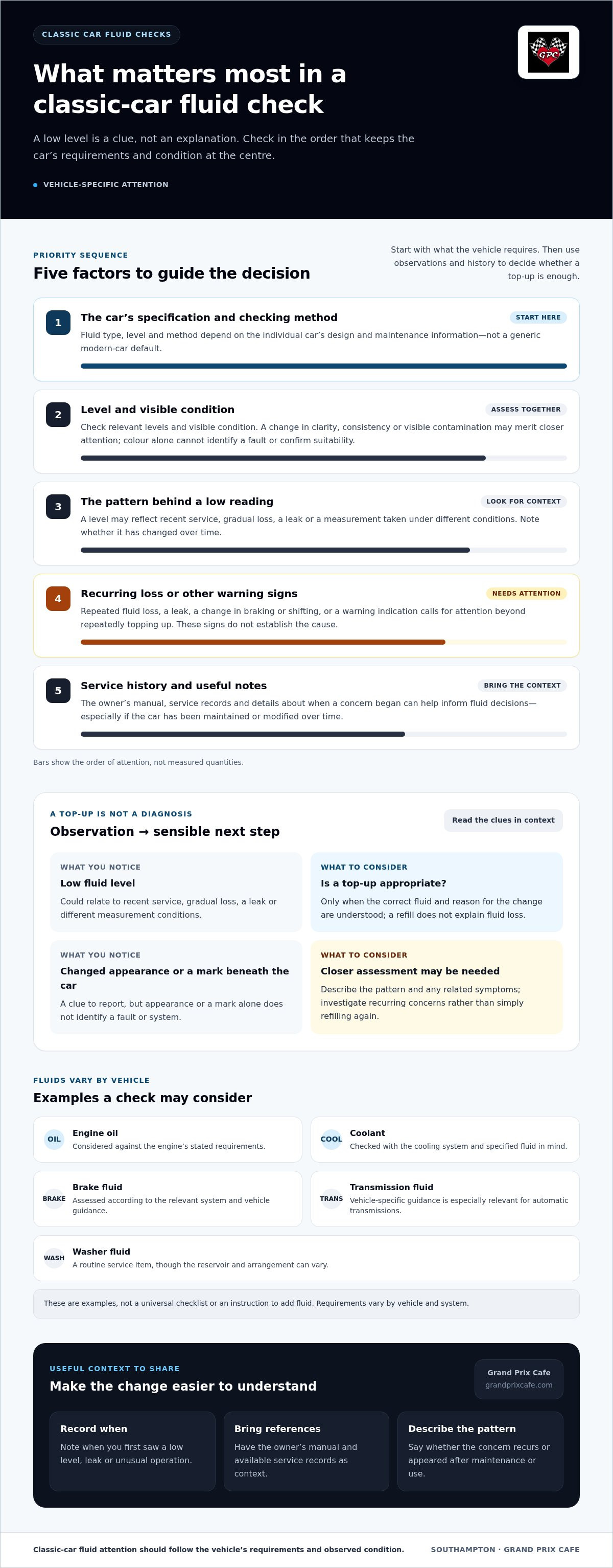
A fluid check assesses relevant levels and visible condition against the requirements of the individual vehicle. It isn’t simply a matter of filling every reservoir to a mark. The correct fluid, level and checking method depend on the car’s design and maintenance information. For owners searching for a classic car fluid check and top-up service in Southampton, that distinction matters: a suitable top-up starts with understanding what the vehicle requires.
A top-up may be appropriate when a level is low and the correct fluid and reason for the change are understood. It restores a level, but it doesn’t establish why fluid was lost. If a level drops repeatedly, or there are signs of a leak or mechanical concern, further assessment may be needed instead of another refill. Fluid attention is one part of comprehensive classic-car servicing, not a substitute for diagnosing a fault.
Which vehicle fluids may be considered during a check?
Depending on the vehicle, common examples include engine oil, coolant, brake fluid, transmission fluid and washer fluid. These systems differ, and not every car uses the same fluid types or service arrangements. A vehicle’s age and design can also affect what is appropriate. For automatic transmissions, the history and evolution of fluid specifications make vehicle-specific guidance especially relevant, as outlined in Automatic Transmission Fluid in Classic Cars.
Engine oil: Considered in relation to the engine and its stated requirements.
Coolant: Checked with the vehicle’s cooling system and specified fluid in mind.
Brake and transmission fluids: Assessed according to the relevant system and vehicle guidance.
Washer fluid: A routine service item, though its reservoir and arrangement can vary.
These are examples, not a universal checklist or an instruction to add fluid. Using a familiar modern-car specification by default can be unsuitable for an older vehicle.
Why a classic car needs a vehicle-specific approach
Age, original design, prior maintenance and available manufacturer guidance all inform fluid decisions. A vehicle may have been maintained or modified over time, so its current condition and service history provide useful context. Checking a level is also different from confirming fluid condition. Appearance can prompt closer attention, but colour alone does not identify a fault or confirm that a fluid is suitable.
Grand Prix Cafe provides servicing for vintage and high-end vehicles in Southampton, with fluid attention considered in the context of the car’s requirements and observed condition. Owners seeking broader mechanical context can explore professional classic-car mechanic service in Southampton. Local owners from Southampton, Westhampton, East Hampton and Sag Harbor can bring their vehicles in for service, with Grand Prix Cafe also serving classic-car owners across Long Island and Manhattan.
Why classic-car fluid checks in Southampton require more than reading the level
A low reading is an observation, not an explanation. A level may reflect a recent service, gradual loss, a leak, or a measurement taken under different conditions. The appropriate response depends on the fluid and the vehicle. Adding more without understanding the cause can conceal a recurring problem rather than resolve it.
Fluid appearance also needs context. A change in clarity, consistency or visible contamination may warrant closer attention, but colour by itself cannot identify a fault. A mark beneath a parked car is a reason to report what you’ve seen, not enough to determine which system is involved. Assessment should consider the vehicle’s condition and any related symptoms.
What can fluid level and condition tell an owner?
Levels and visible condition provide useful clues, but they don’t amount to a complete mechanical diagnosis. Compare observations over time: note whether a level has changed, whether a mark has appeared in the same parking place, or whether the fluid looks different from before. Share these details and any unusual operation during service.
Repeated fluid loss deserves attention. So does a leak, a change in braking or shifting, or a warning indication. These signs don’t establish a particular cause, but they help describe what has changed and guide further assessment. Repeatedly topping up without investigating may leave the underlying concern unaddressed.
Why the correct specification matters
Fluid requirements vary by vehicle and system. Age, original design, maintenance history and any recorded changes can all affect which specification applies. The owner’s manual and service records are useful references. If information is incomplete, avoid assuming that a fluid used in another car is suitable for yours.
Record the change: Note when you first observed a low level, leak or unusual operation.
Bring the reference: Make the owner’s manual and available service records part of the discussion.
Describe the pattern: Explain whether the concern is recurring or appeared after maintenance or use.
For Southampton owners, fluid checks fit naturally within attentive classic-car servicing. Grand Prix Cafe provides servicing for vintage and high-end vehicles. Arrange classic-car service in Southampton with the vehicle’s history and observed changes in mind.
DIY top-up or specialist fluid service for a classic car in Southampton?
A routine owner check may be reasonable when the vehicle’s manual describes it, the fluid specification is clear, and the car is behaving as expected. That familiarity has limits. Classic cars don’t all share the same fluid requirements or maintenance routines, even when two vehicles appear similar. Applying a procedure or product based on another car can create uncertainty rather than resolve it.
A top-up restores a level, but it doesn’t explain a recurring drop or warning sign. If you’re unsure which fluid is correct, don’t have reliable service information, or notice a change in how the vehicle operates, professional servicing is a considered next step. A specialist assessment can put a fluid concern in the context of the vehicle’s broader condition.
When might an owner check a fluid level themselves?
Follow only checks that the owner’s manual identifies as suitable for the owner, including its vehicle-specific procedure and safety instructions. Don’t assume every reservoir is checked in the same way or that a familiar method applies to an older car. If the process or specification isn’t clear, record what you’ve noticed and leave the assessment to a service professional rather than improvising.
When is a specialist assessment the more suitable next step?
Recurring low levels, visible leaks, warning indicators and unusual operation are reasons to seek assessment instead of repeatedly topping up. These signs don’t identify a fault on their own, but they provide important context. In Southampton, servicing for vintage and high-end vehicles takes the individual car and its history into account. The broader classic-car maintenance guide offers additional context on specialist mechanical care.
Use this practical distinction:
Owner check: The manual describes the check, the correct specification is known, and no unusual symptoms or repeated loss are present.
Specialist service: The level keeps changing, a leak or warning appears, operation feels different, or the appropriate fluid remains uncertain.
Pause before topping up: The vehicle’s records are incomplete, the fluid choice is unclear, or the check requires a procedure you’re not equipped to follow safely.
These are decision points, not a diagnosis. Share the concern, when it began and any recent maintenance with the service team. That history helps distinguish a routine check from a question that needs broader attention.
For owners across Southampton, Westhampton, East Hampton and Sag Harbor, a classic car fluid check and top-up service in Southampton should be guided by the vehicle’s own requirements, not a universal rule. Grand Prix Cafe provides classic-car servicing for vintage and high-end vehicles. Arrange classic-car servicing in Southampton with the vehicle’s history and symptoms in view.
How to prepare for classic-car fluid service in Southampton
A little preparation makes a fluid concern easier to describe and gives the service discussion useful context. Before arranging service, gather the vehicle’s identifying details, available maintenance information and a concise account of what you’ve observed. This keeps attention on the car’s history and present condition, rather than assumptions based on another vehicle.
Owners bringing a classic car from Southampton, East Hampton, Westhampton or Sag Harbor can use the same preparation steps. You don’t need to diagnose the issue yourself. Clear observations are more useful than a guess about which component or fluid is responsible.
What vehicle information should an owner bring?
Start with the make, model and year. Include any known engine or configuration details that help identify the vehicle, particularly if it has been changed during its lifetime. Bring the owner’s manual and available service records so the car’s documented requirements and maintenance history can inform the discussion.
Note any recent fluid additions, including what was added and approximately when, if you know. Include changes you’ve noticed since the last service and your current concern. If a record is incomplete, say so rather than filling gaps with assumptions.
What should owners note before arriving?
Write down when a warning light or unusual symptom first appeared and whether it has happened again. If you’ve seen fluid spots, note where the car was parked, where the spot appeared in relation to the vehicle and how often you’ve noticed it. Record unusual smells or changes in operation in plain terms, such as when they occur or whether they persist.
Avoid topping up an unknown fluid solely to conceal a symptom before service. An unrecorded addition can make it harder to understand what changed. If you have already added fluid, include that detail and the product information, if available.
Vehicle identity: Make, model, year, and known engine or configuration details.
History: Owner’s manual, service records, and known recent fluid additions.
Observations: When concerns began, warning indicators, visible spots, unusual smells, or changes in operation.
Questions: Anything you’re uncertain about, including what has changed since the previous service.
This information supports a focused conversation, but you don’t need to arrive with a complete history. Bring what’s available and distinguish what you’ve observed from what you suspect. For a classic car fluid check and top-up service in Southampton, that context helps place fluid attention within comprehensive servicing for vintage and high-end vehicles at Grand Prix Cafe.
Arrange classic-car service in Southampton with the vehicle’s records and observations ready to share.
Arrange classic-car fluid check and top-up service with Grand Prix Cafe
Grand Prix Cafe is a specialized automotive center in Southampton, New York, providing servicing for vintage and high-end vehicles. A fluid concern can be addressed as part of the car’s broader service needs, with decisions guided by its requirements and observed condition. This is more useful than treating every low reading as an isolated reason to add fluid.
Owners arranging a classic car fluid check and top-up service in Southampton can begin with the vehicle’s identity, available maintenance history and specific concern. Describe what you’ve noticed, such as a changing level, a visible spot, a warning light or unusual operation. These details help frame the discussion around your car without requiring you to diagnose the cause in advance.
What to expect from a specialist service conversation
Be ready to share the make, model, year, known engine or configuration details, and any recent maintenance or fluid additions. If the concern is recurring, explain when it began and what has changed. The discussion can take account of the vehicle’s records and condition when considering suitable fluid attention, rather than relying on a routine assumed to apply to all classics.
Grand Prix Cafe serves Southampton and nearby Hamptons communities, including East Hampton, Westhampton and Sag Harbor. The business also serves classic-car owners across Long Island and Manhattan. For local owners, arranging service in Southampton brings classic-car servicing to a specialist automotive center.
Make fluid care part of ongoing classic-car maintenance
Keep service records current. Note the date of maintenance, work discussed, and any fluid additions or symptoms you’ve reported. A clear record preserves useful context for future service conversations, especially when ownership or maintenance history spans several years. It also makes it easier to describe what has changed since the vehicle was last assessed.
If fluid concerns arise alongside planned restoration work, the wider project may provide important context for maintenance decisions. Grand Prix Cafe also provides restoration, and its vintage-car restoration in New York service offers relevant background for owners considering the vehicle’s needs more broadly.
Fluid care is one part of preserving a classic’s condition. Share the concern and the records you have, then arrange service suited to the vehicle rather than applying a generic approach. Southampton-area owners can explore Grand Prix Cafe and arrange classic-car service.
Set a considered course for your classic car
Good maintenance is built on informed decisions, not automatic additions. If a fluid concern has prompted questions about your vehicle’s care, use it as an opportunity to establish a service plan that reflects the car’s needs and history. Dedicated automotive care providers like BLACKCAT AUTO LLC emphasize that consistent preventative maintenance protects long-term mechanical health. That can make future maintenance conversations more precise and help you decide when a routine check is enough and when a concern deserves further attention.
For owners seeking a classic car fluid check and top-up service in Southampton, Grand Prix Cafe provides local classic-car servicing. Its work with vintage and high-end vehicles sits alongside restoration and accident repair, supporting owners as their needs evolve.
Take the next step with your vehicle’s condition and maintenance priorities in mind. Explore classic-car servicing with Grand Prix Cafe and arrange care suited to your car.
Frequently Asked Questions
How often should a classic car’s fluids be checked?
Follow the maintenance schedule in the owner’s manual, since intervals vary by vehicle and how it’s used. A car driven regularly may have different service needs from one used occasionally or kept in storage. Check records for the date of its last service, and review the manual before a planned drive if the car has been idle. If the schedule or history is unclear, have its needs considered as part of classic-car servicing in Southampton.
Can I top up classic-car engine oil with a different oil?
Only use a different oil if the owner’s manual or reliable vehicle-specific guidance supports its specification and compatibility. Similar labels or viscosity descriptions don’t automatically make two oils interchangeable for a particular engine. If you can’t establish what the car requires, don’t guess or combine products as a routine solution. If oil has already been added, note the product and amount, if known, and share that information during service.
Is it safe to drive a classic car if the coolant level is low?
There’s no universal safe answer, so don’t assume the car is suitable to drive with low coolant. If the temperature rises, a warning appears, steam is visible or coolant is escaping, stop in a safe place and switch off the engine. Never open a cooling-system cap while the engine is hot. Let the vehicle cool fully and arrange assessment before continuing if the cause or safe level is uncertain.
What should I do if my classic car keeps losing fluid?
Arrange an assessment rather than treating repeated top-ups as a repair. Note when you added fluid, how often the level changes, and whether you see spots beneath the car or notice altered operation. The affected system matters: a possible brake-fluid loss, for example, deserves particular caution. Owners seeking a classic car fluid check and top-up service in Southampton can discuss recurring loss alongside the vehicle’s maintenance history.
Can old or stored classic cars need fluid attention before driving?
Yes. A period in storage doesn’t establish that fluids are ready for use, nor does it mean every fluid automatically needs replacement. Before driving, consult the owner’s manual and available service records to understand what checks or scheduled maintenance are due. If the storage period is long or the service history is incomplete, have the car’s maintenance needs reviewed before returning it to regular use.
How can I tell whether a fluid leak is serious?
You can’t reliably judge seriousness from a spot’s colour or size alone. Note where it appears, whether it returns, and whether a warning light or change in operation accompanies it. A suspected leak involving braking, overheating or another major change warrants prompt attention; avoid driving if the car seems unsafe. Don’t touch or taste an unknown fluid. Share your observations with a classic-car service professional in the Southampton area.
Does a classic-car fluid check include changing the fluids?
Not necessarily. A check assesses relevant levels and visible condition, while changing fluid is a separate service decision based on the vehicle’s schedule, history and condition. A level observation alone, for example, doesn’t establish that a fluid is due for replacement. When arranging service, describe whether you’re seeking an assessment, scheduled maintenance or help with a specific concern so the work can be discussed in the context of the car.
Comments