


Classic Car Interior Restoration in the Hamptons: The Art of Curatorial Preservation
- sales299631
- Jul 31
- 13 min read
Updated: Aug 12
A single improper material choice or an incorrect stitch can compromise the historical integrity of a rare vehicle, instantly impacting its market valuation. For collectors on the East End, the challenge is multifaceted. You've likely observed how the local salt air and high humidity accelerate the degradation of vintage leathers, wools, and adhesives. It's a persistent threat that demands a specialized response. This article demonstrates how to achieve a classic car interior restoration Hamptons standards require, focusing on the delicate balance between concours-level aesthetics and environmental resilience. You'll learn the precise methodology for sourcing period-correct materials, the technical requirements for protecting against the Long Island climate, and the curatorial techniques used to preserve original patina. We'll explore how integrating professional restoration with climate-controlled storage creates a comprehensive strategy for asset preservation. By the end, you'll understand how to return your cabin to its original showroom condition while securing its value for future auction or consignment.
Table of Contents
The Challenge of Interior Preservation in the Hamptons Climate
The coastal environment of the Hamptons presents a specific set of challenges for vintage automotive interiors. While many owners focus on mechanical reliability, the cabin often suffers the most from the region's high salinity and moisture levels. Standard upholstery shops often overlook these specific environmental stressors, focusing exclusively on the visible surface rather than the invisible decay within the seat's core. Executing a classic car interior restoration Hamptons collectors can trust requires more than just craftsmanship; it requires an engineering mindset. Without addressing the unique coastal variables, even the finest leather work can fail within a few seasons.
Salt Air and Corrosive Humidity
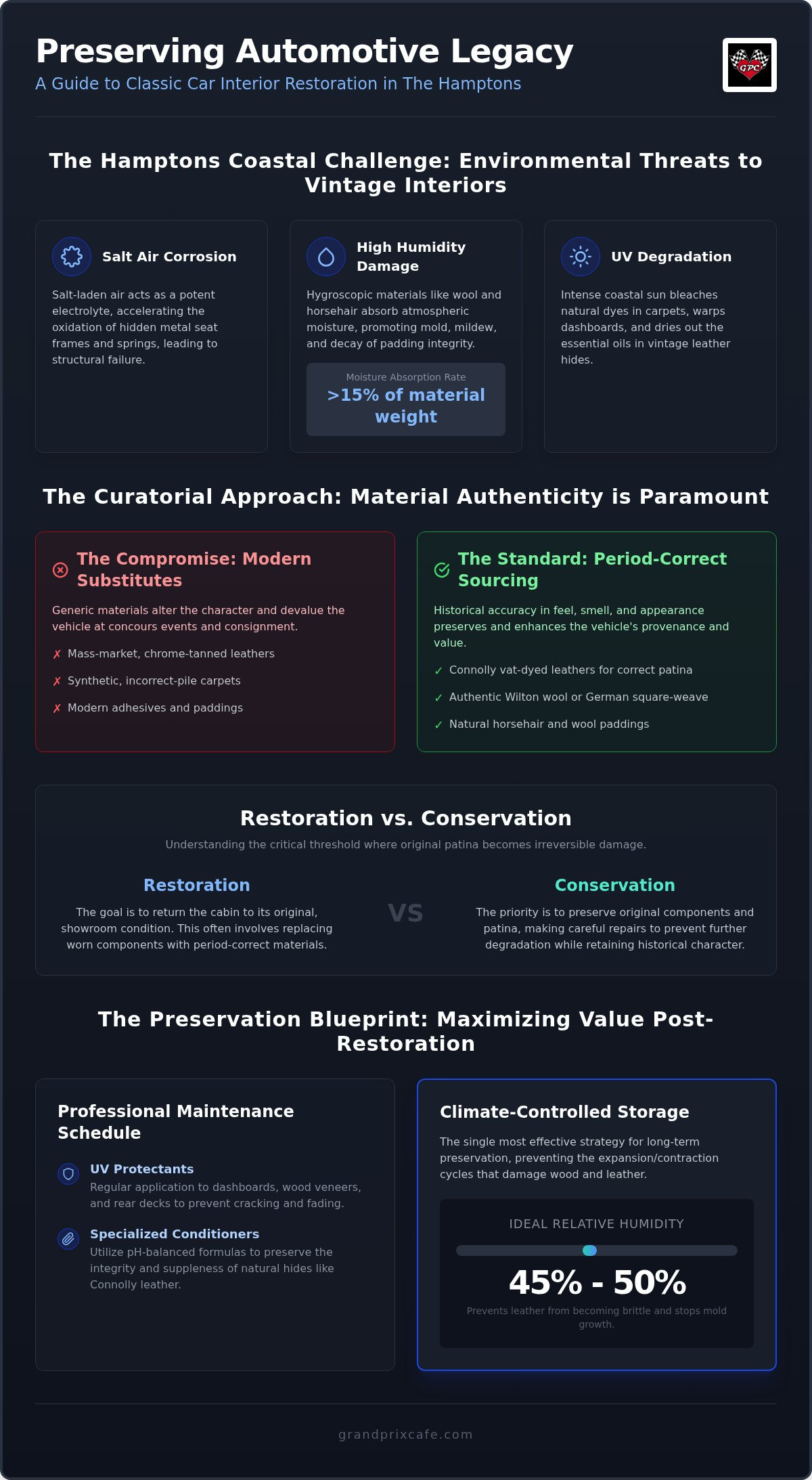
Salt-laden air acts as a potent electrolyte. It accelerates the oxidation of original metal seat frames and spring sets hidden beneath the upholstery. Once moisture penetrates the leather or fabric, it reaches these structural components, causing them to weaken and eventually fail. Hygroscopic materials in vintage cabins, including natural horsehair and untreated wool, absorb moisture from the atmosphere at rates that can exceed 15% of their weight, leading to a steady decay of the padding's structural integrity. Identifying early signs of structural interior corrosion requires a close inspection of the seat bases; look for orange-hued dust on the floorboards or a loss of tension in the spring sets. Humidity also encourages mold and mildew growth within these natural fibers, creating a distinct, unpleasant odor that is difficult to eradicate once it takes root.
UV degradation is equally aggressive in coastal areas. Intense sun exposure bleaches natural dyes in carpets and causes dashboards to warp. Rear decks are particularly vulnerable, as the glass amplifies heat and light, drying out the oils in vintage hides. This technical distinction between Restoration vs. Conservation is the foundation of our philosophy. We don't just replace materials; we select components that respect the vehicle's history while offering enhanced resilience against the elements.
The Role of Climate-Controlled Environments
Preserving a restored cabin requires a stable, monitored environment. A classic car interior restoration Hamptons project is only as successful as the storage solution that follows it. This is why any significant restoration project should be paired with professional indoor car storage in Southampton NY. Maintaining a relative humidity between 45% and 50% is essential for leather longevity. If the air is too dry, hides become brittle and crack; if it's too humid, the risk of biological growth increases.
Protecting sensitive wood veneers from coastal temperature swings is equally vital. Rapid shifts in humidity cause the wood and its substrate to expand at different rates, resulting in the hairline fractures often seen in vintage dashboards. A climate-controlled facility prevents this cycle of expansion and contraction, ensuring that the delicate lacquers and glues remain intact for the long term. By controlling the atmosphere, you're not just storing a vehicle; you're actively extending the life of its most sensitive components.
The Curatorial Approach: Sourcing Authentic Materials
Authenticity is the primary driver of value in the collector market. For a blue-chip vehicle, a standard upholstery job is often a liability rather than an asset. True classic car interior restoration Hamptons standards demand a curatorial approach that prioritizes historical accuracy over modern convenience. Substituting original leather grains with generic, mass-market hides fundamentally alters the tactile experience and visual character of the cabin. This error can lead to significant point deductions at concours events and a reduced valuation during consignment. A cabin doesn't just need to look correct; it must feel and smell correct to the specific era of its manufacture. We often find that collectors who prioritize this level of authenticity also curate their display spaces with fine art and antiques from Antiqueartandtings to ensure a cohesive historical narrative.
Marque-Specific Material Standards
European marques such as Aston Martin and Jaguar were defined by specific material suppliers. Connolly leather, for instance, utilizes a unique vat-dyeing process that allows the hide to age with a specific patina. Modern chrome-tanned leathers can't replicate this aging process, often appearing too uniform or plastic-like. Similarly, authentic Wilton wool carpets or German square-weave textiles provide a density and pile height that synthetic alternatives lack. We apply rigor to every selection, aligning our methods with the high standards found in The Secretary of the Interior's Standards for Historic Preservation. This ensures that every textile and hide reflects the vehicle's production era. Sourcing original equipment manufacturer (OEM) hardware and switchgear is equally critical. A single incorrect bezel or an improperly finished knob can disrupt the entire aesthetic cohesion of a meticulously restored dashboard.
The Science of Period-Correct Adhesives
Restoration involves chemistry as much as craftsmanship. Modern contact cements often contain volatile compounds that lead to 'off-gassing' over time. These vapors can create a permanent haze on the interior of vintage glass and accelerate the pitting of interior chrome trim. We utilize historically appropriate bonding agents that provide long-term stability without compromising adjacent materials. These deliberate choices also preserve the olfactory signature of the vehicle. The 'new car smell' of a 1960s grand tourer is the result of specific natural materials, horsehair padding, and traditional glues. By maintaining these standards, we ensure the cabin remains a sensory time capsule for the owner. If you are considering a project of this magnitude, our team at Grand Prix Cafe can provide a technical assessment of your vehicle's specific material requirements.
Evaluating Your Interior: Restoration vs. Conservation
The decision between preservation and replacement is the most significant choice a collector faces. For a classic car interior restoration Hamptons project, this evaluation dictates the vehicle's future standing at elite events and its long-term market trajectory. Total replacement isn't always the optimal path for high-value assets. Collectors and restoration and preservation specialists often debate the threshold where honest wear becomes terminal damage. This choice directly affects provenance. Every interior component must be scrutinized to identify original factory markings, such as chalk numbers or date stamps hidden within seat assemblies, which serve as definitive proof of originality. Integrating interior work with vintage car restoration in New York ensures the cabin's condition matches the mechanical excellence of the chassis and powertrain.
The Value of Patina in the Modern Market
Preservation focuses on stabilizing existing materials. If the original leather is intact but dry, we utilize specialized hide foods to restore suppleness without erasing the history etched into the grain. Original interiors can command higher prices than restored ones if the condition is exceptional and documented. We evaluate headliners and door cards based on their structural stability and visual cohesion. If the backing boards remain straight and the fabric shows no signs of dry rot, conservation is the preferred route. This approach protects the 'survivor' status of the vehicle, which is increasingly prized in the current market. We look for a consistent level of wear across all surfaces to ensure the cabin feels authentic rather than patchy.
Full Frame-Off Interior Restoration
When degradation is too advanced, a full restoration is necessary. This process begins by stripping seat assemblies down to their bare metal skeletons. We utilize sandblasting and powder coating to protect these frames from the corrosive Hamptons air, preventing future oxidation from the inside out. Structural integrity is paramount. We rebuild seat tracks and adjustment mechanisms to ensure they operate with factory-new precision. Degraded horsehair and coconut fiber padding are replaced with authentic substitutes that provide the correct density and profile. This level of detail ensures the seat feels exactly as it did when it left the factory, providing both comfort and historical accuracy. We don't just cover the damage; we eliminate the root causes of decay to ensure the interior remains stable for decades.
The final result of this meticulous process is a cabin that functions as a cohesive unit. Whether through conservation or restoration, the goal is to maintain the vehicle's narrative. A well-executed interior should never look 'over-restored.' It should look correct. By focusing on these technical details, we protect both the aesthetic beauty and the financial value of your investment.
Maintaining Your Restored Interior in the Hamptons
Completing a high-level restoration is a significant milestone, but the longevity of the results depends entirely on a rigorous maintenance protocol. The Long Island climate remains a persistent threat to natural materials even after they've been professionally treated. Without a proactive schedule, the investment in a classic car interior restoration Hamptons project can begin to degrade within a single season. Preservation is an ongoing commitment. It requires a technical understanding of how coastal stressors interact with vintage textiles and hides over time.
Seasonal Care for Coastal Collectors
A structured approach to cleaning prevents environmental damage from becoming permanent. Following a drive on Montauk Highway, salt particles from the ocean air inevitably settle on interior surfaces. These particles are abrasive and hygroscopic, meaning they draw moisture directly into the grain of the leather. We recommend a three-step seasonal process:
Step 1: Surface Decontamination. Wipe down all leather and vinyl surfaces with a soft microfiber cloth dampened with distilled water to remove salt residue.
Step 2: Deep-Pile Carpet Care. Utilize a vacuum with a soft brush attachment for Wilton wool or German square-weave carpets. Sand and salt trapped deep in the pile act like sandpaper, wearing down the fibers from the base.
Step 3: Leather Preservation. Apply a pH-balanced leather preservative every ninety days. This maintains the suppleness of the hide and creates a sacrificial barrier against UV rays and moisture.
Dashboards and rear decks require specialized attention. Professional-grade UV protectants are essential for preventing the drying and cracking common in the intense coastal sun. Avoid silicone-based products, as these can create an unnatural sheen and trap heat within the material. Instead, opt for matte-finish inhibitors that provide deep-level protection without altering the period-correct appearance of the cabin. To see how these high standards are applied in professional maintenance, you can learn more about LabShine Auto Detailing and their commitment to premium vehicle care.
Storage as Preventative Maintenance
Humidity-controlled storage remains the most effective defense against interior decay. During the humid Long Island summer, moisture levels can easily exceed the safe threshold for natural horsehair and wool paddings. Maintaining a stable environment prevents the "stagnation" odors often associated with vintage cars. Regular mechanical exercise is also vital. Driving the vehicle allows for natural airflow through the cabin, which helps dissipate any latent moisture and keeps the interior smelling as it should. Total vehicle health is a holistic pursuit. It's beneficial to partner with a professional classic car mechanic in Southampton NY to ensure that mechanical systems, such as heaters and vents, are clear of debris that could introduce moisture or odors into the cabin.
The choice of car cover also impacts interior health. In the Hamptons, breathable covers are superior to waterproof versions for indoor use. Waterproof covers can trap condensation against the body and seep into the interior, leading to mildew growth. A breathable, custom-fit cotton or synthetic blend allows moisture to escape while protecting against dust. If you require assistance in establishing a custom preservation plan for your vehicle, contact our specialists at Grand Prix Cafe for a technical consultation.
Grand Prix Cafe: Southampton’s Boutique Restoration Studio
Grand Prix Cafe operates as a boutique gallery for mechanical excellence. Our philosophy of "Mechanical Curatorship" extends beyond the engine bay to the very textiles and hides that define the driving experience. For those seeking the level of classic car interior restoration Hamptons standards demand, our Southampton facility provides a controlled, professional environment where historical integrity is the primary metric of success. We understand that a vintage vehicle is both a mechanical artifact and a significant financial asset. Our processes are designed to honor both. This approach integrates seamlessly with our curated classic car sales in Southampton NY. By maintaining a high standard of interior aesthetics, we ensure every vehicle in our care meets the exacting requirements of the global collector market.
A Personalized Restoration Journey
Every project begins with a comprehensive one-on-one consultation to define the specific scope and goals of the restoration. We don't believe in a one-size-fits-all approach. Whether the objective is a concours-ready cabin or a preserved "survivor" interior, we tailor our methodology to the vehicle's unique history. Clients receive regular progress reporting accompanied by detailed photographic documentation. This transparency ensures you're informed at every stage of the technical process. Our technicians leverage a global network of authentic material suppliers to secure the precise leather grains, wool-pile carpets, and OEM hardware required for an accurate restoration. This meticulous vetting process is what separates a boutique studio from a high-volume repair shop. We prioritize accuracy in every stitch, ensuring the finished cabin is indistinguishable from the day it left the factory.
From Restoration to Disposition
A professionally executed interior is a critical component of a vehicle's long-term marketability. A Grand Prix Cafe restoration prepares your vehicle for luxury car consignment in New York by providing the documentation and physical evidence of quality that discerning buyers demand. Our reputation for technical accuracy helps maximize your vehicle's valuation at the point of sale. We serve as a trusted local partner in the Hamptons, offering the peace of mind that comes with year-round support and climate-controlled care.
By choosing a specialist who understands the nuances of classic car interior restoration Hamptons collectors expect, you're securing the future of your automotive legacy. Our facility is designed to support the East End's most demanding enthusiasts, providing a seamless transition from restoration to storage and eventual disposition. We don't just repair cars; we preserve automotive history through disciplined craftsmanship and an unwavering commitment to provenance. Whether you're preparing for a local concours or a major international auction, our team provides the technical expertise necessary to ensure your vehicle stands apart from the field.
Securing Your Automotive Legacy on the East End
Preserving a vintage cabin requires a technical strategy that addresses both historical accuracy and environmental resilience. Successful classic car interior restoration Hamptons projects balance the use of period-correct materials with proactive climate management. You've seen how salt air compromises structural frames and how authentic textiles maintain a vehicle's provenance. Prioritizing conservation when possible protects the survivor status of your asset; however, full restoration ensures long-term stability against the coastal elements. Each decision directly impacts the vehicle's standing in the global collector market.
Grand Prix Cafe operates a Southampton-based boutique facility dedicated to this level of mechanical curatorship. Our specialized technicians for vintage European marques utilize a transparent, documented process to return your vehicle to peak condition. We don't just replace upholstery. We vet every hide and textile for historical authenticity to ensure it matches original factory specifications. This meticulous approach ensures your vehicle is prepared for the highest levels of competition or professional disposition. We invite you to consult with our restoration specialists at Grand Prix Cafe to discuss the specific requirements of your collection. Your vehicle deserves a preservation plan as distinguished as its heritage.
Frequently Asked Questions
How long does a full classic car interior restoration typically take?
Timeline varies by complexity and the specific requirements of the project. Full restorations often require several months of labor. Sourcing period-correct hides and textiles from European suppliers can extend the schedule significantly. Meticulous frame-off work on seat assemblies is a methodical process. It can't be rushed if concours standards are to be met. Every component is documented and vetted to ensure the final result matches the vehicle's historical profile.
Can you source original fabrics for rare European marques like Porsche or Ferrari?
We maintain a global network of specialized suppliers for rare European marques. This includes authentic German square-weave carpets for Porsche and specific leather grains for Ferrari. Sourcing historically accurate materials is a core component of a classic car interior restoration Hamptons collectors expect. We prioritize OEM textiles to ensure the vehicle's provenance remains intact. Every material choice is verified against factory records to guarantee an accurate finish.
Is it better to preserve original leather or replace it with new hides?
The decision depends on the current state of the material and your long-term goals for the vehicle. If the leather is structurally sound but dry, conservation through specialized hide foods is preferred to maintain original patina. However, if the grain is terminal or dry-rotted, replacement with period-correct hides is necessary. Preservation often commands a higher value for survivor class vehicles at major auctions. We provide a technical assessment to help you choose the correct path.
How does the Hamptons salt air affect my car's interior over time?
Salt air acts as a corrosive electrolyte that accelerates the degradation of both visible and hidden components. It causes oxidation of metal seat frames and spring sets beneath the upholstery. Natural fibers like wool and horsehair absorb this moisture, leading to mold and structural softening. Proactive maintenance and climate-controlled environments are required to mitigate these coastal stressors. Ignoring these factors leads to irreversible structural decay within the cabin's core.
Do you offer climate-controlled storage for cars during the restoration process?
We provide year-round indoor car storage in a climate-controlled environment during the restoration process. Maintaining a stable atmosphere is critical for protecting sensitive materials. Our Southampton facility ensures that leather and wood veneers are shielded from the humidity fluctuations common on the East End. This integrated approach prevents environmental damage from the moment the project begins. It ensures the new interior remains stable throughout the assembly and curing phases.
What is the difference between a standard upholstery shop and a restoration studio?
A restoration studio focuses on historical accuracy and structural curatorship rather than simple cosmetic re-covering. Standard shops often use modern synthetic materials and generic adhesives. A restoration studio provides the classic car interior restoration Hamptons collectors require by stripping components to the frame and using period-correct bonding agents. We treat the cabin as a historical artifact. Every detail reflects the vehicle's original production era and manufacturer standards.
Can interior restoration increase the resale value of my classic car?
A high-quality, documented restoration significantly enhances market valuation. Collectors and auction houses prioritize vehicles with correct materials and professional execution. An accurate interior reflects the overall care given to the vehicle. Conversely, poor-quality upholstery can be a major liability during consignment. It often requires a price reduction to account for future correction. Professional restoration ensures the vehicle is ready for elite competition or high-end sale.
How often should I condition my vintage leather interior in a coastal environment?
We recommend a quarterly conditioning schedule for vehicles kept in a coastal environment. Natural hides require regular nourishment to remain supple against salt-air ingress. Applying a pH-balanced preservative every ninety days creates a sacrificial barrier. This routine prevents the fibers from becoming brittle. It also protects against the aggressive UV exposure typical of Hamptons summers. Regular maintenance is the most effective way to extend the life of a restored cabin.
Comments