


Classic Car Restoration Payment Schedule: A Collector’s Guide
Updated: Oct 13
Should a restoration payment be due because a date has arrived, or because documented work has reached an agreed point? For a classic car owner, that distinction matters. A clear classic car restoration payment schedule connects payments to the approved scope, visible progress, and recorded decisions, while leaving room to address conditions discovered during disassembly.
It’s reasonable to want clarity before authorizing work, especially when proposals use different billing methods or allow for changes to the scope. There isn’t one schedule that fits every restoration. Compare how each proposal defines the deposit, progress payments, work milestones, change approvals, and records supporting each invoice.
This guide explains common payment structures and what to document before work begins. It also shows how to assess estimates when new repairs become necessary and compare proposals by scope, milestones, and communication, rather than headline terms alone. Grand Prix Cafe provides classic-car restoration in Southampton for owners planning a carefully documented project.
Table of Contents
Classic Car Restoration Payment Schedules: What Owners Should Expect
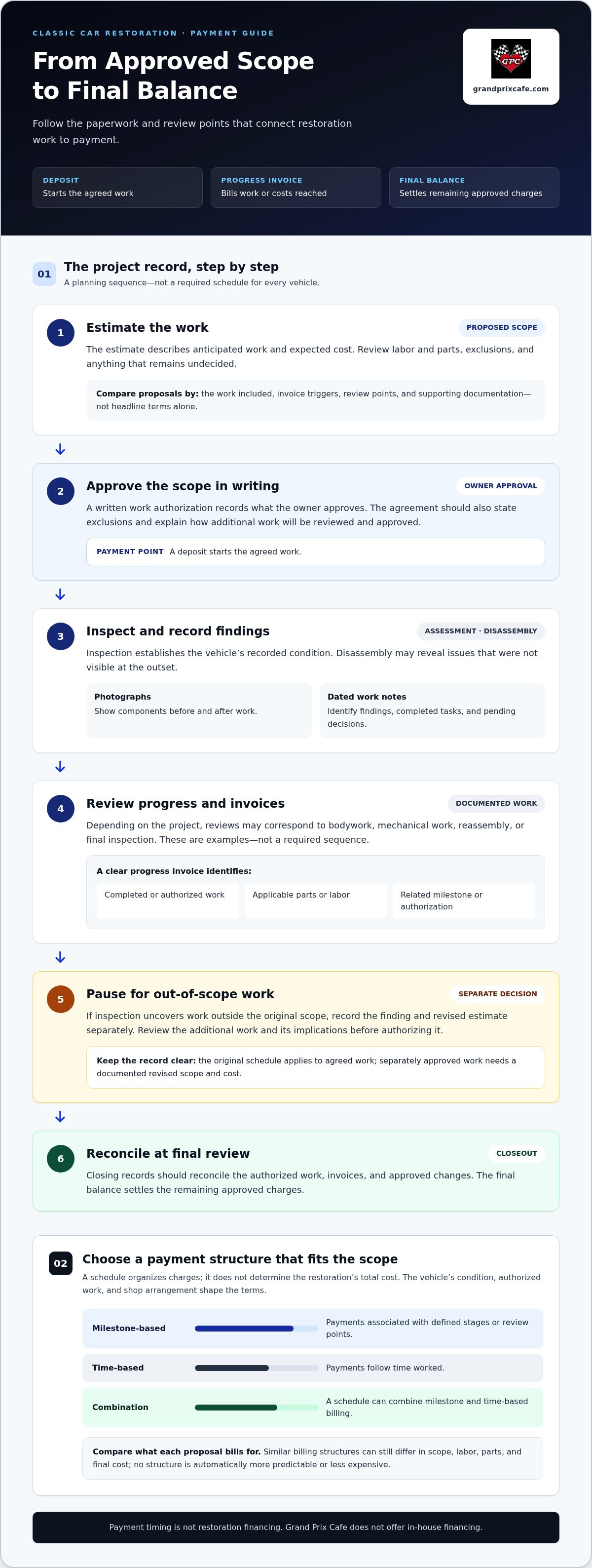
A classic car restoration payment schedule sets out when payment is due in relation to the agreed project scope and documented work. It may use project stages, time worked, or a combination, but no single format suits every vehicle or restoration. The car’s condition, the work authorized, and the arrangement with the shop all shape the terms.
A deposit starts the agreed work, a progress invoice bills for work or costs reached during the project, and the final balance settles the remaining approved charges. These terms describe payment timing, not a way to finance the restoration. Grand Prix Cafe does not offer in-house financing.
What does a restoration payment schedule usually describe?
The estimate describes anticipated work and its expected cost. A written work authorization records what the owner approves. Invoices then request payment according to the agreed terms, using the dates or triggers set out in the schedule. The agreement should also identify exclusions and explain how additional work will be reviewed and approved.
This distinction matters when an inspection reveals a repair outside the authorized scope. The original schedule applies to the agreed work. Any separately approved work should be documented with its revised scope and cost before it proceeds. A clear paper trail helps distinguish scheduled charges from new decisions.
Why classic-car projects need clear payment terms
Two cars of the same model can need different work. Condition, previous repairs, parts availability, and the owner’s priorities all affect the plan. A preservation-focused project, for example, may have a different scope from one that includes broader mechanical and cosmetic work. The process of vehicle restoration can involve distinct levels of intervention, so payment terms should reflect defined work rather than assume every project follows the same sequence.
For owners in Southampton and across Long Island, comparing proposals means looking beyond the initial estimate. Check whether the documents describe the same work, identify exclusions, explain when invoices are issued, and set out how changes are approved. A lower estimate may cover less work rather than offer a directly comparable plan. Clear terms make it easier to understand what each proposal includes before authorizing restoration work.
How Restoration Milestones, Estimates, and Invoices Fit Together
A practical classic car restoration payment schedule can be organized around review points, but the sequence is a planning model, not a standard payment promise. The vehicle’s condition and authorized work determine which stages apply. A project might move from initial assessment to an approved scope, active restoration, progress reviews, and final documentation. Each step should clarify what has been inspected or completed and what decision, if any, the owner needs to make.
Which restoration stages can serve as review milestones?
Inspection establishes the vehicle’s recorded condition and proposed work. Disassembly may reveal issues that were not visible at the outset. Depending on the project, later reviews could correspond to bodywork, mechanical work, reassembly, and final inspection. These are examples, not a required sequence. A focused repair and a comprehensive restoration call for different checkpoints. Similar staging principles apply in precision bodywork and paint correction at facilities like NW Houston Auto Repair and Collision, where verifiable phases protect both the owner and the repair quality.
Photographs and dated work notes make reviews more useful. Images can show a component before and after work, while notes can identify findings, completed tasks, and pending decisions. Written milestones make restoration progress easier to review by connecting each update to specific work and the approvals that authorized it.
What should an estimate and progress invoice communicate?
An estimate should describe proposed work in enough detail to compare it with the authorized scope. It should identify relevant labor and parts, along with exclusions or items that remain undecided. A progress invoice should describe completed or authorized work clearly, list applicable parts or labor, and refer to the related milestone or authorization. Avoid relying on vague entries that don’t explain what a charge is for.
If inspection uncovers work outside the original scope, record the finding and revised estimate separately. The owner can then review the additional work and its implications before authorizing it. This keeps the project record clear and distinguishes the original plan from later decisions. The Federal Trade Commission’s overview of consumer rights for auto repair provides useful context on estimates and repair invoices. Restoration agreements should still be read according to their specific written terms.
At final review, the closing records should reconcile the authorized work, invoices, and approved changes. For owners planning a restoration in Southampton, Grand Prix Cafe’s classic-car restoration service provides local project planning and restoration work.
Milestone-Based vs. Time-Based Payments for Classic Restoration
A payment structure determines how charges are organized, not the total cost of a restoration. Two proposals can use the same billing approach and still differ in scope, labor, parts, and final cost. Compare what each schedule bills for and how it records progress. Don’t assume a particular model is automatically more predictable or less expensive.
When can milestone-based payments suit a restoration?
Defined stages can help an owner review progress against the agreed scope. A milestone might be a documented inspection or a specified phase of bodywork, rather than a calendar date. It should describe a verifiable condition or completed task. A milestone does not guarantee that the stage will be reached by a particular date, since the work and sequence depend on the vehicle and project.
Hidden conditions can still change the scope after disassembly. Clear milestone descriptions, photographs, work notes, and approval records help show what has been completed and distinguish it from newly proposed work. The schedule is only as useful as its definitions and supporting records.
What are the trade-offs of time-based or hybrid schedules?
Time-based billing can reflect ongoing labor as the restoration develops, but owners need records that make the work understandable. Descriptions of tasks, associated parts, and the relevant authorization help connect an invoice to project activity. A hybrid approach may use milestones for review while itemizing labor and approved costs between them. This can accommodate complex work if the agreement explains how each charge is calculated and reviewed.
No structure suits every restoration. For a clearly defined task, a specific stage may make progress straightforward to assess. Work that changes as components are inspected may call for closer labor documentation or a combination of methods. Compare the schedule with the scope, exclusions, approval process, and records it produces. The right classic car restoration payment schedule is one the owner can follow and reconcile with authorized work, not simply one with familiar labels.
How to Review Scope Changes, Approvals, and Final Payment
Inspection and disassembly can expose conditions that weren’t visible at the outset. Rust beneath a panel, previous repairs, or worn components may affect the work required, but additional work isn’t automatic. Distinguish a newly observed condition from an approved change to the restoration plan. A clear record lets the owner understand why the scope may need to change before deciding how to proceed.
How should newly discovered restoration work be documented?
Use a written change order to identify the finding, explain why it calls for additional work, and describe the proposed revision. Attach a revised estimate and note any expected effect on the project sequence or schedule. Record the owner’s authorization before the added work proceeds. Keep the change order with the original scope, related photographs or work notes, and later invoices so the project history remains easy to follow.
This is a practical documentation framework, not legal advice. New York requirements may depend on the circumstances, so verify applicable state and local rules with an authoritative source before relying on a particular form or process.
What belongs in a final restoration review?
Before settling the final balance, compare the completed work with the original agreement and each approved change. Review invoices for clear descriptions of labor, parts, and authorized work, then reconcile them with available photographs, work notes, and other project records. If a line item is unclear, identify the related authorization or milestone in the project file. This keeps the review specific and helps distinguish agreed work from charges that need clarification.
A careful closeout also records any items that remain incomplete or outside the agreed scope. The final balance should reflect documented work and approved revisions, rather than an assumption that every item discussed during the restoration was authorized. For broader context on preservation and mechanical work, read about vintage car restoration in New York.
A well-documented change process supports a more understandable classic car restoration payment schedule from the first inspection through final review. Grand Prix Cafe provides classic-car restoration in Southampton. Explore classic-car restoration at Grand Prix Cafe.
Choosing a Classic Car Restoration Partner in Southampton
A restoration proposal should make the work and its financial terms understandable before authorization. Compare proposals using the same criteria, not just the opening estimate. A clear document can explain what is included without promising a fixed final cost or completion date, particularly when the vehicle’s condition may affect the work required.
What should collectors compare in restoration proposals?
Use this checklist to assess whether the proposed scope fits the car and your priorities:
Scope and exclusions: Are the included tasks specific, and are deferred or excluded items identified?
Condition and preservation priorities: Does the proposal reflect the vehicle’s known condition and your goals for originality, usability, or repair?
Approvals: Is there a clear process for presenting additional work and recording your authorization?
Documentation: Are estimates, invoices, work notes, and progress records described in a way you can follow?
Communication: Does the proposal establish how project updates and decisions will be shared?
These details help distinguish a comparable proposal from one that appears lower only because it covers less work. They also show whether the classic car restoration payment schedule relates to defined work and review points, rather than standing apart from the project plan.
How does local restoration support fit the decision?
For owners in Southampton, Westhampton, East Hampton, and Sag Harbor, working with a local automotive business can make it practical to discuss a vehicle’s condition and restoration priorities. Grand Prix Cafe provides classic-car restoration and accident repair in Southampton, serving owners across Long Island and Manhattan. Its professional classic-car service in Southampton offers additional context on mechanical care, while specialized accident repair for vintage vehicles is relevant when prior damage forms part of the project scope.
Choose a restoration plan you can understand, with work, approvals, and project records connected throughout the process. To explore local restoration, visit Grand Prix Cafe’s Southampton restoration service.
Set Clear Terms Before Restoration Begins
A considered classic car restoration payment schedule connects payments to the authorized scope, documented work, and defined review points. Compare proposals by what they include, how they record progress, and how additional work receives approval, not by payment labels alone. Milestone-based, time-based, and hybrid structures can each suit different projects.
Before work begins, make sure the written agreement explains the scope, exclusions, invoice references, and process for reviewing changes. At completion, reconcile the final balance with approved work and project records. These steps give you a clearer basis for decisions as the restoration develops.
Grand Prix Cafe provides classic-car restoration and accident repair from its Southampton, New York location. To explore restoration support for your vehicle, view classic-car restoration at Grand Prix Cafe.
With a defined scope and careful documentation, you can approach your next restoration decision with greater clarity and confidence.
Frequently Asked Questions
What is a typical payment schedule for classic car restoration?
There’s no single schedule for every restoration. A classic car restoration payment schedule may connect payments to defined project stages, documented labor and costs, or a combination of both. The written agreement should explain when invoices are issued and what they relate to. For a car in Southampton, the vehicle’s condition and approved scope help determine which review points make sense.
Is a deposit normal for classic car restoration?
A deposit is commonly requested to begin restoration work, but its amount and timing vary by project and shop arrangement. Don’t assume a standard percentage. Review the written terms to understand what the deposit covers, how it will be applied, and what work it authorizes. The deposit should align with the agreed scope and payment terms, rather than serve as approval for unspecified repairs.
Should restoration payments be tied to milestones or dates?
Payments tied to verifiable work or project milestones can make progress easier to review, while date-based schedules may provide predictable billing points. Neither approach is automatically best. A milestone should identify a defined stage, such as a documented inspection or agreed phase of work, not promise completion by a particular date. Consider whether the schedule suits the restoration scope and is supported by clear records.
What happens if a classic-car restoration uncovers additional work?
Inspection or disassembly may reveal conditions that weren’t visible initially, but additional work should be distinguished from the approved scope. The project record can describe the finding, proposed work, revised estimate, and any effect on the schedule. Review the change and record your authorization before proceeding. This creates a clear reference for later invoices and separates newly approved charges from the original plan.
Can I compare restoration estimates if their payment schedules differ?
Yes. Compare the scope, exclusions, parts and labor descriptions, approval process, and records as well as the payment structure. One proposal might bill by milestone while another documents ongoing labor. Check whether both cover the same work and how each handles additional findings. For Southampton, nearby Long Island, and Manhattan owners, this method gives a more useful comparison than focusing on payment labels or the initial estimate alone.
When is the final payment due for a classic-car restoration?
The agreement should state when the final balance is due. Before paying, review completed work against the authorized scope and approved changes, then reconcile invoices and project records. If an invoice includes work you don’t recognize, identify the related authorization or request an explanation before treating the account as settled. The final review should reflect documented, approved work, not assumptions about what was included.
Is a restoration payment schedule the same as financing?
No. A restoration payment schedule describes when project charges are due. Financing is a separate arrangement for borrowing or spreading payment through a lender or finance provider. The schedule itself doesn’t mean financing is available. Grand Prix Cafe does not offer in-house financing. The written schedule can still clarify how restoration charges relate to the approved work and project records.
What should a classic-car restoration invoice include?
An invoice should describe the work or costs being billed in understandable terms. Look for relevant labor and parts, the related project stage or authorization, and a clear distinction between the original scope and approved changes. Supporting work notes or photographs can help connect billed tasks with documented progress. For a restoration project in Southampton, keeping invoices with estimates and approvals creates a more complete record of the vehicle’s work history.
Comments