


High Security Car Storage Long Island: The Collector’s Protocol for 2026
- sales299631
- Aug 5
- 10 min read
A locked door is no longer the benchmark for protecting a seven-figure automotive asset. In 2026, the standard for high security car storage Long Island has evolved into a sophisticated blend of physical hardening and environmental precision. You recognize that the region's salt air and humidity are as much a threat as any physical intruder. Entrusting a rare vehicle to a facility requires more than just a lease agreement; it requires a commitment to mechanical integrity and absolute discretion.
This article details the multi-layered protocols essential for preserving high-value investments. You'll learn how advanced alarm monitoring and dehumidified environments prevent the silent damage caused by coastal moisture and particulate matter. We'll also examine the professional maintenance routines, including regular battery management and fluid level inspections, that ensure your vehicle remains in concours condition. Every protocol is designed to eliminate the anxiety of storage, allowing for a seamless transition from the facility floor to the open road. This overview provides the technical framework needed to achieve total peace of mind while maintaining your collection's historical and mechanical provenance.
Table of Contents
Defining High Security Car Storage for the Modern Collector
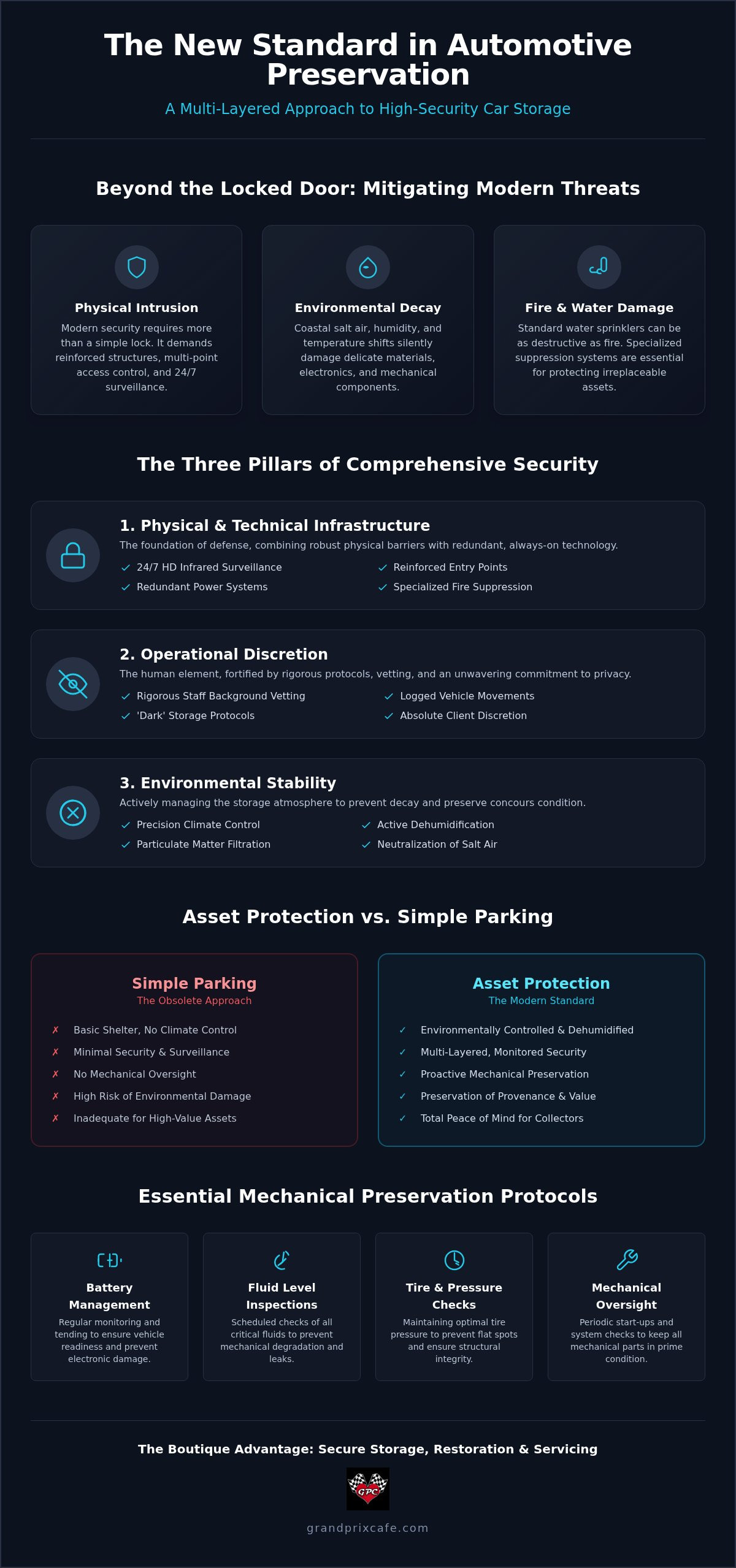
Professional high security car storage Long Island represents a significant departure from conventional vehicle warehousing. It's no longer sufficient to provide a locked door and basic surveillance. Modern collectors require a holistic approach to risk mitigation that addresses three primary vectors: theft, fire, and environmental decay. High-value automotive assets demand a specialized environment where every variable is controlled. Residential garages, while convenient, frequently fail to meet these professional curatorial standards. They often lack the specialized fire suppression systems and precise atmospheric controls necessary to maintain a vehicle in concours condition.
The Three Pillars of Automotive Security
A comprehensive security protocol is built upon three distinct pillars. Physical barriers form the first line of defense. This includes reinforced facility structures and multi-point access control systems that restrict entry to authorized personnel only. Operational protocols constitute the second pillar. Every vehicle movement is logged. Every staff member undergoes rigorous background vetting. This ensures that the human element remains as secure as the physical building. The third pillar is environmental stability. This involves the active management of the storage atmosphere. Protecting the integrity of electronic components and delicate interior materials is a critical part of modern automotive security today. Without these three pillars, a storage solution is merely a parking space.
Asset Protection vs. Simple Parking
Collectors must view their vehicles as financial investments rather than simple machinery. This shift in perspective necessitates a higher standard of care. Utilizing professional indoor car storage in Southampton NY ensures that a vehicle's provenance and condition are meticulously preserved. Simple parking offers shelter; asset protection offers preservation. Insurance companies recognize this distinction. Many high-value policies mandate professional storage as a condition of coverage. These providers understand that a dedicated facility significantly reduces the likelihood of loss due to fire, theft, or environmental degradation. By adhering to a professional protocol, you protect the long-term appreciation and mechanical health of your collection.
Physical and Technical Infrastructure on Long Island
Elite facilities prioritize structural integrity as the foundation of any preservation strategy. Achieving the standard for high security car storage Long Island requires 24/7 monitored surveillance utilizing high-definition infrared technology. These cameras provide exceptional clarity in low-light conditions, ensuring that every square foot of the facility is under constant observation. Industrial-grade perimeter security and reinforced entry points serve as the primary physical deterrents. These barriers are designed to delay and prevent unauthorized access, providing a robust outer shell for the valuable inventory within.
Security systems must remain operational during local power outages or grid instabilities. Redundant power systems, including industrial-grade backup generators, ensure that electronic locks, cameras, and alarm systems function without interruption. The implementation of these technical layers often mirrors the disciplined frameworks found in the Security and Privacy Controls established by NIST. This rigorous approach to technical oversight ensures that the facility's defense remains active regardless of external circumstances.
Electronic Surveillance and Monitoring
Modern monitoring extends beyond simple recording. Integrated motion sensors and glass-break detection systems are linked directly to local law enforcement for immediate response. Every entry and exit from the facility is digitally logged, creating a permanent audit trail of all activity. Discretion is also a key technical component. Many elite facilities employ 'dark' storage protocols. This prevents public visibility of the inventory from the street, significantly reducing the profile of the collection and the risk of targeted theft.
Fire Prevention and Suppression
Standard water-based sprinklers are unsuitable for automotive environments. Water damage to leather interiors, wood veneers, and intricate electronic looms can be as destructive as fire itself. High-end facilities utilize specialized chemical suppression or dry-pipe systems. These technologies neutralize fire risks without saturating the vehicles in water. Regular inspection cycles for all on-site safety equipment ensure that the infrastructure is always ready for deployment. For collectors who demand this level of technical precision, professional vehicle management provides the necessary infrastructure to protect a significant investment.
Operational Discretion: The Invisible Shield
Physical gates and reinforced walls provide a tangible defense, but the most effective security is often invisible. Operational discretion serves as a silent deterrent that ensures the presence of high-value vehicles remains unknown to the public. High security car storage Long Island facilities must prioritize a low-profile exterior. Advertising the contents of a building through flashy signage or social media marketing creates unnecessary risk. True security involves staying out of the public eye. A facility that appears as an ordinary warehouse is far less likely to be targeted than one that broadcasts its inventory.
This philosophy aligns with broader institutional strategies to Protect Your High Value Assets, where the focus shifts from reactive measures to proactive risk avoidance. Appointment-only access is a fundamental requirement. It eliminates unauthorized foot traffic and ensures that every individual on the premises is vetted and expected. By controlling the environment at this level, the facility minimizes the insider threat and accidental exposure. The invisible shield of discretion is what elevates high security car storage Long Island from a standard garage to a world-class preservation environment.
Privacy Protocols for High-Profile Owners
Maintaining owner anonymity is a non-negotiable standard. Staff members and third-party service providers should operate under strict non-disclosure agreements (NDAs). These legal frameworks prevent the leakage of sensitive information regarding collection contents or owner identities. Within the storage area, photography must be strictly prohibited to prevent digital footprints that could be exploited online. When vehicles require transport or external servicing, identities are often masked or vehicles are moved in unmarked, enclosed transporters. This ensures the asset remains anonymous while in transit through public spaces.
Vetted Professional Handling
Technical expertise is a security feature. A standard valet doesn't have the training to manage the complexities of a vintage drivetrain or a modern supercar's electronics. Every vehicle movement should be executed by classic car mechanics in Southampton who understand the specific requirements of rare machinery. Key management follows a standardized check-out protocol where every access is timestamped and attributed to a specific technician. Ignition procedures are performed only by authorized personnel to prevent mechanical wear or unauthorized use. This level of curatorial oversight distinguishes a professional facility from a simple garage. It ensures that the human element of security is as rigorous as the technical infrastructure. It's about maintaining a chain of custody that protects both the physical asset and its long-term value.
Environmental Security: Defending Against the Elements
Long Island's coastal geography presents unique atmospheric challenges that standard garages cannot mitigate. For the modern collector, security must extend to the molecular level. Salt air and extreme humidity are persistent threats that accelerate corrosion and promote the growth of mold within delicate interiors. A facility providing high security car storage Long Island must account for the corrosive nature of the local environment. Protecting a vehicle from environmental decay is as critical as shielding it from physical theft. Rust, dry rot, and the degradation of vintage finishes are silent risks that compromise an investment's value and mechanical integrity.
Security in this context means maintaining the vehicle in a state of stasis. High security car storage Long Island requires a specialized environment where atmospheric variables are actively neutralized. This goes beyond simple shelter. It involves a technical commitment to preserving the physical and chemical properties of leather, rubber, and paint. Without these controls, a high-value asset begins to deteriorate the moment it enters the facility.
Climate Control Precision
Maintaining a consistent 50% relative humidity is the technical benchmark for automotive preservation. This specific level prevents the drying of rubber seals while simultaneously inhibiting the oxidation of metal surfaces. Thermal stability is equally vital. Rapid temperature swings cause the expansion and contraction of metal components, which leads to stress fractures or paint checking over time. Elite facilities utilize industrial-grade HVAC systems paired with advanced air filtration. These systems eliminate dust and corrosive particulates that would otherwise settle on surfaces and trap moisture against the chassis.
Mechanical Preservation Protocols
Static storage is a primary cause of component failure. A comprehensive protocol integrates active mechanical oversight to ensure the vehicle remains roadworthy. Trickle charging and continuous battery health monitoring are standard safety measures to prevent electronic system failures. Tire pressure management is also essential to avoid flat-spotting and structural sidewall damage. Collectors should understand how to prevent mechanical decay in stored vehicles through routine fluid cycling and periodic startups. This process ensures that seals remain lubricated and fuel systems do not stagnate. By combining atmospheric control with mechanical curatorship, the facility provides a true high-security environment. For those seeking this level of specialized oversight, contact the technicians at Grand Prix Cafe to discuss your collection's specific requirements.
The Grand Prix Cafe Advantage in Southampton
Grand Prix Cafe operates as a specialized boutique facility rather than a high-volume warehouse. Every vehicle receives individual attention. By prioritizing quality over quantity, the facility maintains a high standard of high security car storage Long Island. The strategic location in Southampton provides collectors with convenient access while maintaining absolute discretion. It's a curated environment. We design our protocols for those who view their automobiles as significant historical and financial investments. Every vehicle is treated as a unique subject of preservation rather than a unit of inventory.
A Full-Service Automotive Ecosystem
Owners benefit from a comprehensive ecosystem where storage, sales, and technical services converge. This approach defines the premium tier of high security car storage Long Island. Integration is most evident in the on-site vintage car restoration in New York. Master technicians oversee every collection. Beyond restoration, the team provides specialized accident repair for vintage vehicles. This ensures provenance is protected even after an incident. This centralized model allows owners to prepare their vehicles for seasonal use or concours events without moving them between multiple vendors. Consignment services are also available for those looking to rotate their holdings.
Securing Your Legacy
Trust is built on technical excellence. Local collectors choose Grand Prix Cafe because the facility is managed by enthusiasts. We understand the nuances of rare machinery. There is a deep respect for heritage. Peace of mind comes from a multi-layered protocol that includes physical security, environmental control, and professional mechanical oversight. It's not just about parking. It's about preservation. We invite you to contact the team for a private consultation and a tour of our Southampton facility to experience our standards firsthand. Our staff remains dedicated to maintaining a high register of professional distance while providing the functional support your collection requires.
Preserving Automotive Integrity for the Future
The standard for high security car storage Long Island has transitioned from simple warehousing to a disciplined curatorial science. True protection requires a multi-layered strategy that integrates physical hardening with operational discretion and environmental precision. You've seen how climate control and vetted handling protocols prevent the mechanical decay and public exposure that threaten high-value assets. Maintaining a collection in 2026 demands a facility that functions as a mechanical steward rather than a passive landlord.
Grand Prix Cafe provides this level of specialized oversight within a boutique Southampton facility. Our team focuses on the technical requirements of European and vintage models; we ensure every vehicle remains in peak condition. By combining expert mechanical curatorship with advanced security infrastructure, we protect the long-term provenance of your investment. This comprehensive approach ensures that your vehicles are ready for the road or the concours stage at a moment's notice.
Secure your automotive investment at Grand Prix Cafe and ensure your collection receives the professional standard of care it deserves. We look forward to discussing the unique requirements of your vehicles.
Frequently Asked Questions
What is the difference between climate-controlled and temperature-controlled storage?
Temperature control only manages the ambient air temperature, while climate control actively regulates relative humidity levels. For high security car storage Long Island, humidity regulation is the more critical factor. Maintaining a consistent 50% relative humidity prevents leather from cracking and inhibits the oxidation of metal components. Temperature control alone does not prevent moisture-related degradation or mold growth in vintage interiors.
Does my car need to be insured while in high-security storage?
Yes, you must maintain your own comprehensive insurance policy while the vehicle is in storage. While professional facilities carry their own liability insurance, the owner's policy provides the primary coverage for the specific value of the asset. Under New York State law, storage facilities cannot exempt themselves from liability for negligence, but they often require proof of active insurance to ensure the vehicle's provenance is fully protected.
Can I access my vehicle at any time in a high-security facility?
Access is strictly managed through an appointment-only protocol to ensure the highest level of security. This prevents unauthorized foot traffic and ensures that every individual on the premises is vetted and logged. High-security facilities prioritize the safety of the entire collection over on-demand entry. Owners typically provide 24 to 48 hours of notice to ensure their vehicle is staged and ready for departure.
How does salt air on Long Island affect my classic car's security?
Salt air contains corrosive particulates that accelerate rust and degrade clear coats if not managed. In the context of high security car storage Long Island, security includes environmental defense. High-performance air filtration systems and dehumidification are necessary to neutralize these coastal threats. Without these technical safeguards, the structural and mechanical integrity of a classic car is at constant risk from the local atmosphere.
What fire suppression systems are safest for vintage automotive interiors?
Chemical or dry-pipe suppression systems are the safest options because they don't utilize water. Water-based sprinklers can cause irreversible damage to original leather, wood veneers, and delicate wiring looms. Professional facilities use agents that neutralize fire risks while leaving no residue on the vehicle's surfaces. These systems are specifically designed for high-value environments where the preservation of original materials is as important as fire safety.
Do you provide battery tending and tire pressure checks during storage?
Yes, routine mechanical maintenance is a standard component of professional curatorial storage. Technicians utilize trickle chargers to maintain battery health and prevent electronic system failures. Regular tire pressure checks are performed to prevent flat-spotting and sidewall degradation. These proactive measures ensure that the vehicle remains in roadworthy condition and is ready for use immediately upon retrieval from the facility.
Is the location of a high-security facility kept confidential?
Operational discretion is a primary security feature, and high-profile facilities often maintain a low public profile. While the general location is known to clients, the facility does not utilize flashy signage or advertise its inventory to passersby. This dark storage approach significantly reduces the risk of targeted theft or unwanted social media exposure. Confidentiality ensures that the collection remains anonymous to the general public.
Can you transport my exotic car to the storage facility?
Professional facilities offer enclosed transport services to ensure the vehicle remains protected and anonymous during transit. Using a specialized transporter prevents exposure to road debris, weather, and public visibility. This door-to-door service maintains a secure chain of custody from your residence to the facility. It's the preferred method for moving high-value assets without adding unnecessary mileage or environmental wear.
Comments