


Long-Term Car Collection Storage in Sag Harbor: A Collector's Guide to Preservation
- sales299631
- Aug 4
- 11 min read
Updated: Aug 12
Passive parking is the silent enemy of a high-value automotive investment. While a residential garage offers convenience, it rarely provides the specialized environment required to combat the aggressive salt air and humidity unique to the East End. For the discerning owner, long term car collection storage Sag Harbor represents more than a lease on square footage; it's a commitment to mechanical curatorship and the preservation of historical provenance.
You likely recognize the difficulty of maintaining a growing collection when space is limited and the coastal climate threatens to compromise delicate finishes or internal components. It's a common concern for those who value mechanical integrity as much as aesthetic perfection. This guide explores how professional storage solutions protect your assets from decay and environmental damage. We'll examine the technical standards of year-round indoor facilities and the maintenance protocols that ensure your vehicles remain in concours-ready condition. You'll learn how a structured environment ensures your collection is prepared for the road the moment the driving season begins, maintaining both its resale value and its readiness for the open road.
Table of Contents
The Coastal Challenge: Why Sag Harbor Requires Specialized Collection Storage
Sag Harbor's coastal geography dictates a rigorous approach to automotive preservation. Proximity to the Atlantic introduces a high concentration of airborne chlorides. These salt particles are highly corrosive. They accelerate the oxidation of ferrous metals and cause irreparable pitting on vintage chrome and magnesium alloys. Professional long term car collection storage Sag Harbor provides the only effective barrier against these aggressive environmental stressors.
Atmospheric Corrosion in the Hamptons
Salt particles are small enough to bypass standard garage door seals. Once inside, they settle in hidden structural cavities where moisture naturally accumulates. This leads to flash rust on unprotected steel components. Magnesium alloys, common in classic European sports cars from the 1950s through the 1970s, are especially susceptible to galvanic corrosion when exposed to salt-laden air. Moisture ingress also threatens sensitive vintage electrical systems; it causes high-resistance connections and degrades wire insulation over time. Adhering to established vehicle preservation principles requires a sealed, controlled environment that neutralizes these atmospheric threats before they compromise vehicle integrity.
The Limits of Residential Climate Control
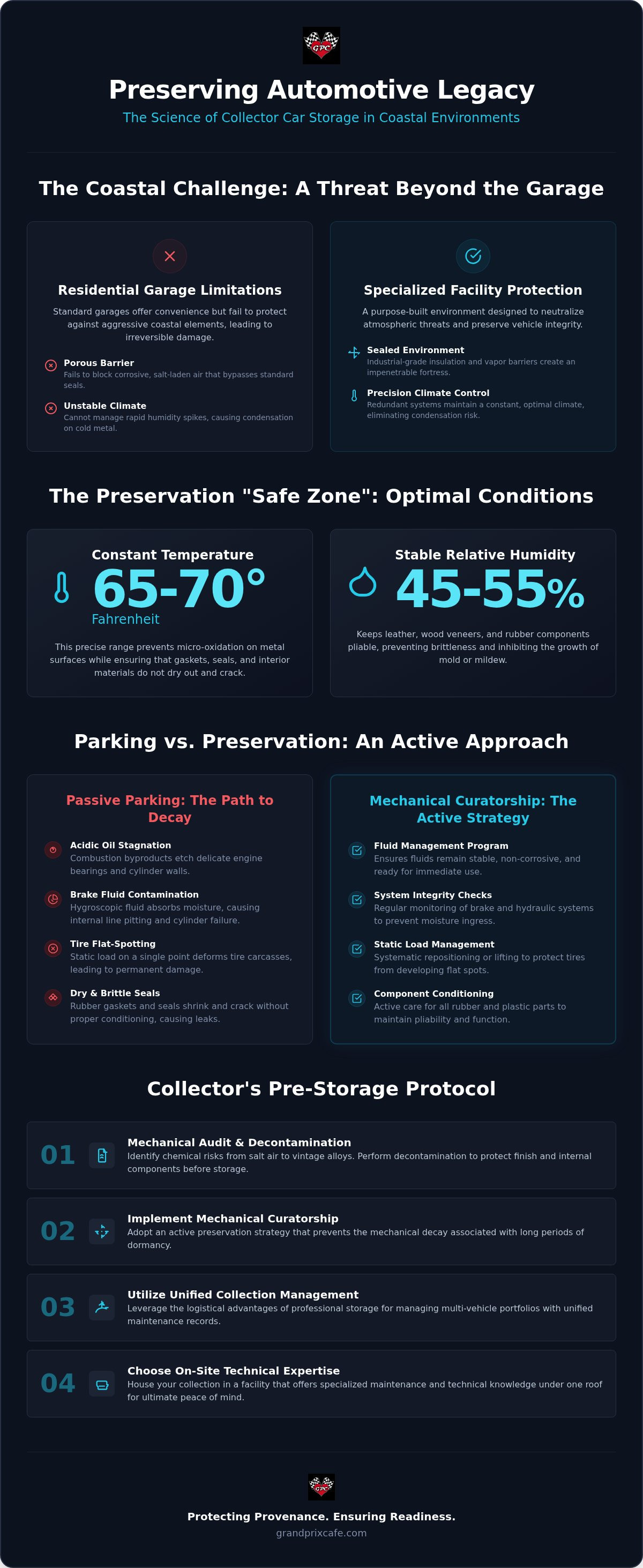
Standard residential garages are typically repurposed spaces. They lack the industrial-grade insulation and vapor barriers found in specialized facilities. Home HVAC systems are designed for human comfort rather than the specific needs of a dormant vehicle. These systems often struggle with rapid humidity spikes during the transition from day to night. When warm, humid air hits a cold metal car body, condensation forms in areas that are nearly impossible to dry. This cycle of wetting and drying is a primary driver of mechanical decay in the Hamptons.
Relative Humidity is the measure of water vapor in the air relative to the maximum amount the air can hold at a specific temperature; for automotive leather and wood veneers, a consistent 50% prevents the material from becoming brittle or developing mildew.
Technical preservation standards in 2026 define the Safe Zone as a strictly monitored environment. It requires a constant relative humidity between 45% and 55%. Temperatures should remain stable between 65 and 70 degrees Fahrenheit. This specific range prevents micro-oxidation on metal surfaces while ensuring that gaskets, seals, and interior materials don't dry out. Maintaining this balance is impossible in a typical residential setting. It requires industrial-grade dehumidification and redundant monitoring systems to ensure the vehicle's provenance remains intact over years of storage.
Technical Preservation: The Difference Between Parking and Storage
Passive parking is often mistaken for preservation. A vehicle left in a static state begins to deteriorate immediately. True preservation requires mechanical curatorship, an active management style that prioritizes technical integrity over simple space allocation. For owners seeking long term car collection storage Sag Harbor, understanding the physiological needs of a dormant machine is essential to maintaining resale value and mechanical readiness. It's the difference between a car that starts on the first turn and one that requires an expensive flatbed to the workshop.
Fluid Dynamics and Seal Integrity
Engine oil accumulates acidic residues from combustion byproducts. If left stagnant, these acids etch into delicate engine bearings and cylinder walls. Brake fluid is hygroscopic, meaning it actively attracts moisture from the air even in climate-controlled spaces. This leads to internal line pitting and master cylinder failure. Professional standards for a Pre-Storage Mechanical Audit emphasize that fluid state is as critical as physical security. Vintage fuel systems are particularly vulnerable to ethanol-blended fuels, which phase-separate and corrode carburetor bowls. Coolant inhibitors also deplete over time, risking electrolysis in vintage aluminum radiators. Gaskets and rubber seals require moisture to remain pliable; without it, they shrink and leak immediately upon the vehicle's return to service.
Static Load Management
Tires are engineered for motion. When a heavy vehicle remains stationary for months, the carcass develops flat spots that can lead to permanent vibration and safety risks. Suspension components suffer from static fatigue when kept under constant load in one position. While some collectors utilize jack stands, this can overextend bushings not designed for such articulation. Battery health is another critical factor. Simple trickle chargers often fail to prevent plate sulfation. High-end storage protocols utilize active cycling to simulate real-world usage and maintain internal chemistry. Periodic drivetrain rotation is also necessary to prevent valve springs from weakening under constant pressure on specific camshaft lobes. Professional long term car collection storage Sag Harbor ensures these mechanical nuances are managed by technical experts who understand the engineering behind the investment.
Maintaining these technical standards requires specialized equipment and on-site expertise, such as the car service capabilities found in professional facilities.
Collection Management vs. Single Unit Storage
Managing an automotive portfolio involves complexities that standard single-unit storage cannot address. For the collector with multiple high-value assets, the logistical burden of coordinating individual maintenance schedules and transport becomes a significant endeavor. Long term car collection storage Sag Harbor should function as a centralized hub for oversight rather than a collection of disconnected parking spaces. This unified approach ensures that every vehicle, regardless of its specific marque or era, receives consistent technical attention. It eliminates the risk of forgotten maintenance that often occurs when a collection is spread across multiple residential or commercial sites.
The Portfolio Approach to Storage
Centralizing a collection allows for the synchronization of service intervals and fluid management. A diverse portfolio often includes vehicles with disparate mechanical requirements, from air-cooled flat-sixes to complex, multi-carburetor V12 engines. Managing these across various remote locations leads to fragmented maintenance records and missed service windows. A professional facility provides a single point of technical accountability. This environment facilitates ongoing preservation and provides immediate access to specialized vintage car restoration New York services. Maintaining unified digital and physical records for each chassis is vital. These logs track battery health, tire rotation, and fluid chemistry, providing a transparent history that is essential for preserving provenance and maximizing future resale value.
Access and Concierge Logistics
Seasonal rotation is a primary requirement for residents in Sag Harbor. The transition into the summer driving season requires precise coordination to ensure specific vehicles are mechanically ready and delivered on schedule. This concierge-level service removes the friction of vehicle transport through the congested summer traffic of the East End. Discreet handling is a baseline expectation for rare collectible cars. Transport should utilize enclosed, low-profile carriers to maintain privacy and protect vehicles from road debris. Security protocols must extend beyond simple surveillance to include environmental safeguards. In coastal regions, emergency preparedness includes redundant power systems. These systems maintain critical climate control and security monitoring during the power outages that occasionally affect the South Fork. Securing professional long term car collection storage Sag Harbor provides the peace of mind that a multi-vehicle investment is managed with the same precision as a fine art portfolio.
The Pre-Storage Mechanical Audit: A Collector's Checklist
A professional mechanical audit is the definitive starting point for effective preservation. It serves as a technical baseline, documenting the vehicle's state before it enters a controlled environment. For those utilizing long term car collection storage Sag Harbor, this audit identifies pre-existing vulnerabilities that dormancy might exacerbate. It's a proactive measure to ensure the vehicle's provenance remains undisputed and its insurance valuation is accurately supported by current condition reports. Neglecting this step often results in the discovery of avoidable leaks or electrical failures when the vehicle is eventually recommissioned.
Modern ethanol-blended fuels are particularly destructive during periods of inactivity. Ethanol is hygroscopic; it absorbs water from the atmosphere, leading to phase separation and the formation of corrosive resins in fuel lines and carburetors. Stabilization involves treating the fuel system with specialized additives and running the engine to ensure the treated fuel reaches every internal component. This process protects the delicate internals of vintage 1950s-1970s European classics from the gummy deposits that can ruin a fuel system over a single winter.
Mechanical Preparation Steps
Following a structured sequence ensures no technical detail is overlooked during the intake process:
Step 1: Perform a fresh oil change to remove combustion byproducts. Used engine oil contains acids and contaminants that can etch into metal surfaces over time. Replacing it with fresh, neutral-pH oil provides a protective environment for bearings and cylinder walls.
Step 2: Check and adjust all fluid levels to prevent air pockets. Ensuring that brake, coolant, and transmission reservoirs are at the correct levels minimizes the amount of air in the system, which reduces the opportunity for internal condensation and corrosion.
Step 3: Inflate tires to storage pressure to mitigate flat-spotting. Increasing the tire pressure beyond standard operating levels helps the carcass maintain its shape under the static weight of the vehicle, preventing permanent deformation of the rubber compound.
Aesthetic and Interior Protection
Environmental contaminants must be neutralized before a vehicle is covered. This is especially critical in Sag Harbor, where road salt and coastal brine can cling to the undercarriage and wheel wells. A thorough detailing of the chassis and suspension components removes these catalysts for rust. Once the exterior is decontaminated, applying a breathable car cover designed for indoor use prevents dust accumulation while allowing any residual moisture to evaporate from the paint surface.
Interior preservation is equally specialized. Placing high-capacity desiccant bags within the cabin and trunk space effectively regulates localized humidity levels to protect vintage Connolly leather and walnut veneers from mold and dry rot. Documenting the interior's condition at this stage ensures that any subtle changes in material integrity are noticed early. To ensure your investment is prepared for its period of dormancy, you should book year-round indoor car storage that includes a comprehensive technical intake.
Grand Prix Cafe: Secure Long-Term Storage for Sag Harbor
Grand Prix Cafe operates as a technical sanctuary for high-value automotive assets. Our facility provides a year-round indoor environment specifically engineered to exceed the preservation requirements of rare and significant vehicles. Located in Southampton, we offer a strategic hub for long term car collection storage Sag Harbor residents. This proximity allows for rapid vehicle deployment while ensuring the collection remains isolated from the corrosive coastal elements discussed in previous sections. We provide more than just space; we offer a controlled atmosphere where mechanical integrity is the primary objective.
Our approach centers on the principle of mechanical curatorship. This is not a passive parking facility; it's a technically active environment where every vehicle remains under the direct supervision of our classic car mechanic Southampton NY. This ensures that the technical protocols, from battery cycling to fluid chemistry monitoring, are executed with professional precision. We possess deep expertise in the preservation of 1950s through 1970s European classics, providing the specific technical knowledge required to maintain these complex machines in their peak state.
Beyond storage, our infrastructure supports the entire lifecycle of a collection. We provide a full suite of on-site capabilities, including accident repair vintage vehicle services and comprehensive mechanical restoration. This integration allows for major maintenance projects or repairs to be completed during the off-season. It ensures your vehicle is ready for the road without the need for additional transport to external workshops, preserving both your time and the vehicle's condition.
Beyond Simple Storage
Secure Your Collection's Future
Establishing a long-term storage partnership with us begins with a technical consultation regarding your specific collection needs. Our Southampton location serves as a discreet and secure environment for significant automotive wealth. We prioritize transparency and historical integrity, functioning as a trusted advisor for your preservation strategy. Our team is dedicated to the long-term health of your vehicles and the preservation of their provenance. Contact Grand Prix Cafe to discuss your collection storage needs.
Preserving Your Automotive Legacy
Effective preservation in the Hamptons requires a transition from passive parking to active mechanical curatorship. The aggressive coastal environment necessitates a controlled, indoor setting that neutralizes the risks of salt air and humidity spikes. Maintaining the provenance and mechanical readiness of a multi-vehicle portfolio is a technical responsibility. It involves rigorous pre-storage audits, fluid management, and consistent atmospheric monitoring to prevent the decay associated with dormancy.
Grand Prix Cafe provides a secure, year-round indoor facility designed specifically for high-value automotive investments. Our specialized classic car technicians ensure every vehicle remains in peak condition through professional mechanical curatorship and dedicated oversight. Securing long term car collection storage Sag Harbor owners can trust ensures your vehicles are prepared for the open road the moment the season begins. We invite you to Secure your collection at Grand Prix Cafe and protect the historical integrity of your investment. Your collection deserves a sanctuary that matches its significance.
Frequently Asked Questions
Is climate-controlled storage necessary for a car collection in Sag Harbor?
Climate control is essential for any significant collection near Sag Harbor. Coastal humidity and salt air act as aggressive catalysts for corrosion on both ferrous and non-ferrous metals. A stabilized environment prevents the condensation cycles that occur during seasonal temperature shifts. It protects the structural integrity of the chassis and the delicate finishes of vintage components from environmental degradation.
How often should a stored classic car be started or driven?
Avoid starting a vehicle for short durations during storage. Idling an engine without reaching full operating temperature introduces moisture into the oil and exhaust system, which leads to internal corrosion. Professional protocols favor periodic drivetrain rotation and active maintenance cycles over frequent, short-range driving. This approach preserves engine health and prevents premature wear on internal gaskets and seals.
What is the ideal humidity level for long-term vintage car storage?
The ideal relative humidity for vintage vehicles is between 45% and 55%. This specific range is high enough to keep heritage leather and wood veneers from becoming brittle but low enough to inhibit metal oxidation. Maintaining this precise balance requires industrial-grade dehumidification systems. Standard residential garages rarely offer the consistency needed to protect a high-value automotive investment over several months.
Can I store multiple cars in one professional facility near the Hamptons?
Professional facilities are specifically engineered to accommodate multi-vehicle portfolios. Centralizing your assets allows for unified maintenance logs and streamlined logistical management for your entire collection. Long term car collection storage Sag Harbor becomes significantly more efficient when a single technical team oversees the mechanical needs and transport logistics of every vehicle in your care.
What should I do about the fuel in my car before long-term storage?
Fill the tank with ethanol-free fuel and add a high-quality stabilizer before entering storage. You must run the engine for several minutes to ensure the treated fuel circulates through the entire fuel system, including the carburetor or fuel injectors. This prevents the phase separation and gumming that common ethanol-blended fuels cause during long periods of inactivity.
How does professional storage affect a classic car's insurance premiums?
Professional storage typically improves a vehicle's risk profile in the eyes of specialty insurers. Facilities featuring advanced security, fire suppression, and climate control provide a safer environment than most private residential garages. While it doesn't guarantee a rate reduction, it provides the documentation and security standards that often lead to more favorable premium structures for collectors.
Is it better to store a car with the windows up or down?
Leave the windows slightly cracked to allow for internal air circulation during storage. This prevents the air inside the cabin from becoming stagnant, which can lead to moisture traps and mold growth on interior surfaces. Using desiccant bags in conjunction with slight ventilation provides the most effective protection for heritage leather and fabric interiors in coastal climates.
What is mechanical curatorship and why does a collection need it?
Mechanical curatorship is an active, technical management style for dormant vehicles. It involves specialized technicians who perform regular fluid checks, battery cycling, and mechanical audits to ensure the car remains in peak condition. A collection needs this oversight to ensure it remains road-ready and retains its historical provenance throughout the storage term, preventing the decay of static components.
Comments