


Rare Classic Cars for Sale in New York: Collector's Guide
The most expensive collector car is rarely the vehicle with the highest acquisition cost; it's the undocumented chassis concealing structural corrosion beneath fresh lacquer. When evaluating rare classic cars for sale New York collectors frequently encounter open classifieds that prioritize inventory volume over mechanical truth. Tracing authentic ownership lineage, verifying factory casting numbers, and uncovering previous collision repairs proves exceptionally difficult behind polished photography. In coastal New York, the stakes are even higher, as ambient salt air and damp winter storage quietly compromise unsealed floor pans and suspension mounts.
You already know that aesthetic appeal cannot substitute for verified provenance and disciplined mechanical inspection. This guide delivers an uncompromising framework to help you navigate the regional market, secure investment-grade motorcars, and avoid deceptive cosmetic restorations. We'll examine forensic verification standards, title and registration requirements, and the dedicated mechanical stewardship required to protect automotive assets for decades to come.
Table of Contents
The Landscape of Rare Classic Cars for Sale in New York
Manhattan and Long Island maintain one of the highest concentrations of blue-chip motorcars in North America. Sourcing authentic, rare classic cars for sale New York collectors seek requires distinguishing true rarity from market hype. Automotive rarity isn't determined by price tags alone. It rests strictly on documented production totals, verified surviving examples, factory options, and continuous ownership history. While historical automotive registries define what is a classic car based on age thresholds, investment-grade status demands far higher standards of mechanical and structural integrity.
The Distinction Between Volume Marketplaces and Curated Collections
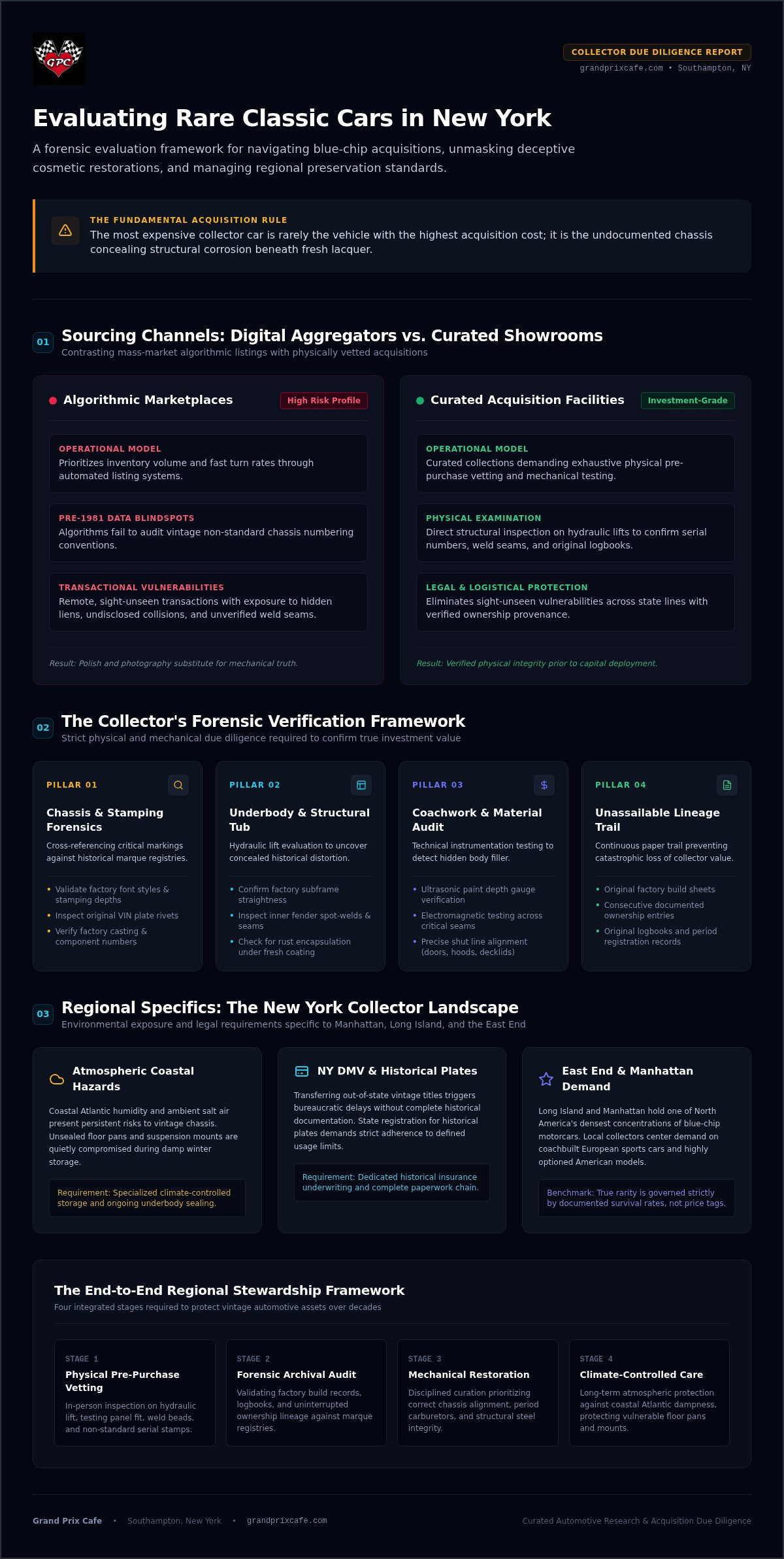
Mass-market digital aggregators apply automated algorithms to vintage motorcars just as they do to late-model commuter vehicles. These systems fail to evaluate critical nuances like correct chassis weld seams, period-correct carburetors, or documented ownership chains. Remote peer-to-peer transactions introduce substantial exposure to hidden title liens, unrecorded collision repairs, and deceptive cosmetic touch-ups. Conversely, curated acquisition facilities allow buyers to physically inspect structural components on a hydraulic lift, examine stamped serial numbers, and review original logbooks before deploying capital.
Algorithmic listings: Prioritize high vehicle turn rates without verifying matching components or coachwork authenticity.
Curated showrooms: Require exhaustive physical pre-purchase vetting, mechanical testing, and documented provenance.
Transaction safety: Eliminates the legal and logistical vulnerabilities of buying sight-unseen across state lines.
Market Dynamics: Why New York Demands Rigorous Due Diligence
Acquiring rare classic cars for sale New York regional collectors target requires navigating complex local realities. Transferring out-of-state vintage titles through the New York Department of Motor Vehicles often encounters bureaucratic delays without complete historical documentation. State registration for historical plates demands strict adherence to usage limits and specialized historical insurance underwriting. Regional demand across the East End and Manhattan centers predominantly on coachbuilt European sports cars and highly optioned American performance models with traceable histories. Reviewing our analysis on curated classic car sales in Southampton NY reveals why local inspection and documented heritage remain non-negotiable standards for serious collectors.
Evaluating Rare Classic Cars: The Collector's Verification Framework
Acquiring investment-grade machinery requires moving past surface aesthetics to verify forensic integrity. Automated history platforms cannot audit pre-1981 vehicles due to their non-standard chassis numbering conventions. As a result, evaluating rare classic cars for sale New York collectors pursue demands strict physical and mechanical due diligence. Genuine rarity requires unassailable provenance; unverified claims diminish collector value permanently. Every prospective acquisition must present a documented historical trail, confirming factory build sheets, consecutive ownership entries, and period registration records matching the standards for official New York historical vehicle registration.
Chassis Forensics and Structural Integrity
Structural validation begins on a lift. Factory panel gaps, inner fender spot-welds, and floor-pan pressings reveal whether a tub retains its original steel or suffered historical collision distortion. Heavy undercoating often conceals localized rot or poorly executed fiberglass patching. Ultrasonic paint depth gauges and electromagnetic testing identify excessive polyester filler across critical seams. Preserving true chassis alignment demands the specialized standards outlined in our study on vintage car restoration in New York.
Chassis stampings: Cross-reference factory fonts, stamping depths, and VIN plate rivets against marque registries.
Underbody architecture: Confirm factory subframe alignment, longitudinal rail straightness, and absence of rust encapsulation.
Body panel fit: Inspect shut lines across doors, hoods, and decklids for uniform millimeter tolerances.
Mechanical Authenticity and Original Componentry
Numbers-matching verification extends well beyond the primary block stamping. True forensic inspection checks casting dates on cylinder heads, transmission casings, differential housings, and steering boxes. Original induction systems must carry period-correct carburetors, fuel injection pumps, and historical ignition distributors rather than modern aftermarket retrofits. Suspension pick-up points and geometry require direct measurement to ensure historical precision.
Evaluating potential rare classic cars for sale New York specialists provide also involves dynamic diagnostic testing. Cold-crank compression audits and cylinder leak-down tests reveal ring seal integrity, valve seating, and internal wear patterns before purchase commitments occur. When you need independent assessment of a prospective asset, you can schedule a pre-purchase review through our car service department in Southampton.
Sourcing Channels Compared: Digital Auctions vs. Boutique Dealerships
Acquiring rare classic cars for sale New York enthusiasts seek involves choosing between blind digital bidding and curated physical showrooms. While online platforms deliver inventory breadth, they place all verification liability entirely on the buyer. Direct boutique acquisitions prioritize buyer security, discretion, and documented mechanical health.
The Real Cost of Remote and Auction-Based Acquisitions
The final hammer price on a digital platform rarely reflects the true total cost. Successful bidders face substantial buyer premiums, cross-country enclosed freight expenses, and immediate post-delivery remediation. Vehicles arriving in New York frequently exhibit undisclosed suspension wear, aged wiring harnesses, or fluid leaks that were invisible in staged online galleries. Resolving these defects requires substantial workshop labor before the car can safely navigate regional roads.
The Advantage of Curated Consignment and Dedicated Showrooms
Physical showrooms establish accountability. When exploring rare classic cars for sale New York collectors benefit from professional curators who inspect every consigned asset before presenting it to the market. This operational model encourages open discussion between prospective buyers and seasoned mechanics regarding mechanical tolerances, historical service records, and original componentry. For owners planning vehicle placement rather than purchase, the framework detailed in our guide to luxury car consignment New York outlines how professional representation preserves vehicle equity while safeguarding transaction confidentiality.
Regional Considerations: Owning and Preserving Classic Cars in New York
Regional geography dictates distinct preservation challenges for classic automobiles. Sourcing rare classic cars for sale New York specialists provide is only the initial step; maintaining structural and mechanical integrity demands proactive stewardship. The East End of Long Island and the greater New York metropolitan corridor expose vintage chassis to airborne ocean salinity, extreme seasonal temperature swings, and severe road surface debris.
Mitigating Environmental Exposure on Long Island and Manhattan
Coastal marine layers deposit microscopic sodium chloride particles onto automotive surfaces. Over time, this ambient salt air attacks unprotected bare-metal subframes, unsealed seam welds, and brightwork plating. In Manhattan stop-and-go driving, high ambient summer temperatures stress vintage cooling circuits and vaporize fuel inside period carburetors.
Corrosion barriers: Apply cavity waxes and penetrating corrosion inhibitors inside boxed rocker panels and floor supports.
Hydraulic maintenance: Flush hygroscopic brake fluids annually to prevent internal cylinder pitting caused by coastal humidity.
Cooling management: Verify radiator core efficiency, fan clutch lockup, and thermostat calibration before seasonal city driving.
The Necessity of Year-Round Climate-Controlled Storage
Standard home garages cannot shield historical vehicles from moisture condensation. When spring humidity meets cold garage concrete, condensation blankets bare cast iron, causing flash rust on brake rotors and exhaust manifolds. Stabilizing relative humidity between 40% and 50% while holding ambient temperatures around 60°F prevents moisture damage, leather shrinkage, and rubber weatherseal decay.
Prolonged seasonal inactivity introduces mechanical hazards. Modern ethanol fuel blends separate and oxidize within months, gumming needle valves and deteriorating vintage rubber fuel lines. Tires resting stationary on concrete develop permanent flat spots, while suspension bushings deform under sustained, unvarying load. Dedicated facilities mitigate these issues through regulated air circulation, battery tender management, and managed tire pressure.
Protecting rare classic cars for sale New York collectors bring home requires purpose-built infrastructure. Review the facility standards detailed in our report on professional indoor car storage in Southampton NY. To safeguard your automotive collection in a secure, climate-monitored environment, reserve year-round indoor car storage today.
Acquiring Rare Classic Cars Through Grand Prix Cafe in Southampton
Grand Prix Cafe operates as a specialized classic automotive center in Southampton, New York. For decades, the facility has served East End and Manhattan collectors seeking verified, investment-grade machinery. Rather than operating as a conventional broker, the center provides an integrated ecosystem combining classic car sales, bespoke mechanical maintenance, restoration, and secure preservation under one roof. Every vehicle entering the showroom undergoes exhaustive physical and forensic vetting conducted by technicians experienced in historic coachwork, period metallurgy, and vintage engineering.
Bespoke Acquisition and Consignment Curatorship
Locating verified machinery requires private networks and technical discipline. When evaluating rare classic cars for sale New York collectors often require specific chassis configurations, historical racing pedigrees, or low-production variants. Our curatorial team sources off-market examples matching exacting matching-numbers criteria and verifiable provenance. For collectors divesting single assets or entire estates, our vehicle consignment services provide discreet representation, forensic cataloging, and direct placement. Outright vehicle purchase options are also available for owners seeking immediate liquidity without auction delays.
Complete Lifecycle Support: Service, Restoration, and Storage
Acquisition marks only the initial phase of collector ownership. Preserving historical authenticity requires specialized ongoing stewardship. Our workshop delivers full car service and mechanical maintenance tailored specifically to vintage European and American sports cars. With dedicated in-house capabilities for comprehensive car restoration and accident repair, our technicians handle structural metalwork, engine rebuilding, and correct cosmetic refinishing to strict historical standards.
Post-acquisition preservation is supported through our dedicated year-round indoor car storage facility. Stored vehicles remain protected from coastal Long Island humidity in a secure, climate-monitored environment. Sourcing rare classic cars for sale New York enthusiasts can collect with total confidence begins with physical verification. Contact Grand Prix Cafe in Southampton to arrange a private acquisition consultation or inspect our current showroom inventory.
Securing Your Next Automotive Investment in New York
Acquiring investment-grade machinery requires looking past digital volume and prioritizing forensic mechanical verification. When evaluating rare classic cars for sale New York collectors must demand complete matching-numbers documentation, verified ownership lineage, and firsthand chassis inspection. Sustainable appreciation depends entirely on authentic provenance and disciplined environmental preservation against coastal elements.
Grand Prix Cafe provides a comprehensive standard for discerning collectors across Manhattan and the East End. Backed by decades of curatorial expertise, our Southampton facility pairs specialized classic car sales with full in-house mechanical servicing, accident repair, and concours restoration. In our dedicated year-round climate-controlled indoor storage facility, your automotive investments remain shielded from seasonal humidity and temperature swings.
Take the uncertainty out of vintage motoring. Schedule a Private Acquisition Consultation at Grand Prix Cafe to inspect our current vetted inventory or discuss complete stewardship solutions for your collection.
Frequently Asked Questions
How do I verify the authenticity and matching numbers of a rare classic car in New York?
Authenticity verification requires cross-referencing engine block stampings, transmission casting numbers, and chassis plates against factory build records and marque archives. In New York, collectors should retain an experienced marque technician to inspect factory fonts, broach marks, and chassis welds on a lift. Physical verification confirms original running gear hasn't been substituted during prior cosmetic restorations, preserving long-term investment value.
What are the common risks when buying classic cars through digital online auctions?
Digital auctions transfer all mechanical risk to the bidder without allowing pre-sale physical inspection or lift access. High-resolution gallery photographs frequently conceal active fluid leaks, chassis rust encapsulation, and aging electrical components. In addition to binding bids, buyers incur auction premiums, enclosed freight charges, and immediate mechanical remediation expenses before the vehicle is roadworthy for New York highways.
Can coastal humidity on Long Island damage a classic car's chassis and paintwork?
Yes, coastal air across Long Island accelerates oxidation on unsealed bare steel, chrome trim, and boxed chassis sections. Airborne salt particles draw moisture directly into micro-scratches in single-stage paint and corrode suspension pickup points. Collectors in Southampton and the East End require regular underbody corrosion inhibitor treatments, hygroscopic fluid flushes, and sealed climate monitoring to halt progressive structural decay.
What paperwork is required to legally register a vintage classic car in New York State?
Registering a vintage car requires an original title, bill of sale, and proof of specialized historical vehicle insurance marked "HISTORICAL". Vehicles manufactured more than 25 years ago qualify for historical plates through the New York Department of Motor Vehicles, provided they're maintained as collector items rather than daily transport. Expect standard state title fees, plate fees, and sales tax based on your home county.
Why is professional indoor storage essential for classic car preservation in the Northeast?
Northeast winter freezes and summer humidity spikes induce severe condensation cycles that attack vintage metallurgy, dry out leather, and crack aged rubber seals. Unmanaged storage also leads to fuel phase separation and tire flat-spotting. Purpose-built indoor facilities stabilize humidity between 40% and 50% while regulating temperatures, protecting rare classic cars for sale New York owners acquire from long-term environmental deterioration.
How does purchasing through a curated boutique showroom differ from private classifieds?
Boutique showrooms provide vetted provenance, known mechanical condition, and physical workshop accountability that unverified private listings cannot match. When sourcing rare classic cars for sale New York collectors at a dedicated center inspect structural components on lifts, review comprehensive diagnostic records, and avoid the legal complexities of unrecorded liens or questionable ownership chains typical of peer-to-peer transactions.
Does Grand Prix Cafe offer outright vehicle purchasing for rare classic collections?
Yes, Grand Prix Cafe actively executes outright vehicle purchases for individual collectible sports cars and complete estate holdings. This service provides immediate liquidity and discreet settlement without the delays, public disclosure, or platform commissions associated with public auctions. Our Southampton team handles mechanical appraisal, provenance verification, and legal transfer documentation directly.
Comments