


Southampton Classic Car Storage: 2026 Collector's Guide
What works for one collector car may not suit the rest of the collection. A sound plan for classic car collection storage Southampton starts with each vehicle’s condition, materials and storage needs, not simply the search for indoor space.
It’s reasonable to be concerned about deterioration during a long storage period, especially when a facility’s environmental conditions, security and access arrangements aren’t clear. Those details matter, as does a practical preparation plan for each car. This guide explains how to assess storage conditions, prepare several vehicles and compare year-round options in Southampton, New York.
You’ll find a vehicle-by-vehicle checklist, questions to ask before committing, and guidance on confirming insurance, access and any included checks. Grand Prix Cafe, a Southampton automotive center, offers year-round indoor vehicle storage, along with servicing, restoration and accident repair. Confirm specific facility conditions and terms directly before deciding. The goal is to find a convenient local option that fits your collection, without assuming what a storage space provides.
Table of Contents
Classic Car Collection Storage in Southampton: Why the Right Setting Matters
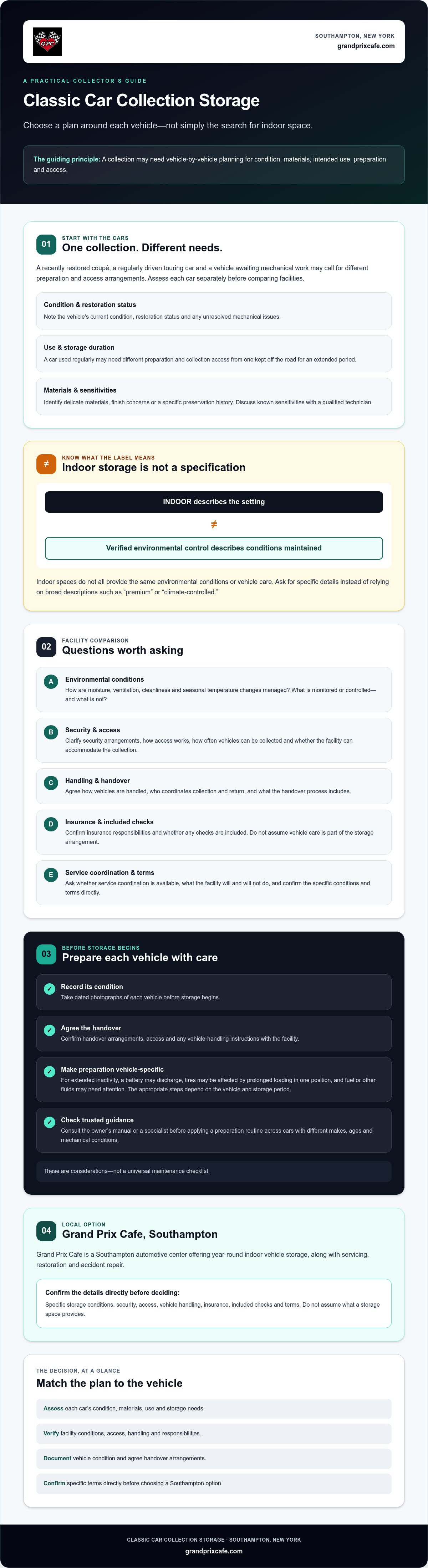
Several collector cars aren’t necessarily one storage problem. A recently restored coupé, a regularly driven touring car and a vehicle awaiting mechanical work may each need different preparation and access arrangements. For owners comparing classic car collection storage Southampton, the practical goal is to protect every vehicle while choosing a setting and terms that fit the collection.
“Classic car” has no single universal definition. The overview of classic cars on Classic Car Club of America references one established club definition, but collectors may use different criteria. For storage planning, the label matters less than each car’s age, materials, condition and intended use.
What does classic car collection storage involve?
Storage involves more than parking a vehicle indoors. Plan for how long each car will be stored and what it may need before, during and after that period. A car in regular use may need different preparation from one that will be off the road for an extended time. Follow vehicle-specific guidance and agree in advance what the facility will, and will not, do.
Indoor storage describes the setting, not a standard level of environmental control or vehicle care. Ask what conditions the facility provides and which checks, if any, are included. Confirm the details rather than assuming every facility offers the same protections.
Why assess each car separately?
Cars in one collection can differ in mechanical condition, restoration status and frequency of use. A recently restored vehicle may need careful attention to its finish, while a car with unresolved mechanical issues may require specific instructions before storage. A frequently driven vehicle may also be collected more often than one kept for a longer period. These differences affect preparation, access planning and handover.
A sound storage plan reflects each vehicle’s condition, not simply its place in the collection. Record each car’s needs, then discuss them individually with the storage provider. This helps avoid applying one routine to vehicles with different requirements.
Location matters, too. A nearby facility in Southampton, New York, may make it easier to coordinate several vehicles, arrange handovers and plan collections than a distant site. Proximity alone doesn’t establish suitability. Compare verified facility conditions and arrangements with your priorities, including how access works and whether the collection can be accommodated. Grand Prix Cafe is a Southampton automotive center offering year-round indoor vehicle storage. Confirm its specific storage conditions and terms before deciding.
How Storage Conditions Affect a Classic Car Collection
Storage conditions can affect how a vehicle fares after an extended period off the road. Moisture may contribute to corrosion, while dust can settle on surfaces and enter parts of the vehicle. Temperature changes may affect materials and components in different ways. The risks depend on each car’s construction, condition and storage duration, so don’t assume that every indoor space offers the same conditions.
Indoor storage describes where a car is kept; verified environmental control describes the conditions maintained there. Ask the facility how it manages moisture, ventilation, cleanliness and seasonal temperature changes. Request a clear explanation of the systems and how they operate rather than relying on labels such as “premium” or “climate-controlled.” If a vehicle has known sensitivities, discuss them with a qualified technician before choosing a facility.
Which environmental factors should collectors ask about?
Moisture and ventilation are relevant to corrosion risk, while dust and cleanliness matter for a car’s finish and interior. Temperature variation may also matter, particularly for vehicles with delicate materials or a specific preservation history. Ask what the facility monitors or controls, and what it cannot control. Compare the answers with the needs of each car in your collection.
What can extended inactivity change?
A battery may discharge, tires may be affected by prolonged loading in one position, and fuel or other fluids may need attention depending on the vehicle and storage period. These are considerations, not a universal maintenance checklist. Appropriate steps depend on the car’s condition and manufacturer guidance. Consult the owner’s manual or a specialist before applying one preparation routine to cars with different makes, ages and mechanical conditions.
For a practical overview of preparation considerations, see Hemmings’ guide to storing your classic car. Treat general advice as a starting point, then confirm what applies to each vehicle. Owners reviewing maintenance needs can also consult information on professional classic car service in Southampton.
When comparing classic car collection storage Southampton options, check how the facility’s confirmed conditions match each vehicle’s needs. Grand Prix Cafe offers year-round indoor vehicle storage in Southampton, New York. If service needs arise during planning, learn about Grand Prix Cafe’s automotive services, and confirm storage conditions and arrangements directly with the facility.
How to Compare Classic Car Storage Options in Southampton
A useful comparison goes beyond whether a vehicle is kept indoors. Ask for specific descriptions of facility conditions and procedures, then check them against your collection’s needs. Words such as “secure” or “premium” aren’t detailed explanations. Indoor storage alone doesn’t confirm environmental controls, vehicle checks or a particular standard of care.
What should a storage facility confirm before you decide?
Ask the provider to explain facility conditions, access procedures and responsibility for moving vehicles or conducting routine checks. Confirm storage terms and insurance responsibilities directly, and make sure you understand what is included. Don’t assume storage includes maintenance or repair. If work is needed, establish whether it must be arranged separately and who is responsible for authorising it.
Keep the answers in writing where possible. Written details make it easier to compare providers and clarify arrangements once vehicles are stored. For classic car collection storage Southampton, a clear account of what’s confirmed, and what remains your responsibility, is more useful than a broad service label.
How do collection size and use affect the choice?
Collection logistics matter alongside storage conditions. Consider how many vehicles need space, whether they’ll arrive together and how often you expect to retrieve each one. A car used for occasional drives may require different access arrangements from a vehicle kept off the road for an extended period. Ask whether the provider can accommodate the collection, and verify current capacity and availability directly.
Proximity can make coordination easier, but consider the facility’s location in relation to your home, workshop and likely seasonal routes. Grand Prix Cafe, based in Southampton, New York, offers year-round indoor vehicle storage. Confirm its environmental conditions, access arrangements, capacity and terms before committing. Its automotive service, restoration and accident repair offerings may be relevant to separate vehicle needs, but don’t assume those services are included with storage.
Prepare Your Classic Car Collection for Storage
Prepare each vehicle as an individual handover. A consistent process gives you a clear record of condition and helps you communicate requirements before the car enters storage. For classic car collection storage Southampton, preparation should reflect each vehicle’s history, current condition and expected storage period.
What should you document before handover?
Start with a dated record for every car. Note its mileage, visible condition, keys and accessories, along with any known mechanical concerns. Photograph the exterior, interior and existing damage in clear detail. Disclose modifications, restoration work and special handling needs, as these may affect how the vehicle should be moved or stored.
Next, review the owner’s manual and vehicle-specific guidance. If a mechanical issue or restoration detail could affect storage, ask a qualified specialist how to account for it. Information on vintage car restoration in New York may be relevant when restoration condition forms part of the storage plan.
How should owners coordinate storage and maintenance?
Agree on arrangements with the provider before delivery. Confirm what documents it needs, how condition notes and photographs will be shared, and what handover record it can provide. Clarify who is responsible for moving the vehicle and how existing damage will be recorded on arrival. Keep a copy of the agreed instructions for each car.
Discuss service needs separately. One vehicle may need attention before storage, while another may be suitable for storage with maintenance planned for later. Don’t assume that starting the car, battery care, inspections or repairs are included. Confirm what the storage arrangement covers and what must be organised independently.
Document: Record mileage, visible condition, keys, accessories and known concerns.
Photograph: Take dated images of the vehicle and existing damage.
Disclose: Share mechanical issues, modifications, restoration history and handling needs.
Agree: Confirm storage instructions, maintenance responsibilities and provider documentation.
Complete handover: Review the vehicle’s condition record and retain a copy.
Before committing, ask how the provider records the car’s arrival condition and which checks, if any, are included. To discuss your collection’s storage needs, contact Grand Prix Cafe. The Southampton automotive center offers year-round indoor vehicle storage; confirm specific storage terms and responsibilities directly.
Year-Round Indoor Classic Car Storage at Grand Prix Cafe
Grand Prix Cafe is an automotive center in Southampton, New York, offering year-round indoor vehicle storage. For collectors comparing classic car collection storage Southampton, it’s a local option to consider after matching each vehicle’s needs with the facility’s confirmed conditions and terms.
The business also offers car service, restoration and accident repair. These services may be relevant if a vehicle needs attention before or after storage, but don’t assume maintenance or repairs are included in a storage arrangement. Discuss any work separately and confirm its scope, timing and arrangements directly.
What can Southampton collectors discuss with Grand Prix Cafe?
Describe the collection clearly. Share how many vehicles you’re considering storing, their condition, the intended storage period and how often you anticipate needing access. Differences between cars may affect suitability, so include any known mechanical issues, restoration work or special handling requirements.
Ask direct questions about the facility’s environmental conditions, security measures, access procedures, storage terms and available capacity. Request current information before making a decision. Also clarify whether any vehicle checks are included and which maintenance tasks, if needed, must be arranged separately.
How to take the next step
Prepare a short record for each vehicle before contacting the Southampton team. Include make and model, condition, relevant service or restoration history, expected storage period and anticipated retrieval needs. A concise list of questions will help you compare the answers with your priorities and identify details that still need confirmation.
Assess suitability vehicle by vehicle, then confirm that the collection as a whole can be accommodated. A local facility may simplify coordination, but the right choice depends on verified conditions, arrangements and capacity that match your requirements. Confirm current availability and terms directly rather than relying on assumptions.
To discuss your collection and confirm the details, Contact Grand Prix Cafe about indoor storage.
Choose Storage That Fits Every Vehicle
Preserving a collection starts with treating each car individually. Let condition, storage duration and intended use guide preparation. Before committing, confirm facility conditions, access arrangements and included services directly. Indoor space is a starting point, not proof of specific environmental controls or vehicle care.
For collectors comparing classic car collection storage Southampton options, a clear record of each vehicle and a written understanding of storage terms can make planning more straightforward. Grand Prix Cafe is based in Southampton, New York, and offers year-round indoor vehicle storage. Confirm current conditions, capacity and arrangements with the team to determine whether the option suits your collection.
Prepare your vehicle details and questions, then discuss indoor storage for your classic car collection. With careful planning and clear expectations, you can choose a practical next step for your cars’ continued care.
Frequently Asked Questions
What should I look for in classic car collection storage in Southampton?
For classic car collection storage Southampton, compare the facility’s indoor conditions, access procedures, vehicle-handling arrangements and storage terms. Ask what environmental controls and security measures are provided, and whether routine checks or maintenance are included. Consider each car’s condition and how long it will be stored. Grand Prix Cafe offers year-round indoor vehicle storage in Southampton, New York; confirm its current capacity and specific arrangements directly.
Is indoor storage enough to protect a classic car?
Indoor storage can shelter a vehicle from outdoor exposure, but the word “indoor” alone doesn’t confirm environmental control or a particular level of care. Ask how the facility manages moisture, ventilation, cleanliness and seasonal temperature changes. Consider the car’s materials, condition and known sensitivities when assessing the answers. A qualified technician can help identify vehicle-specific concerns, especially for a car with delicate finishes or previous restoration work.
How do I prepare a classic car for long-term storage?
Prepare each vehicle according to its condition, expected storage period and manufacturer guidance. Record mileage and visible condition, take dated photographs, and note existing damage, mechanical issues, modifications and restoration details. Consult the owner’s manual or a qualified specialist about battery, tire, fuel and fluid considerations rather than applying one routine to every car. Before handover, agree how instructions and condition records will be shared with the storage provider.
Can I store several classic cars at one facility?
Possibly, but confirm the facility’s current capacity and whether it can accommodate your vehicles. Share the number of cars, their dimensions if relevant, arrival timing and expected retrieval frequency. Each vehicle may have different access or handling requirements. Collectors in Southampton, Westhampton, East Hampton, Sag Harbor, elsewhere on Long Island or Manhattan should also weigh travel convenience against their preferred collection and service arrangements.
Should a classic car be serviced before it goes into storage?
It depends on the vehicle’s condition, the planned storage period and any manufacturer guidance. If a car has a known mechanical issue or is due for attention, ask a qualified technician whether it should be addressed before storage or planned for later. Grand Prix Cafe offers car service, but don’t assume work is included with storage. Confirm service scope and arrangements separately with the provider.
What questions should I ask a Southampton car storage provider?
Ask what indoor and environmental conditions the facility provides, how access and vehicle movement are arranged, and who is responsible for routine checks. Confirm storage terms, insurance responsibilities, capacity and any notice required for retrieval. Request clarity on which services are included and whether maintenance or repairs must be arranged separately. Specific answers help you assess suitability for each car rather than relying on general descriptions.
Does indoor car storage include maintenance or vehicle checks?
Not necessarily. Indoor storage describes where a vehicle is kept, not whether it receives maintenance, battery care, starting, inspections or other checks. Ask the provider to state exactly what the storage arrangement includes and what remains your responsibility. Grand Prix Cafe offers year-round indoor vehicle storage alongside car service, restoration and accident repair. Confirm separately whether any work or checks are available for your vehicle and how they’re arranged.
Comments