


Vehicle Exercising Service for Stored Cars in Southampton
Updated: Oct 13
An occasional start may offer a stored car less protection than its owner expects. A vehicle exercising service for stored cars Southampton owners consider should be guided by the car’s condition and storage needs, not simply a routine start-up.
Should you start the engine, let it idle or take the car on the road? Responsible exercise starts with the vehicle’s requirements. It may involve operating the car to circulate fluids and move components, but the right approach depends on its model, condition and manufacturer guidance. Starting alone is not a substitute for a suitable plan.
This guide explains what vehicle exercising can and cannot do, which details matter when planning care, and how changing seasons around Southampton can prompt a review. It also covers the role of servicing and indoor storage in a broader preservation plan. Grand Prix Cafe provides year-round indoor storage, servicing and specialist care for classic and high-end vehicles in Southampton.
Table of Contents
Why a stored car may need more than a place to park
A car can be sheltered from use and still need considered mechanical care. Vehicle exercising is planned operation intended to support a stored car’s condition, guided by its requirements rather than a routine engine start. The aim is to consider relevant systems while the vehicle is out of regular use. The right approach depends on the car, its condition and how it is stored.
Inactivity can affect more than the battery. Tyres remain under load in one position, and fluids, seals and moving components experience a different pattern of use than they would on the road. Exercise may form part of a preservation plan, but it does not replace inspection or scheduled servicing. A vehicle may still need checks or repairs even if it has been operated during storage. General principles of car maintenance help explain why care involves several systems, not the engine alone.
What can change when a vehicle sits unused?
A battery may lose charge while a car is parked. The rate and effect vary with battery condition, vehicle electronics, temperature and storage duration, so a brief start cannot be assumed to restore it adequately. Tyres may also develop flat spots after remaining in the same position under load. The risk, and whether any effect is temporary, depends on factors such as tyre type, pressure, vehicle weight and storage duration.
Other systems also deserve attention. Fluids can age or be affected by moisture, fuel can change during prolonged storage, and seals may respond to limited circulation or changing conditions. Brakes and other moving components can behave differently after an extended period without use. These are possibilities, not guaranteed outcomes for every car. A classic vehicle and a modern sports car can have different requirements, which is why condition-led care matters.
How storage conditions shape the question
Indoor storage can reduce direct exposure to weather and environmental debris, but it cannot prevent every mechanical or material change. Outdoor storage brings different considerations, including protection from moisture and changing temperatures. In either setting, storage duration and the car’s existing condition are more useful starting points than a universal exercise interval.
Consider whether the vehicle was serviced before storage, how long it is expected to remain unused and whether any known faults need attention. Southampton’s changing seasons can prompt a review, but they do not create one suitable routine for every car. Record observations such as a warning light, unusual noise or visible leak, and treat them as reasons for inspection rather than problems an engine run will resolve. Grand Prix Cafe’s year-round indoor storage and car servicing bring storage into the wider picture of vehicle care. Its guide to professional indoor car storage offers further context on preserving a vehicle while it is not in regular use.
What responsible vehicle exercising involves
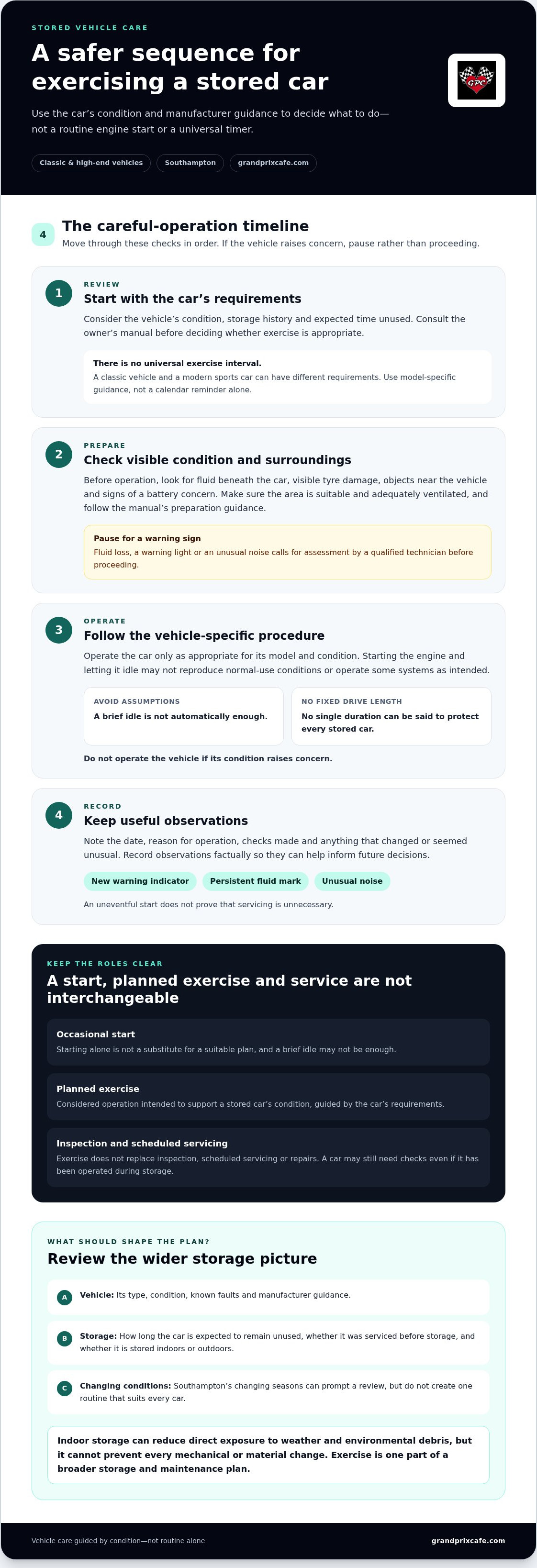
Responsible exercise begins with the vehicle’s requirements, not a calendar reminder. Review its condition and storage history, consult the owner’s manual, prepare the car safely, operate it only as appropriate, and record what you observe. The goal is to make a considered decision, not to run the engine simply for reassurance.
Exercise should follow vehicle-specific guidance, not a universal timer. A classic car with particular operating requirements may need a different approach from a modern sports car. The automotive industry organizations and resources available to owners reflect the breadth of specialist knowledge involved in vehicle care, but the manufacturer’s instructions remain central to decisions about a particular model.
Checks before operating a stored vehicle
Begin with a visual review. Look for fluid beneath the car, visible tyre damage, objects near the vehicle and signs of a battery concern. Make sure the area is suitable for operation, with adequate ventilation, and follow the manual’s preparation guidance. This overview is not a substitute for an inspection. If you notice fluid loss, a warning light or an unusual noise, pause and arrange assessment by a qualified technician before proceeding.
Why a brief idle is not automatically enough
Starting an engine and letting it idle may not reproduce the conditions of normal use. Depending on the vehicle, a short idle may not operate some systems as intended, while an unsuitable run can introduce its own risks. No fixed drive length can be said to protect every stored car. Follow model-specific instructions and do not operate a vehicle if its condition raises concern.
A simple exercise record can make future decisions more informed. Note the date, reason for operation, checks made and anything that changed or seemed unusual. Keep observations factual: a new warning indicator or persistent fluid mark gives a technician more useful context than a general note that the car “seemed fine.” An uneventful start does not prove that servicing is unnecessary.
For a stored vehicle, use a practical, cautious sequence:
Review: Consider the vehicle’s condition, storage period and manufacturer guidance.
Prepare: Check the surroundings and visible condition before operation.
Operate: Follow the vehicle-specific procedure, without assuming idling is sufficient.
Record: Note the operation and any signs that warrant attention.
Owners looking for specialist maintenance can explore professional classic car service in Southampton. Grand Prix Cafe provides car servicing and year-round indoor storage for classic and high-end vehicles. Learn more about Grand Prix Cafe’s car servicing and storage.
Occasional starts, proper exercise, and routine service are not the same
An engine starting is only one event. It does not mean the car has had useful exercise or establish that the vehicle is mechanically sound. A vehicle exercising service for stored cars Southampton owners consider should be understood as planned, condition-led operation, not simply turning the key from time to time.
Occasional start: The engine is started, often briefly. This may reveal little about the vehicle’s wider condition and may not suit every car or storage situation.
Planned exercise: Operation follows the manufacturer’s guidance and takes the vehicle’s condition into account. The purpose and observations are considered instead of assuming any start is beneficial.
Routine service: Maintenance checks and work address scheduled needs and developing faults. Exercise does not replace this work.
These categories can overlap, but they are not interchangeable. Planned exercise may reveal a concern that needs assessment, while routine service addresses maintenance beyond operating the car.
Does starting a stored car help or cause problems?
It depends on the vehicle. Repeated short starts may not suit every engine or storage environment, and operation without a clear purpose can add avoidable wear. A cold start followed by a brief idle, for example, is not automatically equivalent to an appropriate operating cycle. Let the model-specific instructions, current condition and storage circumstances guide the decision, including any exceptions in the manufacturer’s guidance.
Safety comes first. Never run an engine in a closed garage. Exhaust gases can accumulate and create a serious risk, even if the engine runs only briefly. If the car cannot be operated safely in suitable conditions, do not start it just to meet an assumed routine.
When vehicle exercise cannot replace maintenance
Exercise will not correct an existing fault, make up for a missed service or guarantee that storage-related problems will not occur. A warning light, visible leak, abnormal noise or unusual behaviour calls for assessment, not repeated starting in the hope that the symptom disappears. Avoid diagnosing the cause remotely, since the same sign can have different explanations across vehicles.
Keep the distinction clear: exercise is planned operation, while servicing is inspection and maintenance according to the car’s requirements. Both depend on design, condition, storage environment and manufacturer guidance. A stored classic and a modern sports car may need different care, and neither benefits from a universal rule applied without context. Southampton owners can connect storage with wider vehicle care through Grand Prix Cafe’s car servicing and year-round indoor storage.
Build an exercise plan around the vehicle and Southampton seasons
A suitable plan depends on the vehicle, its condition and its storage period. No reliable schedule applies to every car. Manufacturer instructions and professional assessment should guide whether exercise is appropriate, how it is carried out and when the decision should be reviewed. For owners searching for a vehicle exercising service for stored cars Southampton, planning should start with those details, not a fixed calendar rule.
Details that influence the right schedule
Before making a plan, gather the car’s history and intended use. Its age, mechanical condition, fuel and battery arrangements, storage duration and manufacturer guidance can all affect the right approach. A classic car may have particular preservation needs, while a performance vehicle or modern model may have different systems and instructions. Also distinguish a car kept for occasional outings from one being prepared to return to regular driving.
Vehicle: Note the model, age and relevant manufacturer instructions.
Condition: Record known faults, recent service history and concerns identified before storage.
Storage: Consider how long the car is expected to remain stored and its fuel and battery arrangements.
Intended use: Decide whether it will remain in occasional use or return to regular driving.
Use Southampton’s changing seasons as prompts to review the plan, not as a reason to assume a particular exercise routine. At a seasonal transition, reconsider the vehicle’s condition, storage period and intended use. A change in plans, a new warning or a longer-than-expected period in storage may call for reassessment. The calendar is a reminder to review, not a substitute for model-specific guidance.
Prepare for the return to regular driving
Before a planned drive, make a methodical visual and functional review. Check for visible fluid leaks, tyre damage or apparent pressure concerns, and confirm that lights and other basic controls work as expected. Look for warning indicators and listen for unusual sounds during any operation that is safe and appropriate. These checks can identify reasons to pause, but they do not establish that every system is ready for road use.
Warning lights, fluid loss, unfamiliar noises, braking concerns or unexpected behaviour merit professional assessment before driving. Do not use an exercise run to test a car that already shows signs of a fault. For classic vehicles, classic car maintenance guidance can help place storage care in the wider context of specialist servicing.
Grand Prix Cafe provides car servicing and year-round indoor storage for classic and high-end vehicles in Southampton. If your vehicle’s condition or return-to-use plans call for specialist care, explore Grand Prix Cafe’s car servicing.
Arrange stored-car care with a Southampton automotive specialist
Some storage concerns call for more than an exercise plan. Persistent warning lights, fluid leaks, unusual noises or uncertainty about a vehicle’s condition are reasons to arrange professional servicing before operating or returning the car to regular use. Exercise can be part of considered care, but it is not a diagnosis and cannot replace inspection or repair.
For owners researching a vehicle exercising service for stored cars Southampton, a useful first step is to describe the vehicle and its circumstances clearly. Details about its history, storage and present condition help frame its broader service and storage needs, without assuming the same procedure suits every car.
What to prepare before arranging stored-car service
Gather the details that help build a clear picture. The make, model and year identify the vehicle; service history and known concerns add context. Include how long it has been stored, whether it has been started or operated during that period, and any recent symptoms. If a warning appeared, note what it displayed and when. If there is a leak, describe where you saw it rather than guessing at its cause.
Vehicle details: Make, model and year.
History: Available service records and known mechanical concerns.
Storage: Approximate duration and whether the car has been started or driven.
Current condition: Warning lights, visible leaks, unusual sounds or other changes.
Intended use: Whether the car will remain stored, be used occasionally or return to regular driving, and when that change is planned.
This information helps frame the next step. A vehicle expected to return to regular use may need different consideration from one staying in storage, while a new symptom can take priority over a planned outing. Avoid repeatedly starting a car to investigate a warning or leak. A technician can assess the concern as part of professional servicing.
A local path from storage to considered care
Grand Prix Cafe is a Southampton automotive facility providing car servicing and year-round indoor storage for classic and high-end vehicles. Owners in Southampton, Westhampton, East Hampton, Sag Harbor, across Long Island and Manhattan can consider storage and servicing alongside the vehicle’s history, present condition and intended use. Maintenance decisions remain specific to each car, so do not assume one exercise interval or procedure suits them all.
Whether you are planning a return to use or addressing a concern noticed during storage, clear records support a more informed service discussion. Grand Prix Cafe also provides restoration and accident repair, alongside servicing and storage. Explore Grand Prix Cafe’s vehicle services.
Plan the next step for your stored car
A stored vehicle’s next step need not be a guess. Treat its return to use as a planned decision, guided by its condition, intended use and manufacturer instructions. Keep service records and notes about changes during storage together, as this history can help inform future care. If your plans change, revisit the approach rather than following a routine simply because time has passed.
Owners considering a vehicle exercising service for stored cars Southampton can place that question within the car’s wider storage and maintenance needs. Grand Prix Cafe is a Southampton automotive centre providing year-round indoor vehicle storage, car servicing and restoration for classic and high-end vehicles. Appropriate care depends on the individual car, but a considered plan can make the path from storage to future use clearer.
Explore vehicle service and storage at Grand Prix Cafe to plan a practical next step for your car.
Frequently Asked Questions
Is it good to start a car that has been sitting in storage?
It may be appropriate, but the car’s condition and manufacturer guidance should determine the decision. Before starting, look for fluid beneath the vehicle, damaged wiring or signs of animal activity around the engine bay. A weak battery, known fault or unusual brake feel may call for assessment first. Do not keep trying to start a car that will not turn over. Note what happens and arrange a technician’s evaluation.
How often should a stored car be exercised?
No interval suits every stored car. A vehicle exercising service for stored cars Southampton owners consider should account for the model, storage conditions, battery arrangements and intended return to use. Consult the owner’s manual and review the plan if the storage period changes or a new symptom appears. Avoid starting the vehicle solely because a fixed number of days has passed; the calendar alone does not establish that operation is appropriate.
Can idling a car recharge its battery after long-term storage?
Idling may provide some charge in certain circumstances, but it should not be relied on to restore a depleted or deteriorated battery. Charging depends on the vehicle’s electrical system, battery condition and operating conditions. A battery that repeatedly loses charge may need testing, not more brief starts. Follow the vehicle’s manual for charging guidance, and use a suitable battery charger only as directed for that car and battery type. For vehicles equipped with custom electrical setups or auxiliary power requirements, resources such as thurtonautocentre.co.uk provide guidance on modern battery solutions and upgrades.
What happens if a classic car is not driven for several months?
There may be no immediate visible problem, but prolonged inactivity can affect systems differently depending on the car and its storage conditions. The battery may discharge, tyres may lose pressure, and fuel or seals may be affected over time. Older vehicles can have particular sensitivities, so do not assume a modern-car routine applies. Keep a note of when storage began, prior service work and any concerns observed before the car was parked.
Should a stored car be driven or only started briefly?
Neither option is right for every vehicle. A brief start may not achieve the intended purpose, while driving a car with an unresolved fault or uncertain safety condition may be inappropriate. Use the manufacturer’s instructions and the vehicle’s present condition to decide whether operation is suitable. If it is driven, choose a route and conditions that allow safe operation and a return without placing unnecessary strain on the car.
Can a car be exercised safely inside an indoor storage facility?
Only if the space and procedure are suitable for engine operation. Never run an engine in a closed garage or enclosed area without appropriate exhaust extraction, as exhaust gases can be dangerous. Indoor storage does not automatically mean a facility is intended for running vehicles. Follow the facility’s operating and safety instructions, and do not start the car indoors if safe ventilation and conditions are not assured.
When should a stored vehicle be inspected before returning to the road?
Arrange an inspection before driving if the vehicle has a warning light, visible leak, unusual noise, braking concern or uncertain mechanical condition. An inspection is also prudent when service is due or the car has been stored longer than planned. Grand Prix Cafe provides car servicing for classic and high-end vehicles in Southampton. Share the storage period, service records and intended use so the assessment can take the vehicle’s history into account.
Comments