


Winter Car Storage in East Hampton: 2026 Collector’s Guide
An empty garage isn’t automatically the right winter home for a collector car. The better question is whether the space and care plan suit the vehicle, its condition, and how often you expect to use it. For winter car storage East Hampton owners should weigh cold, moisture, and seasonal exposure alongside practical details such as access and preparation.
A valuable or infrequently driven car needs more than a place to park. A home garage may suit some vehicles, while professional indoor storage may be a better fit for others. The right choice depends on the car and the storage conditions, not simply on whether a space is enclosed.
This guide explains how to compare home and professional options, prepare a vehicle for winter, and identify the features that matter for classic, modern sports, and collectible cars. It also explains how Grand Prix Cafe’s year-round indoor storage in Southampton can serve East Hampton owners as part of a broader automotive-care environment.
Table of Contents
Why Winter Car Storage Matters for East Hampton Owners
As winter approaches, owners face a practical choice: continue driving, keep the car at home, or arrange indoor storage. The decision depends on more than the calendar. Consider the vehicle’s condition, how it will be used, the space available at home, and how long it may sit between drives. When comparing winter car storage East Hampton options, match the plan to the car rather than assuming every vehicle should be taken off the road.
Cold temperatures, precipitation, and damp conditions are factors to account for during the season. A car parked outdoors is directly exposed to the elements, while an indoor setting limits exposure to rain, snow, and other precipitation. Neither choice removes the need for care. The car’s materials, existing condition, and mechanical requirements influence which precautions are appropriate.
Preservation is a planned process, not a facility feature alone. The principles discussed in Conservation and restoration of road vehicles underscore the value of considering a vehicle’s materials and condition as a whole. Indoor storage can be part of that plan, but it doesn’t replace appropriate preparation or model-specific guidance.
Which vehicles benefit most from winter storage?
Collectible, classic, and performance cars often have distinct storage priorities, particularly when owners intend to keep them off the road for the season. A vehicle that will sit for an extended period may need a deliberate plan for its condition, materials, and mechanical systems. A car driven regularly through winter has different needs. Storage is an option, not a requirement for every vehicle.
What East Hampton’s winter season can mean for a stored car
Cold-weather exposure and moisture deserve attention, whether a car is parked at home or stored indoors. If the vehicle has been driven on treated roads, residue can remain on its surfaces and components, so preparation should account for recent use. Also consider how long the vehicle will be stationary and follow the owner’s manual or technician guidance for suitable procedures.
Start by assessing the actual vehicle, not a generic checklist. A recently driven sports car, a preserved classic, and a daily-use vehicle each present different considerations. Note the car’s current condition, expected storage duration, and known maintenance needs. Then decide whether the space at home provides the shelter you want or whether year-round indoor storage is a better fit. In either case, preparation remains essential: a covered space cannot correct an existing issue or replace instructions specific to the vehicle.
How Indoor Winter Car Storage Helps Preserve Vehicle Condition
Indoor car storage means keeping a vehicle inside a dedicated storage facility rather than leaving it on a street or in an uncovered driveway. An enclosed setting places a physical barrier between the car and direct precipitation, wind-blown debris, and other outdoor exposure. For a collectible vehicle, limiting that exposure can be a useful part of a broader preservation plan.
Indoor storage can reduce direct exposure to outdoor conditions, but it does not by itself guarantee a particular temperature, humidity level, security standard, or vehicle condition. “Indoor” describes the setting, not every feature of a facility. Distinguish what the term establishes from assumptions about climate control, moisture management, access, or monitoring. Those details matter, but they should not be inferred from the word alone.
Indoor storage, a home garage, or covered parking?
A dedicated indoor facility offers an enclosed setting separate from street or driveway parking. A private garage can provide similar enclosure, but its suitability depends on its condition and use. Leaks, clutter, frequent door openings, or limited room to move around the vehicle can affect its practicality. Covered parking offers overhead shelter, but it isn’t equivalent to an enclosed space because the vehicle remains exposed around its sides.
Access and oversight also differ. At home, an owner can usually reach the car directly and observe the surrounding space, while a facility has its own access arrangements. Consider whether you need to retrieve the vehicle during winter, how much room the car requires, and whether the space will remain dedicated to it. For a low-clearance performance car or a classic with delicate finishes, maneuvering room and a clean, suitable parking area may matter as much as convenience.
What indoor storage does not replace
Storage alone doesn’t prepare or maintain a car. A vehicle placed indoors may still have existing mechanical needs, contamination from recent use, or condition-specific concerns that require attention. Preparation advice can differ between a modern sports car driven occasionally and an older classic with different materials or mechanical systems. Use the owner’s manual and guidance from a qualified automotive technician for model-specific procedures.
Before selecting a space, separate the benefits of enclosure from the care the vehicle still needs. Assess the car’s condition and intended storage period. Indoor placement is one part of the plan, not a substitute for inspection, preparation, or maintenance. This distinction is especially useful when comparing general vehicle storage with an automotive environment familiar with classic and modern sports cars.
Grand Prix Cafe in Southampton serves East Hampton-area owners with year-round indoor car storage alongside specialist automotive experience. For owners considering a dedicated indoor setting as part of their winter plan, explore year-round indoor car storage at Grand Prix Cafe.
How to Compare Winter Car Storage Options Near East Hampton
The right choice depends on the vehicle and storage plan, not on a label alone. A household unit intended to hold a car may provide space, while a specialist automotive setting places storage within a vehicle-focused environment. When comparing winter car storage East Hampton options, consider the setting, intended vehicle type, access arrangements, care responsibilities, and connection to automotive services.
The table is a starting point, not a substitute for assessing the actual space and terms. “Indoor” describes an enclosed setting; it doesn’t by itself establish climate, humidity, security, monitoring, or access specifications. Likewise, a specialist label alone doesn’t tell you what vehicle care is included. Compare the stated arrangements rather than assuming that spaces described similarly provide the same conditions.
Questions that clarify whether a facility suits your car
Start with the vehicle’s age, condition, value, and mechanical needs. Consider whether its dimensions and configuration suit the space, how long it will remain stored, and how often you need access. Then assess whether the storage arrangement connects meaningfully with service or restoration needs. These criteria help distinguish a simple place to park from a broader automotive context without presuming any particular facility feature.
When a specialist automotive setting may be the better fit
A collectible or mechanically specialized car may call for more vehicle-specific consideration than ordinary household items. An automotive setting can be relevant when storage decisions intersect with servicing or restoration, while a general unit is principally a space-based solution. The best fit still depends on the car, the owner’s priorities, and the actual arrangements. Grand Prix Cafe in Southampton combines year-round indoor storage with automotive service and restoration experience for East Hampton-area owners.
For a modern sports car driven occasionally, convenient access may be a priority. For a classic kept off the road, the owner may place more weight on the vehicle’s condition, the storage period, and how preparation is handled. Set those priorities before comparing options. That keeps the decision grounded in the car’s needs rather than broad claims about storage categories.
How to Prepare a Car for Winter Storage in East Hampton
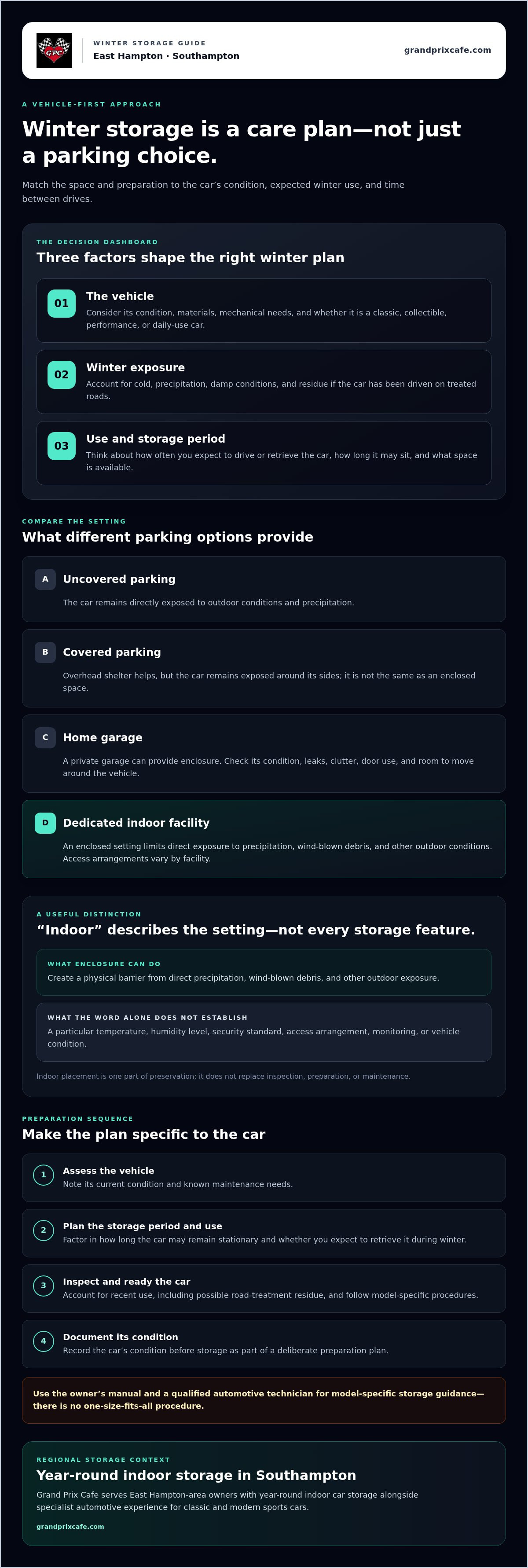
A sound storage plan begins before the car reaches its parking space. For winter car storage East Hampton owners can follow a simple sequence: define the storage period, inspect the vehicle, prepare it according to its needs, and record its condition. This makes decisions easier to revisit at the end of the season and helps distinguish existing issues from changes noticed later.
Plan the period. Estimate how long the car will be stored and when you expect to use it again. The duration informs preparation and restart planning.
Inspect the vehicle. Note visible damage, warning lights, leaks, unusual sounds, and maintenance concerns. Address issues that could affect storage before putting the car away.
Prepare the car. Clean it and follow the owner’s manual and technician guidance for model-specific procedures.
Document its condition. Record the mileage and take clear photographs of the exterior and interior before storage.
Before the car goes into storage
Clean the exterior and interior, with particular attention to residue after winter-road use. A clean starting condition makes later inspection more useful. Record existing marks, paint or trim concerns, and maintenance items already due. Keep the notes with the vehicle records so the spring inspection can be compared against a clear baseline.
Prepare an arrival checklist, too. Remove personal belongings and note which keys accompany the vehicle. Gather service records and write down current concerns, recent work, and instructions relevant to handling or starting the car. This record supports continuity, especially if the vehicle has been driven infrequently or has a maintenance history that needs context.
Battery, tires, fluids, and start-up planning
Battery care, tire pressure, fluid checks, and restart procedures vary by model, age, and mechanical condition. Follow the manufacturer’s guidance rather than applying a universal storage routine. Periodic engine starts aren’t automatically appropriate; plan them only in line with vehicle-specific instructions and technician guidance. A classic with older components may require a different approach from a modern sports car.
Before placing the car in storage, decide how its return to use will be handled. Note any work due before the next drive, and keep the manual and relevant service records available. A restart plan should account for the car’s actual condition, not just the number of months it has been stationary. Owners can also review guidance on preventing mechanical decay in stored vehicles.
Grand Prix Cafe’s year-round indoor car storage is part of a broader automotive setting that includes car service and restoration. East Hampton owners preparing a classic or modern sports car can explore indoor car storage at Grand Prix Cafe as one part of a considered seasonal plan.
Choosing Year-Round Indoor Car Storage with Grand Prix Cafe
Choosing winter storage is a decision about the vehicle’s needs as well as its location. Grand Prix Cafe is based in Southampton and provides year-round indoor car storage for East Hampton-area owners. The Southampton automotive setting connects storage with experience in classic and modern sports cars, car service, and restoration. Grand Prix Cafe also serves owners in Westhampton, Sag Harbor, elsewhere on Long Island, and Manhattan.
A local automotive setting for seasonal storage
Indoor storage provides an enclosed place for a vehicle, while its suitability still depends on the car, the expected storage period, and the owner’s preparation plan. Grand Prix Cafe provides year-round indoor car storage. Its broader automotive work with classic and modern sports cars gives owners relevant context when considering how storage fits alongside a vehicle’s service or restoration needs.
That distinction can matter for a collectible or mechanically specialized car. Its owner may be balancing seasonal shelter with maintenance concerns, an upcoming restoration, or a return to driving after a period off the road. A business that works with vehicles in these categories offers a different automotive context from a general-purpose storage setting. Storage remains one part of the decision, not a guarantee of a particular condition or result.
As you compare options, separate known details from assumptions. “Indoor” describes where the car is stored; it doesn’t by itself establish temperature or humidity conditions, security systems, access arrangements, or preparation procedures. Focus on the vehicle’s requirements and the storage arrangement. This keeps the decision grounded and avoids treating a broad label as a complete preservation plan.
Plan the next step for your vehicle
Before arranging seasonal storage, consider three points: the vehicle type, the intended storage period, and the preparation it requires. An older classic and a modern sports car may have different service histories and model-specific instructions. A car stored for a short interval may also have different priorities from one kept off the road for the full season. Use the owner’s manual and technician guidance to shape the preparation plan.
Then consider how the storage choice fits into the car’s wider care. If service or restoration is relevant, an automotive environment can make that connection part of the decision. Grand Prix Cafe’s Southampton location serves owners across East Hampton, Westhampton, Sag Harbor, Long Island, and Manhattan, offering a local option for year-round indoor storage within a broader automotive setting.
For a measured next step, review the vehicle’s condition, planned storage period, and model-specific preparation needs, then explore year-round indoor car storage at Grand Prix Cafe.
Set a Clear Plan for the Season Ahead
Before winter begins, decide what a successful return to the road will look like. Is the car being preserved for a planned spring drive, kept available for occasional use, or held until conditions suit it again? Defining that purpose gives your winter car storage East Hampton decision a practical reference point and helps align the vehicle’s care with how you intend to enjoy it.
Keep that intention alongside the car’s records. A brief note about the expected storage period and next planned use can guide later decisions without relying on memory. If plans change, revisit the arrangement and preparation rather than treating the original choice as fixed. Thoughtful stewardship is ongoing, and a clear seasonal objective makes it easier to carry that care forward.
For owners considering an indoor setting, explore year-round indoor car storage at Grand Prix Cafe in Southampton. Contact Grand Prix Cafe to plan indoor storage for your vehicle.
Frequently Asked Questions
Is winter car storage necessary in East Hampton?
No, winter storage isn’t necessary for every vehicle. The decision depends on how often you’ll drive, the car’s condition, and whether you’re comfortable using it in winter road conditions. East Hampton owners may choose indoor storage for a seasonal or collectible vehicle while continuing to drive a well-maintained daily car. Reassess if your plans change or the car develops a condition that makes winter use less suitable.
Can I store a car for winter without a garage?
Yes. A private garage isn’t required if you arrange a suitable indoor vehicle-storage space. Consider whether the space accommodates your car and whether its access arrangements work for your plans. Covered parking is another possibility, but it leaves the vehicle more exposed than an enclosed setting. Whichever option you choose, include preparation and model-specific care in your plan.
Should I disconnect the battery before storing my car?
Not automatically. Battery procedures vary by vehicle, and disconnecting one may affect saved settings or systems that rely on continuous power. Check the owner’s manual for the recommended storage procedure, particularly if the car has an alarm, electronic accessories, or specialized battery management. Follow model-specific technician guidance if the manual does not cover the situation.
How often should a stored car be started during winter?
There’s no single interval that suits every stored vehicle. Don’t start the engine simply to follow a generic schedule; the manufacturer’s guidance and the car’s mechanical condition should determine the plan. If you expect to drive it during storage, consider what preparation is needed for that outing and return. For a vehicle that will remain parked, use vehicle-specific guidance to determine whether starting it is appropriate.
What should I remove from my car before winter storage?
Remove valuables, loose personal items, food, and anything that could spill, spoil, or be affected by temperature changes. Check door pockets, the glove compartment, the trunk, and under the seats, where items are easily overlooked. Take portable electronics and charging accessories with you. If the car contains toll or parking devices, review their settings so they won’t be used unintentionally while the vehicle is stored.
Does indoor car storage prevent every kind of winter damage?
No. Indoor storage can reduce direct exposure to precipitation and other outdoor conditions, but it can’t guarantee that a car will be free from damage or mechanical problems. Existing wear, an unresolved maintenance issue, or an unsuitable storage routine may still affect the vehicle. “Indoor” also doesn’t establish specific temperature or humidity conditions. Base your expectations on the storage arrangements and the car’s individual needs.
When should I prepare my car for winter storage?
Prepare it before the planned storage date, leaving time to address maintenance concerns rather than discovering them as the vehicle is put away. If you’ve driven on treated roads, clean the car before storage. Review the owner’s manual and follow technician guidance for model-specific procedures. East Hampton owners can use the same approach whether the car will be kept at home or stored indoors.
Comments