


Pre-Concours d’Elegance Preparation in the Hamptons: A Collector’s Guide
A concours-ready car is more than a polished car. For collectors seeking a pre-concours d'elegance preparation service Hamptons owners can access, start with a careful assessment of the vehicle’s condition, not an indiscriminate cosmetic overhaul.
It’s reasonable to ask which issues deserve attention first and how to prepare without compromising originality. An inspection-led plan helps prioritize mechanical, safety, and presentation needs while respecting the vehicle’s history and value. This guide covers practical preparation steps, how to weigh different kinds of work, and how to coordinate specialist support around Southampton, Westhampton, East Hampton, Sag Harbor, Long Island, and Manhattan. Grand Prix Cafe’s GPC Service Department begins with an in-house 100-point inspection covering mechanical, exterior, interior, safety, and security checks. Full diagnostics and restoration using original or specially sourced parts wherever possible can help shape the next steps. The aim is a considered plan for bringing the car to an event in sound condition.
Table of Contents
What Pre-Concours d’Elegance Preparation Means for a Hamptons Collector Car
A concours car needs more than a final polish. Preparation is a coordinated review of mechanical condition, safety, originality, documentation, and presentation. Work should be prioritized according to the vehicle’s condition and the event’s requirements. Put simply: Concours preparation aligns a car’s condition, documentation, and presentation with its class.
That order matters. Routine detailing focuses mainly on appearance. Pre-concours work begins by identifying issues that could affect safe operation, function, or preservation. Cosmetic cleaning and presentation come after the owner understands what the car needs and which interventions suit its history. A Concours d'Elegance has a distinct history and format, but judging expectations vary between events.
Careful preparation can make a car more considered and ready for display. It cannot guarantee acceptance, an award, or a particular judging result. Those decisions belong to event organizers and judges and may depend on eligibility, class, condition, and event rules. Grand Prix Cafe provides pre-concours preparation in the Hamptons to support a sound, well-presented vehicle, not to promise a result.
What concours judges and event organizers may assess
Criteria can vary by event, class, and organizer, so distinguish entry requirements from judging standards. RAND Luxury’s event information, for example, identifies Ferrari and Porsche judging and describes submission opportunities for European collector cars. That is specific to the event, not a universal rule for every concours.
Visible presentation is only one part of the picture. Cleanliness and condition can be observed on the display field, while mechanical condition concerns how the vehicle functions. Historical integrity concerns whether its components and details reflect its identity and past. Organizers may set eligibility or submission requirements separately from what judges assess, so review the current rules for the event you plan to enter.
Why originality matters during preparation
Before work begins, record which components are understood to be original, previously restored, or modified. Note known repairs and retain relevant records or photographs. This gives you a reference when deciding whether to preserve a feature, repair it sympathetically, or change it. Not every collector car must remain untouched; the right approach depends on its history, condition, and intended class.
Preservation-minded repair addresses a real need without erasing sound historic material or introducing unnecessary changes. Grand Prix Cafe uses original or specially sourced parts wherever possible, and its engineers fabricate replacements to original specifications. The vintage car restoration guide offers further context on balancing mechanical work with a car’s heritage.
Build a Pre-Concours Inspection Around Condition, Safety, and Originality
A useful inspection turns preparation from guesswork into a prioritized plan. Grand Prix Cafe’s in-house 100-point Inspection Service reviews five categories: mechanical, exterior, interior, safety, and security. Its value is not simply the number of points. It gives owners a structured basis for deciding what needs attention before presentation work begins.
A structured inspection helps identify condition issues before event-day preparation. Record observations by category, note items that affect safe operation or function, and distinguish them from appearance concerns. This also preserves context: a mark on original trim, for example, may call for a different decision than damage that affects the vehicle’s integrity. Use the findings to guide the work plan, rather than assuming every imperfection needs correction.
Mechanical: assess the vehicle’s operation and record visible faults or concerns for further review.
Exterior: document paint and body condition before deciding whether a defect calls for repair or preservation.
Interior: note cabin condition and any areas where restoration could affect original material.
Safety: give safety concerns priority over cosmetic refinements.
Security: include the vehicle’s security condition in the broader review.
These categories describe the scope of Grand Prix Cafe’s 100-point inspection, not a universal judging checklist. Interpret the findings in relation to the specific car, its history, and its intended use.
Mechanical and diagnostic checks before the event
Start with the car’s condition and operation rather than assuming a fixed list of faults. Record what you observe, then use diagnostic findings to guide further service where appropriate. Grand Prix Cafe’s Full Diagnostic Service Center specializes in Ferrari, Lamborghini, and Maserati. For related mechanical service context, see its guide to a classic car mechanic in Southampton.
This order helps separate an operational concern from a cosmetic one. If the review identifies work that may affect safe use or vehicle function, address it before spending time on final cleaning or display details. Diagnostic findings can focus the repair plan and help avoid unnecessary work on components functioning as intended.
Safety, cabin, bodywork, and security review
For exterior and interior findings, document the condition before choosing a response. A photograph and concise note can help distinguish existing wear from a new issue and support a considered repair decision. Cleaning improves presentation; it does not resolve a defect that affects safety or vehicle integrity. Keep those tasks separate.
Preservation also has a wider purpose. Organizations such as America’s Automotive Trust focus on automotive heritage, a reminder that care involves more than appearance. A pre-concours d'elegance preparation service Hamptons owners choose should make priorities visible and keep condition, safety, and originality in view. Owners in Southampton, Westhampton, East Hampton, Sag Harbor, Long Island, and Manhattan can explore Grand Prix Cafe’s collector-car service support as they develop an inspection-led plan.
How to Balance Concours Presentation with Authenticity
A uniform, highly polished finish isn’t automatically the right objective for a collector car. Preparation choices should reflect the vehicle’s condition, documented history, originality, safety needs, and intended event class. A new finish or replacement component may look immaculate yet alter a detail that contributes to the car’s character. Ask whether each proposed intervention serves a clear purpose.
Before approving work, record the current condition and identify what is known about each component: original, previously restored, or modified. Then compare the purpose and likely visible effect of each option. This keeps presentation decisions tied to the individual car rather than to a general idea of perfection.
Preservation: retain a sound existing detail and its character. The visible result may include age or wear, but the component remains undisturbed.
Sympathetic repair: address a functional or condition issue while aiming to retain the original character. Limit the visible change to what the repair requires.
Modification: alter a component or finish. This may change the car’s appearance or historical specification, so consider its purpose and relevance to the class before proceeding.
These are decision categories, not fixed instructions. Event expectations differ, and the appropriate choice depends on the car. A repair needed for safe operation deserves priority; a small mark on a sound, documented original feature may call for preservation rather than correction.
When to preserve, repair, or restore a detail
Consider condition first, then authenticity, safety, and the event class. If a component functions as intended and contributes to the car’s documented character, preserving it may be appropriate. If it needs work, define the repair’s purpose and extent before proceeding. Restoration does not mean replacing every aged detail. The objective is a considered response to the specific vehicle, not a promised judging score or future value.
Where replacement is needed, Grand Prix Cafe uses original or specially sourced parts wherever possible. Its engineers can fabricate replacements to original specifications. This gives owners a practical option to consider while keeping the vehicle’s known history central to the decision.
Presentation work without unnecessary alteration
Make presentation orderly and consistent, but don’t let detailing substitute for service or erase evidence that matters to the vehicle’s history. Complete the inspection and necessary repairs first. Treat cleaning and final appearance work as the last stage, after you have agreed on preservation or restoration choices.
Keep prior damage and earlier repairs in the preparation record. A mark or finish difference may have a history that informs whether to retain it or address it. Grand Prix Cafe’s vintage vehicle accident repair guide provides related context for owners considering how repair history fits into preservation. A thoughtful pre-concours d'elegance preparation service Hamptons collectors rely on should make these trade-offs explicit, so the final presentation reflects the car’s condition and identity rather than unnecessary alteration.
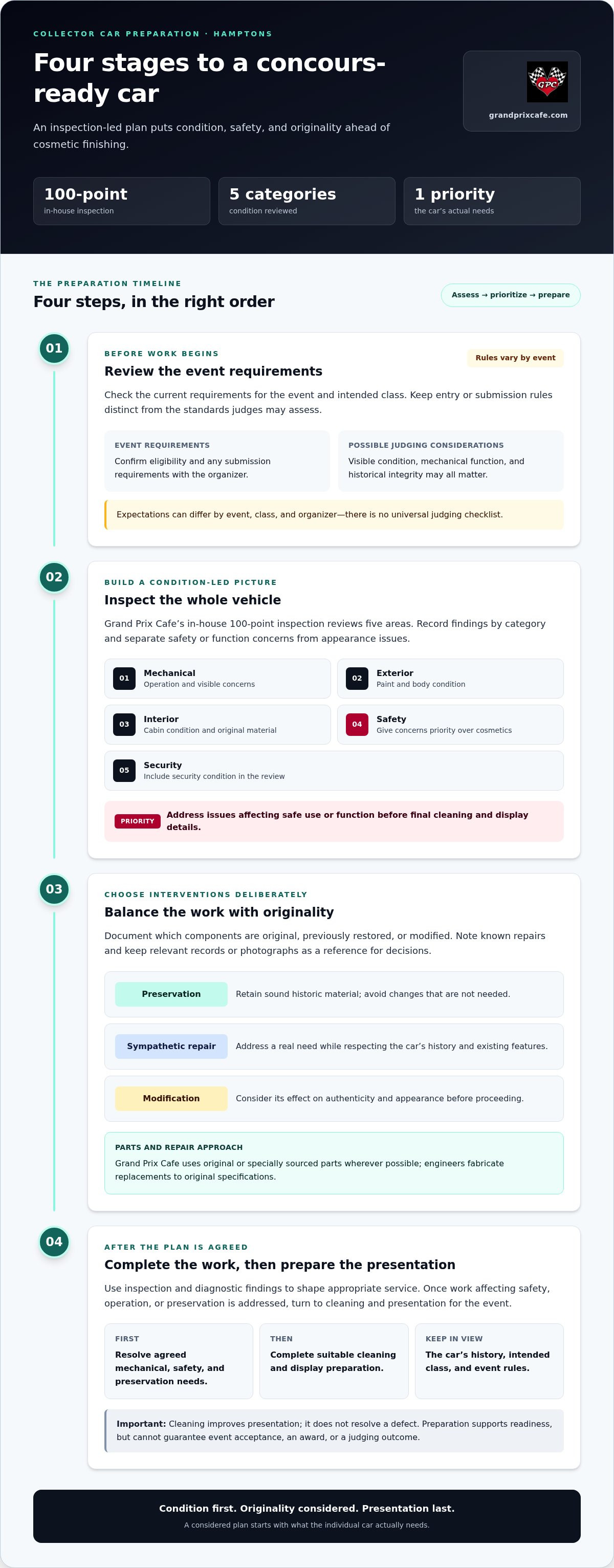
Plan a Hamptons Pre-Concours Preparation Timeline
A staged plan gives owners time to make considered decisions instead of rushing repairs and presentation work into the final days. Treat the schedule as a sequence, not a fixed countdown: the time required depends on the vehicle’s condition and the agreed work. Build in a practical buffer after repairs to review completed work and address follow-up before departure.
Use four stages:
Confirm event requirements. Verify the current date, venue, eligibility, classes, judging rules, and submission instructions with the organizer.
Inspect and document. Establish the car’s condition, known issues, and relevant history before deciding what work to undertake.
Complete agreed work. Prioritize diagnosis and necessary service before appearance-focused tasks.
Prepare presentation. Reassess completed work, organize event materials, and confirm how the vehicle will be presented and transported.
This sequence gives preparation a clear purpose at each stage. If the inspection identifies a mechanical concern, address it before committing time to final cleaning. If the car needs limited work, avoid unnecessary restoration and focus on a measured presentation.
Start with event requirements and a vehicle baseline
Event information can change, so confirm details for the specific year and organizer rather than relying on an earlier listing. Review eligibility, class placement, judging rules, and submission instructions. RAND Luxury’s event information requests three vehicle photos and a brief description for submissions, a reminder that entry preparation may involve presenting the car’s identity as well as its condition.
Before workshop work begins, record known issues, prior repairs, modifications, and details relevant to the car’s history. Keep this baseline with photographs and available records. It helps clarify what changed during preparation and supports decisions that respect the vehicle’s originality.
Sequence inspection, service, and final presentation
Once the event requirements and vehicle baseline are clear, schedule inspection and diagnosis, then agree on necessary maintenance or repair. Leave appearance work until those priorities are addressed. After service, review the completed work and confirm the presentation plan, including event materials and transport arrangements. Avoid a last-minute finish date that leaves no room for reassessment.
Owners coordinating from outside the Hamptons can plan logistics alongside workshop work. Grand Prix Cafe offers vehicle collection and delivery from anywhere in the world, providing a transport option for collectors based elsewhere. A pre-concours d'elegance preparation service Hamptons should fit the sequence to the car and event rather than impose an assumed timetable. To plan inspection-led preparation with Grand Prix Cafe, discuss your collector car’s service needs.
Grand Prix Cafe’s Specialist Support for Concours Preparation in the Hamptons
Concours preparation should be shaped around the individual vehicle, not treated as a fixed package. Grand Prix Cafe provides pre-concours support in Southampton and across the Hamptons through its GPC Service Department, Full Diagnostic Service Center, and GPC Home Service. Work can begin with an inspection and proceed according to the car’s condition, the owner’s priorities, and the event’s requirements.
This inspection-led approach keeps mechanical needs and preservation decisions in view before presentation work begins. It gives owners a practical basis for deciding which work is necessary, which details to retain, and how to prepare the car without assuming every vehicle needs the same level of restoration.
A service approach grounded in inspection and preservation
Grand Prix Cafe’s in-house 100-point Inspection Service covers mechanical, exterior, interior, safety, and security checks. The findings provide a structured starting point for identifying condition issues and considering next steps. Full diagnostics can add useful information when the car’s operation or a fault needs further assessment.
If restoration is appropriate, Grand Prix Cafe uses original or specially sourced parts wherever possible. When a replacement must be made, its engineers can fabricate it to original specifications. These methods support preservation-minded work, while the scope remains specific to the vehicle. An owner may prioritize mechanical condition, retain sound original features, or address selected restoration needs. The plan follows the car’s condition and the owner’s preservation priorities, not a promise of a judging result.
Support for owners across Southampton and the Hamptons
Grand Prix Cafe’s Full Diagnostic Service Center specializes in Ferrari, Lamborghini, and Maserati. For owners of these marques, specialist diagnostics can inform service decisions as part of a broader preparation plan. GPC Home Service provides on-site servicing, detailing, and maintenance, along with customized property-management solutions. These services help owners coordinate care around where their collector vehicle is kept.
For a collector based beyond the local area, Grand Prix Cafe also offers vehicle collection and delivery from anywhere in the world. This provides another way to coordinate transport alongside preparation, without making assumptions about how an individual event handles vehicle arrival or display.
A pre-concours d'elegance preparation service Hamptons owners consider should connect inspection, appropriate service, and presentation while keeping the car’s history in view. Grand Prix Cafe provides specialist vehicle support, not influence over event entry or judging. Owners can begin with a clear account of the vehicle, its known condition, relevant history, and the work they are considering. Contact Grand Prix Cafe to discuss your collector car’s preparation needs.
Set a Clear Direction for Your Car’s Next Chapter
Define what readiness means for your particular car. Gather its relevant history, note your priorities, and keep the event’s requirements close as you consider the work ahead. This gives each decision a reference point: not an abstract standard of perfection, but a presentation that suits the vehicle and its story.
A thoughtful pre-concours d'elegance preparation service Hamptons owners choose should make the path forward easier to discuss, while leaving room for informed decisions as the car’s needs become clearer. Preparation is an opportunity to care for a collector vehicle with intention, not a promise of a particular judging result. If you’re ready to consider the next steps, discuss your collector car’s preparation with Grand Prix Cafe. A measured plan can help you approach the event with greater clarity and confidence.
Frequently Asked Questions
What does pre-concours preparation for a classic car include?
It includes an assessment of the vehicle’s condition, operation, safety, originality, and presentation, with the work tailored to the car and event. Grand Prix Cafe’s 100-point Inspection Service reviews mechanical, exterior, interior, safety, and security categories. For example, a recorded inspection can help distinguish a service need from a cosmetic preference. A pre-concours d'elegance preparation service Hamptons owners choose can inform readiness, but can’t guarantee event acceptance or an award.
How far in advance should I prepare my car for a concours d’Elegance?
Begin once you know the event requirements and have an initial picture of your car’s condition. That gives you room to investigate issues, decide which work is appropriate, and review it before departure. There isn’t one timeline for every vehicle: a car needing diagnosis or restoration will require a different plan from one needing limited service. Confirm submission deadlines and event details with the organizer before scheduling work.
Can I prepare a concours car without compromising its originality?
Yes. Preparation can focus on retaining sound original details and making only considered repairs or changes. Before authorizing work, note which areas are original, previously repaired, or modified, and keep relevant records. Grand Prix Cafe uses original or specially sourced parts wherever possible, and its engineers can fabricate replacements to original specifications when needed. The right choice depends on the component, its condition, safety, history, and the event class.
What should I check before entering a car in a concours?
Review the event’s current eligibility, class, judging, and submission requirements first, since organizers set their own rules. Then gather the car’s history, note known repairs or modifications, and prepare accurate photographs if requested. For example, if you are considering a particular class, compare the car’s documented specification with that class’s criteria before planning changes. Use the organizer’s current instructions rather than relying on requirements from a different event.
Does concours preparation involve a full restoration?
No. Preparation may involve inspection, diagnostics, selected maintenance, or presentation work without a full restoration. A car in sound condition may need a narrower scope than one with operational concerns or significant deterioration. Separate work needed for function or safety from optional cosmetic changes, then consider whether broader restoration suits the vehicle’s history and intended class. This avoids treating a complete rebuild as the default route to event readiness.
Can Grand Prix Cafe collect a vehicle for service in the Hamptons?
Yes. Grand Prix Cafe offers vehicle collection and delivery from anywhere in the world, which can help owners coordinate service from Southampton, East Hampton, or farther afield. GPC Home Service provides on-site servicing, detailing, maintenance, and customized property-management solutions. Share the vehicle’s location, known condition, and intended event when discussing the work so transport and service needs can be considered together.
What is the difference between concours detailing and mechanical preparation?
Detailing addresses cleanliness and display presentation; mechanical preparation concerns the car’s operation, diagnostics, maintenance, and safety. They serve different purposes. For instance, cleaning a stained area may improve appearance, but it won’t resolve an underlying fault or determine whether a surface should be preserved. While specialized automotive care services like amhamadache.com.au focus on comprehensive detailing and ceramic coatings for finish protection, pre-concours preparation requires balancing display presentation with historical authenticity and mechanical integrity. Plan service needs before final presentation work, and use the event’s judging instructions to understand how the vehicle should be shown.
What are the 2026 Hamptons Concours d’Elegance date and entry requirements?
The 2026 Hamptons Concours d’Elegance was listed for August 1 in Bridgehampton. RAND Luxury’s event information described Ferrari and Porsche judging and requested three vehicle photos with a brief description for submissions. That date has passed, and future schedules or entry instructions may differ. For another edition, consult the organizer’s current information for its date, venue, eligibility, submission process, and judging categories before planning your car’s preparation.
Comments