


Selling a Car Collection in New York: A 2026 Guide
Selling every vehicle in a collection through the same route can create more work, not less. For owners selling a car collection in New York, a practical approach is to match each vehicle to its condition, records, location, and sale priorities while keeping the overall process coordinated.
Managing separate listings, buyer enquiries, paperwork, and collection arrangements takes time. A clear comparison between an outright sale and consignment can help you decide how much involvement you want for each car. Preparing titles and condition details in advance also helps keep the handover organized.
This guide explains how to assess sale options vehicle by vehicle, prepare accurate records, and plan transaction and collection logistics. It also covers New York transfer paperwork to organize, while recognizing that the requirements can vary with the vehicle and transaction.
Grand Prix Cafe handles classic and modern collector cars through outright purchase and consignment. Its in-house 100-point Inspection Service and worldwide vehicle collection and delivery can also support owners as they plan a sale. The sections ahead cover the process from initial inventory through final transfer.
Table of Contents
Selling a Car Collection in New York Starts with a Collection-Wide Plan
Outright Purchase or Consignment: Choose the Right Route for Each Car
Prepare Vehicle Records, Condition Details, and New York Transfer Documents
Coordinate Collection, Buyer Enquiries, and Vehicle Handover
Sell Your Collection with Grand Prix Cafe's Collector-Car Services
Selling a Car Collection in New York Starts with a Collection-Wide Plan
Selling several vehicles involves more than repeating a single-car listing process. Each car may have different records, condition, storage arrangements, and likely audience. Treating the collection as one coordinated project helps you see which vehicles are ready, which need attention, and where separate sale decisions make more sense than a single approach.
A collection sale is a coordinated set of vehicle-specific decisions, shaped by your priorities and each car’s history, condition, and audience.
Build a usable inventory before deciding how to sell
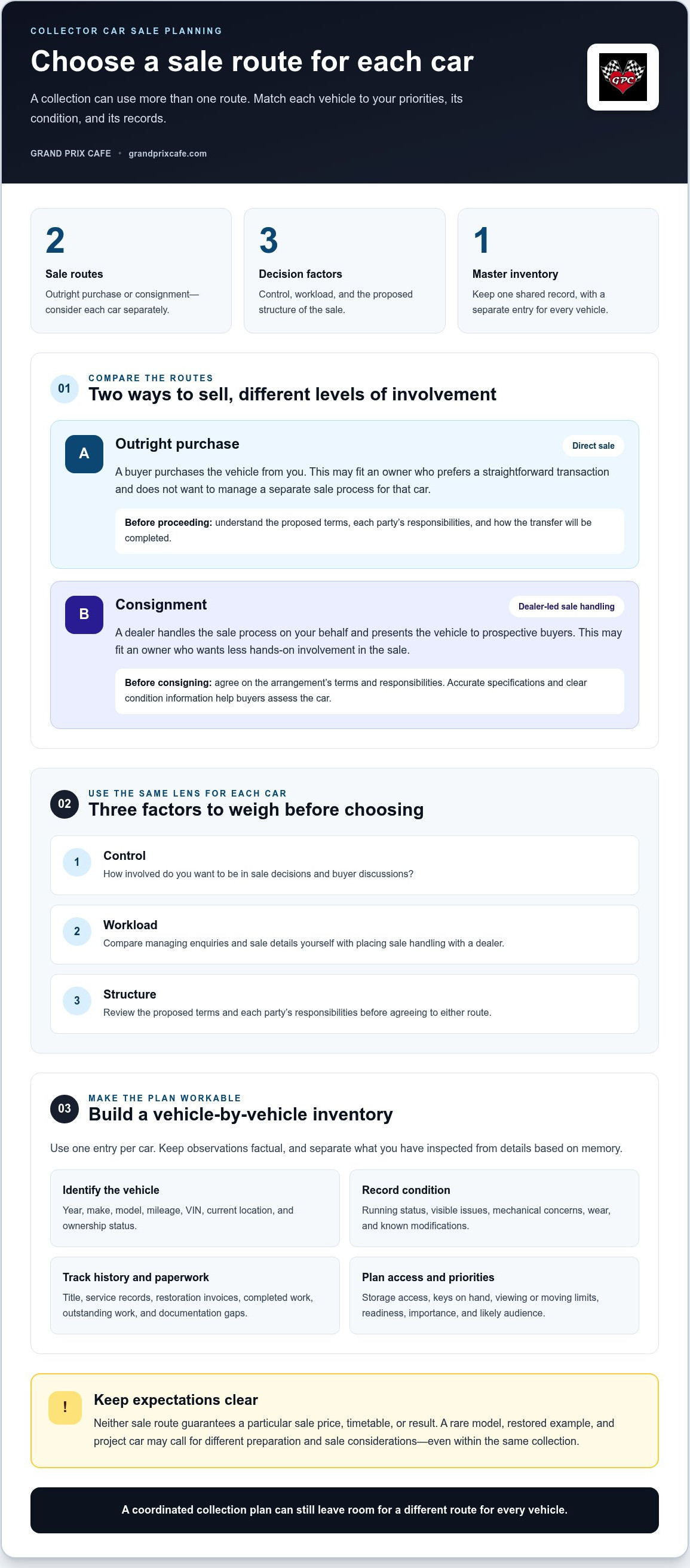
Start with one master inventory and create a separate entry for each vehicle. Include the year, make, model, mileage, current location, and ownership status. Add the vehicle identification number (VIN) to distinguish similar cars, then note whether the vehicle runs, visible issues, known modifications, and completed or outstanding restoration work. Keep observations factual and separate what you have inspected from details based on memory.
Condition: Record mechanical concerns, exterior and interior wear, and work completed or still outstanding.
Documentation: Note whether the title, service records, and restoration invoices are available, and flag gaps for follow-up.
Access: List the storage location, keys on hand, and any practical limits on viewing or moving the vehicle.
This shared record makes comparisons easier and keeps details from being scattered across emails, folders, and notes. It also gives you a reliable starting point for preparing each car’s sale information.
Set priorities for the New York collection sale
Before choosing a sale route, decide what matters most across the collection. You may prioritize a defined handover, more involvement in individual sales, less work handling enquiries, or time to reach buyers interested in a particular vehicle. These priorities can differ from car to car, so record them alongside the inventory instead of relying on one general plan.
Readiness: Separate cars with organized records and clear condition details from those needing more documentation or inspection.
Importance: Identify vehicles with sentimental value or provenance that call for more of your involvement.
Audience: Group cars by marque, era, or condition when those distinctions may shape who is likely to be interested.
A rare model, a restored example, and a project car may need different preparation and sale considerations. Don’t assume they should share one route or timetable simply because they belong to the same collection. A car-by-car plan can still support a coordinated handover while giving you flexibility where vehicles differ.
With the inventory and priorities in place, you can compare sale options against each vehicle’s actual circumstances. That turns selling a car collection in New York from a series of disconnected tasks into a structured process, with clear next steps for every car.
Outright Purchase or Consignment: Choose the Right Route for Each Car
Once you’ve set priorities for each vehicle, compare the main sale routes. An outright purchase is a direct sale, where the buyer purchases the vehicle from you. With consignment, a dealer handles the sale process on your behalf. The distinction affects your level of involvement and how the transaction is structured. Neither route guarantees a particular sale price, timetable, or result.
Assess each option against the practical demands of the individual car:
Control: Consider how involved you want to be in sale decisions and buyer discussions.
Workload: Compare handling enquiries and sale details yourself with placing sale handling with a dealer.
Structure: Review the proposed terms and each party’s responsibilities before agreeing to either route.
When an outright vehicle purchase may fit
A direct purchase may suit an owner who values a straightforward transaction and prefers not to manage a separate sale process for that vehicle. The car’s identity, condition, history, and supporting records inform the purchase discussion. Before proceeding, make sure you understand the proposed terms, each party’s responsibilities, and how the transfer will be completed. The appeal of a simpler process should not be confused with a promise of a particular outcome.
When consignment may fit a collector's priorities
Consignment may suit an owner who wants a dealer to handle the sale process while the vehicle is presented to prospective buyers. Accurate specifications, clear condition information, and thoughtful presentation help buyers assess the car. Agree on the arrangement’s terms and responsibilities before consigning a vehicle. For a closer look at the process, explore professional classic-car consignment in New York.
A mixed collection doesn’t require one route for every car. You might choose a direct purchase for a vehicle where limiting your involvement is the priority, while consigning a distinct or particularly well-documented example for dealer-led sale handling. Compare the options vehicle by vehicle, and record your reasons to keep the overall plan clear.
Keep ownership transfer in view as you decide. The New York DMV Vehicle Ownership Transfer guidance outlines the state’s transfer process. Review it alongside the proposed terms so you account for paperwork as well as the commercial arrangement. These details matter whether one car or several are changing hands.
For owners selling a car collection in New York, Grand Prix Cafe offers outright vehicle purchases and consignment for classic and modern collector cars. If dealer-led handling suits a vehicle’s priorities, Grand Prix Cafe’s collector-car sales and consignment offer a route to consider.
Prepare Vehicle Records, Condition Details, and New York Transfer Documents
Reliable sale materials begin with a clear record for each car. Work through the collection in the same sequence: establish ownership, assemble service and restoration history, document present condition, then prepare sale information and transfer paperwork. Keep confirmed documents separate from personal recollections. If a date, repair, or ownership detail is uncertain, label it as unknown rather than presenting an assumption as fact.
Consistent records help buyers assess each vehicle’s history and condition without confusing one car’s details with another’s.
Gather ownership records. Locate the title and related ownership documents for each vehicle.
Compile history. Group service records, restoration invoices, and available provenance by car.
Document current condition. Record observations and photograph the vehicle from consistent angles.
Prepare sale materials. Assemble the relevant records and transfer paperwork for that vehicle.
Create a clear record file for every vehicle
Use a separate digital or physical file for each car, labeled with its year, make, model, and VIN. Keep ownership documents, maintenance records, restoration invoices, and provenance together. Photograph the exterior, interior, and engine area, then include close-ups of notable defects or modifications. Consistent images make it easier to compare vehicles and answer questions accurately.
Keep records vehicle-specific throughout enquiries and handover. A shared folder can hold the collection index, but each car should have its own clearly named subfolder. This reduces the risk of assigning one vehicle’s service invoice or photograph to another.
Present condition and inspection information accurately
Describe what you know, not what you hope a buyer will infer. Note mechanical concerns, exterior and interior observations, and relevant safety or security details. Date your observations and distinguish your own inspection from information supplied by a previous owner. If records don’t resolve a gap, state that plainly.
Grand Prix Cafe’s in-house 100-point Inspection Service covers mechanical, exterior, interior, safety, and security checks. Its defined scope can help organize a thorough condition review. Describe inspection findings accurately, without implying that an inspection guarantees a particular sale result. For related sale-preparation context, see this collector’s guide to classic-car sales in Southampton.
Give transfer paperwork its own check for every vehicle. Requirements can depend on the transaction and vehicle details, so consult the current New York State DMV ownership-transfer guidance rather than relying on a copied checklist. Keep sale documents with the corresponding vehicle file, and confirm that the records you provide match that car. This creates a dependable administrative foundation for selling a car collection in New York, even when the vehicles have different histories and levels of documentation.
Coordinate Collection, Buyer Enquiries, and Vehicle Handover
A collection may be spread across garages, storage facilities, or private properties. Treat movement and handover as a separate workstream for each vehicle, even when you plan to sell the cars as part of one broader collection. A location map, access notes, and transaction progress record help prevent one car’s arrangements from being confused with another’s.
Plan movement and access for vehicles across New York
For every car, record its current address or storage site, the person responsible for access, and any restrictions that may affect collection. Note whether the vehicle can be driven, where the keys are kept, and whether the site has loading or scheduling requirements. If cars are in different locations, this information helps you plan a practical sequence instead of arranging each movement in isolation. It can be especially useful when coordinating vehicles around Southampton, Westhampton, East Hampton, Sag Harbor, Long Island, and Manhattan.
Location and access: Record site details, access instructions, and relevant contact arrangements.
Vehicle readiness: Note whether the car runs, which keys are available, and any factors that may affect loading or movement.
Handover order: Set a preferred sequence while allowing for each vehicle’s individual sale and collection arrangements.
Grand Prix Cafe provides worldwide vehicle collection and delivery, supporting logistics when a collection is spread across multiple locations. If a car will remain in storage during the transition, this professional indoor car storage guide for Southampton offers relevant context.
Keep each transaction's handover organized
Maintain a separate transaction log for each vehicle. Record buyer enquiries, key communications, agreed next steps, and completed milestones with dates. Keep the log with that car’s sale and ownership records, not in a general thread covering the whole collection. This makes it easier to see which vehicle still needs a response, document, or handover arrangement.
Before transfer, gather the keys and available records for the specific car. Use a handover checklist to note what is being passed on and what remains outstanding. Keep a copy of the final sale and transfer documents with the vehicle’s file so the transaction record is complete.
New York transfer steps can vary with the transaction and vehicle. Consult the current New York DMV ownership-transfer guidance for the applicable requirements rather than relying on one checklist for every car. Planning these details alongside buyer communication makes selling a car collection in New York more manageable, particularly when vehicles are stored at different sites.
For coordinated vehicle collection and delivery as part of a collector-car sale, explore Grand Prix Cafe’s vehicle sale services.
Sell Your Collection with Grand Prix Cafe's Collector-Car Services
A collection sale can involve different needs from one vehicle to the next. Grand Prix Cafe handles classic and modern collector cars through consignment and outright purchase, giving owners distinct routes to consider for individual vehicles. The choice can reflect your preferred level of involvement, the car’s condition and records, and how you want to coordinate the sale.
For a useful first discussion, bring together each vehicle’s identifying details, current location, known condition, and available ownership and service records. A concise, accurate overview keeps the conversation specific and helps identify where cars share requirements and where each needs an individual plan.
A sale process grounded in vehicle-specific information
Vehicle details and supporting records help establish what is known about each car before discussing a sale route. Grand Prix Cafe’s in-house 100-point Inspection Service covers mechanical, exterior, interior, safety, and security checks. Inspection information can contribute to a clearer account of condition. Keep documented observations distinct from owner recollections or assumptions.
For vehicles requiring restoration, original parts are specially sourced wherever possible, and engineers fabricate replacements to original specifications. The Full Diagnostic Service Center specializes in Ferrari, Lamborghini, and Maserati, making that expertise relevant to vehicles from those marques. These services add vehicle-specific information, but do not establish a guaranteed sale value or outcome.
Matching vehicle information to its intended sale route keeps the process grounded. For one car, available service history may be central to the discussion; for another, present condition or restoration work may need closer attention. Keep gaps visible and let the records support a measured conversation rather than overstating provenance or mechanical condition.
Discuss a collection sale with Grand Prix Cafe
Before beginning a sale conversation, organize a collection inventory with one entry per vehicle. Include the details that distinguish each car, the records available, its current location, and your preferred sale route if you have one. You don’t need to resolve every open question first. Clearly label missing documents or uncertain details to keep the initial discussion accurate and focused.
Grand Prix Cafe handles consignment and outright purchase for collector vehicles. These routes serve different priorities, and the right fit may vary across the collection. If your cars are in multiple locations, worldwide vehicle collection and delivery can be part of your coordination plan.
For owners selling a car collection in New York, a prepared inventory is a practical starting point for a considered conversation about each vehicle. Share the cars’ details and records, then discuss which sale route fits your priorities. Discuss selling your car collection with Grand Prix Cafe.
Set the Next Step for Your Collection
Turn your inventory into a working decision document. Mark which vehicles are ready for discussion, where details remain uncertain, and what matters most to you for each car. This gives you a practical basis for deciding what to address first, without forcing the entire collection into one timetable or set of priorities.
Selling a car collection in New York doesn’t require every decision to be made at once. Begin with the vehicles whose records and plans are clearest, then use what you learn to shape the next steps for the rest. A measured process keeps you informed and involved as the collection moves toward its next chapter.
When you’re ready, share your inventory and discuss the sale route that fits each vehicle with Grand Prix Cafe. Discuss selling your car collection with Grand Prix Cafe, and take the next step with a clear plan.
Frequently Asked Questions
How do I sell a car collection in New York?
Start with a separate inventory entry for every car, then assemble ownership papers, service history, condition notes, and location details. Match each vehicle to a possible route, such as consignment or outright purchase, based on your priorities and its records. Keep each transaction’s correspondence with that car’s file. For vehicles around Southampton, Manhattan, or elsewhere, include access and movement arrangements, and consult current New York State DMV transfer guidance.
Is consignment or an outright sale better for a classic car collection?
Neither option is universally better; the right choice depends on how you want to manage each sale. An outright purchase is a direct transaction, while consignment places sale handling with a dealer. Compare your preferred level of involvement, control, and the proposed transaction terms. You might assess a well-documented driver differently from a car with incomplete history, but neither route guarantees a particular price or result.
What documents do I need to sell a car in New York?
New York transfers generally involve proof of ownership and proof of sale, though the applicable documents depend on the vehicle and transaction. Locate the title and compare its identifying details with the car before preparing sale paperwork. Service records, restoration invoices, and provenance can help explain the vehicle’s history, but they are distinct from transfer documents. Check the current New York State DMV instructions for the specific transfer and keep documents grouped by vehicle.
Can I sell several cars to one buyer in New York?
Yes, a buyer may consider multiple vehicles, but the proposed transaction should specify which cars are included. Create a separate record for each, including its condition, ownership information, and any open questions. For example, a collection spanning Southampton and Manhattan may have distinct access and handover arrangements even if one buyer is interested in several cars. Grand Prix Cafe handles collector-car sales through outright purchase and consignment; the suitable structure depends on the vehicles and your priorities.
How should I prepare a classic car before selling it?
Gather the title, available service records, restoration invoices, keys, and provenance before presenting the car. Use clear photographs and describe known defects or unfinished work precisely. Don’t claim originality unless records support it. A professional inspection can add structured condition information. Grand Prix Cafe’s in-house 100-point Inspection Service covers mechanical, exterior, interior, safety, and security checks, giving owners a defined set of areas to document.
Can a collector car be collected from outside New York?
Collection arrangements depend on the car’s location, access, and agreed transaction details. Grand Prix Cafe provides vehicle collection and delivery from anywhere in the world, which can help when a collection spans Long Island, Manhattan, or locations farther away. Prepare the vehicle’s address, access instructions, keys, and records in advance. Keep transport planning separate from ownership-transfer paperwork, and consult current DMV guidance for applicable transfer steps.
Comments